
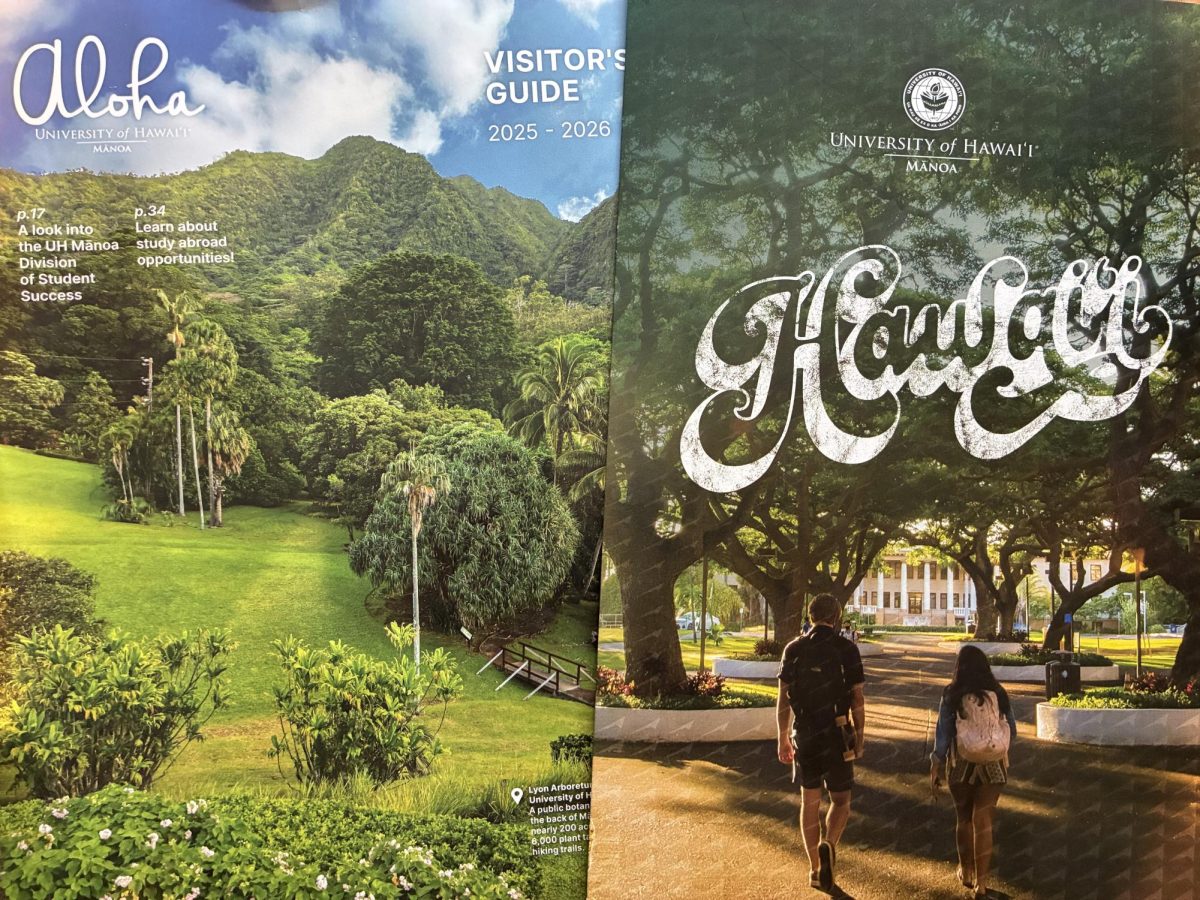
When Brett Oppegaard arrived at the University of Hawaiʻi at Mānoa in 2014, the journalism program was struggling. It had roughly 30 majors and a fractured community.
He reached out to the students in the program and made clear that the program they had enrolled in was worth their time and ambition. It was something simple that, he said, might sound like common sense but was much needed at the time.
That deliberate act of community-building turned out to be the foundation of everything that followed.
Over the next 12 years, he restructured the curriculum, rebuilt the camaraderie, launched a student publication that now produces about 30 original stories a month, partnered with Hawaiʻi’s most respected newsrooms to bring students into those workplaces, increased the award-winning work of students five-fold, and became the only person in the six-year history of UH’s Innovation and Impact Showcase to earn the College of Social Sciences’ top honor three consecutive times. When he left UH this spring, the Journalism program had nearly 100 majors and was positioning itself to take another run at national accreditation.
Yet Oppegaard never seemed particularly interested in fanfare about such accomplishments. What interested him was the work — and more specifically, the students doing it. His one driving question as a teacher, he said, was simple: “Can I say something that gives somebody the spark to give it a try?”
The Accidental Journalist
Oppegaard never planned to become a journalist. He took a required writing class as a sophomore at Washington State University — the kind students sign up for because they have to — and spent the first weeks doing what many students do: complaining. His target was the campus newspaper, The Daily Evergreen, and his complaints were relentless.
His professor, Roberta Kelly, remembers it vividly. “He would come to class early, and he’d always have the Daily Evergreen in his hand, and he would be grumping about something,” she said. “He didn’t like the story. He didn’t know why they did the story the way they did the story, why did they talk to this person, why didn’t they talk to that person. It just was this litany of complaints, twice a week.”
After weeks of this, Kelly had heard enough. “After a while, it just drove me bonkers,” she said, “and I just said something like — well, if you don’t like it, go downstairs and do something about it. Go down and volunteer, write for the paper.”
It was a spontaneous remark, but he took it as a directive. He walked to the basement where the newspaper was printed, introduced himself, wrote some stories he later described as “really stupid,” and never left. By his senior year, he had won a national college writing award. Within a few years, he was in a newsroom with fifty professional journalists, writing stories all day, thinking: They can do it, so I can do it.
“That one line by that one professor was such an impactful line,” he said. “I was trying to think — if only I could do that for one student.”
What Kelly saw in him, she said, was something rare for a student his age, “He clearly had talent, and he had an opinion. Most kids at that age don’t have an opinion — they’re just skating to get through. But he cared enough to be angry about the quality of a product. That’s unique.”
She did not know, at that moment, how far that eagerness to invoke change would travel. What neither of them had known then was that the student complaining about a college paper in a classroom in Washington State would one day restructure an entire journalism program on a small island in the middle of the Pacific, and that the students he taught would go on to publish in Civil Beat, the Honolulu Star-Advertiser, and newsrooms across the country.
“You don’t know who you touch and how you touch them,” she said quietly. “It’s good to be mindful of those things.”
Building the Program
When Oppegaard became program director at UH Mānoa, the senior year curriculum locked students into a year-long, six-credit hybrid print-broadcast sequence. Many had no interest in television journalism but were forced to take it anyway, causing consistent complaints. He broke that structure apart and turned a faculty-prescribed program into a student-choice program, which gave students the flexibility to build the journalism career they wanted.
He also intentionally built other aspects of the curriculum and community to encourage students to interact with each other. For example, he sent welcoming emails to every incoming major, encouraged students to attend advising hours that he kept open every semester, and made sure to let students know that they were not isolated individuals pursuing a degree — they were part of something larger, with power and a platform.
That shift in identity — from student to journalist — was intentional. Oppegaard believed that the biggest obstacle standing between a student and a good story was not skill but the confidence to get started. So he pushed students into the field early, gave them real assignments with real deadlines and real audiences, and refused to let them wait until they felt ready. In his view, readiness was not a prerequisite for the work.
On the practical side, he also built a pipeline to the pros, with internships established at nearly every media organization in the state, readily available scholarships, and grant-funded special projects that supported students reporting all over the state, the country, and even throughout the world, including in the Philippines and in India. Students who earned internships very frequently were hired, even before graduation.
“Over half of the class of 2026 journalism majors graduated with a job or internship offer,” said Angie Hamilton-Lowe, the program’s educational specialist. “An outstanding outcome, which is directly related to Dr. Oppegaard’s contributions to building the program.”
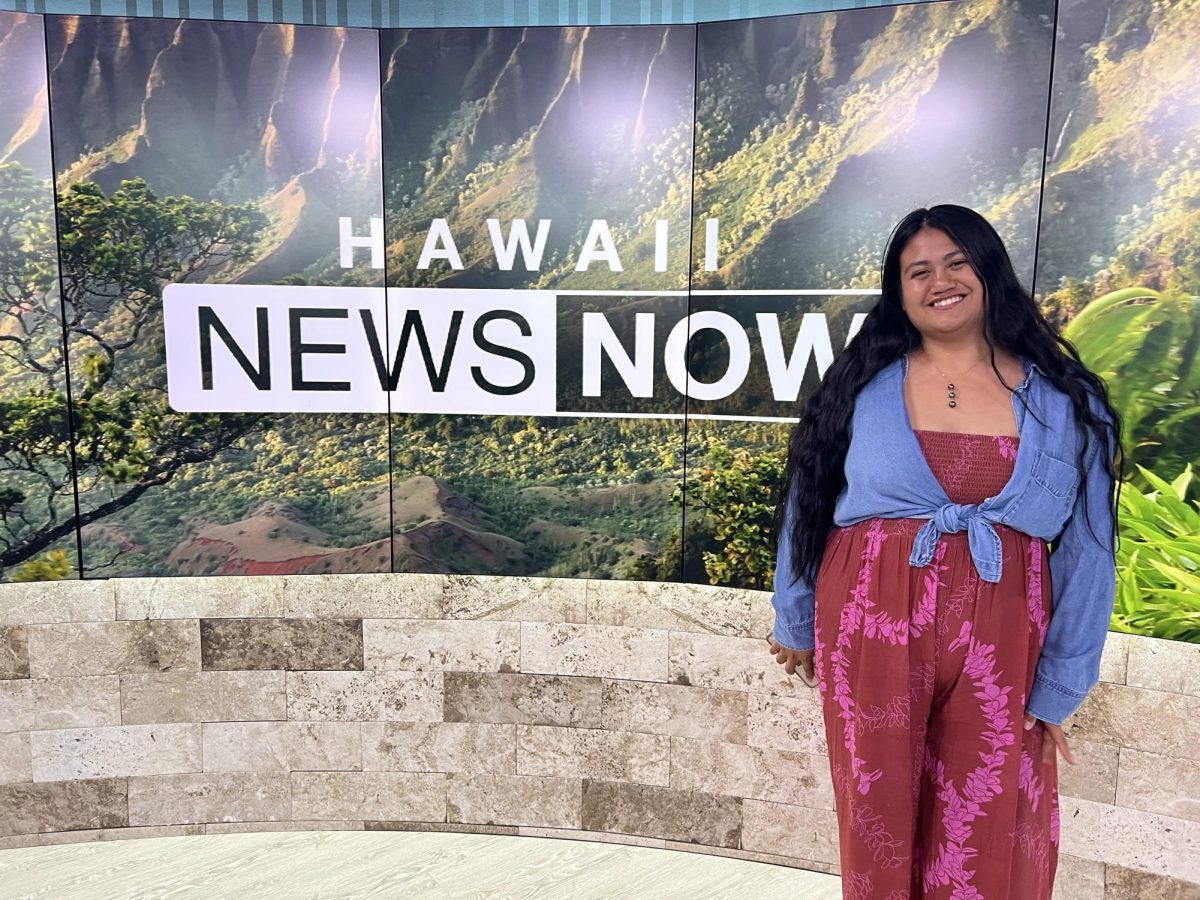
The impact was felt immediately in the classroom. Gabriella Galan, a journalism student at UH Mānoa who took one of his classes, recalls being caught off guard by his energy from the very first day. “I didn’t expect to feel connected to him,” she said. “You can feel his passion for journalism and how much he advocates for it — the way he stresses freedom of speech. I just wasn’t expecting him to be so enthusiastic about it, and that really helped the class process.”
The Mānoa Mirror
The publication you are reading right now exists because of Brett Oppegaard. He built it in a semester when he was the only full-time faculty member in the program, working alongside roughly a hundred majors and a vision for something that didn’t yet exist.
He saw a gap where students were producing Civil Beat-quality stories with nowhere to publish them. He wanted a place where anyone, at any level, could get their first byline and grow from there.
“We don’t have to wait for some billionaire to make a new media source for us,” he said. “We can make it ourselves. And that’s a really powerful idea.”
In its first year alone, The Mānoa Mirror produced dozens of stories, including ones that won statewide Society of Professional Journalists awards. He won grants to fund the online publication, hired staff, and built the infrastructure to keep it going. By the time of his retirement, it was publishing around 30 UH-connected stories a month — 30 stories, he said, that likely “wouldn’t have existed if The Mānoa Mirror didn’t exist.”
A Standard of Excellence
Beyond the classroom and the Mirror, Oppegaard’s teaching was recognized at the highest institutional level as well. Yao Zhang Hill, who initiated and runs UH’s Innovation and Impact Showcase at the Assessment and Curriculum Support Center, describes the award as one of the most rigorous teaching distinctions on campus. Faculty must submit detailed descriptions of their innovative teaching practices along with concrete evidence of student impact — data, published work, career outcomes — all reviewed by peers using an established rubric.
Oppegaard won it three times. He is the only person ever to do so.
“Every time, Brett’s application received one of the highest scores,” Hill said. “His narrative is clear. His impact is clear. His innovation is clear. There’s never any debate.”
What set him apart, she explained, was not simply that he placed students in demanding, real-world situations — it was the systematic way he supported them through those situations. “It’s not like he’s just throwing students into ‘go interview the legislators.’ No. He is taking it step-by-step, scaffolding the learning — having students idealize their storyboard, identify the gaps in the news, come up with a story, get peer and instructor feedback, iterate and refine — until the story is at publication level.”
The results were measurable. Besides in the Mirror, students published stories from classes in The Honolulu Star-Advertiser, Civil Beat, Hawaii Business Magazine, and many other professional journalism venues across the state. For many of those students,seeing their byline in a professional publication for the first time was not a milestone they expected to reach before graduation. It was, by Oppegaard’s design, a requirement. He did not believe in saving the real work for after graduation. He believed the degree was the real work and that every story a student produced in his classroom should be good enough to stand next to the work of professionals.
In most cases, it was. “Every single story students wrote was published,” Hill said. “That is extraordinary.”
She was emphatic about what Oppegaard’s three consecutive wins mean in the context of the College of Social Sciences — the largest college on campus, with the most faculty, “High standards, rigorous requirements, but strong support. Authentic tasks, locally relevant, personally meaningful. Those are the secrets to his success. There is no surprise he won three times. It is very systematic. It is very rigorous. And he put students in professional tasks while seriously, carefully, thoughtfully supporting them to succeed.”
On Ancestry and the Stories We Carry
Beyond the classroom and the newsroom, Oppegaard has devoted significant volunteer hours with genealogical organizations, such as FamilySearch, to help people trace their family histories and better understand where they come from. He has traced his own family back hundreds of years — to soldiers in the American Revolution and in the War of 1812, to immigrants who crossed oceans and left everything behind for a chance at something new.
“I think there are about 10,000 couplings that have to happen to get us to where we are today,” he said. “At any point, any one of those could have not worked out, and we wouldn’t be here.”
It is hard not to see a parallel between that work and the journalism he spent his career teaching. Both, at their core, are about making a life visible and giving it context. For Oppegaard, the two were never really separate. Whether he was helping a student find the right angle on a story about the state legislature or helping a stranger trace a great-grandparent’s name in a military record, the impulse was the same — to look closely, to ask who, why, what, where, when, and to make sure the person in front of you was seen and understood.
“The more you understand about yourself and how you got to this place in the world,” he said, “the more you can appreciate and understand your context.”
What He Leaves Behind
For Oppegaard, journalism in Hawaiʻi is irreplaceable. Hawaiʻi is unlike any other place in the United States. It is the only state in the nation where Native Hawaiian culture, Asian immigrant history, military presence, environmental fragility, and tourism economy all collide in the same place, at the same time, shaping the lives of everyone who lives here. The stories that come out of these islands cannot be told from a newsroom in New York or Washington. They require someone who is here, who knows this place, and who understands what is at stake.
“We have a cultural, social, historical perspective that almost no one else has in the world — just by being in this environment and being part of this community,” he said. “That makes our stories uniquely us. You combine that with your own background — how did you get to Hawaiʻi? Why are you here? What’s important to you? — and you end up with stories that nobody else can tell.”
Galan says that since taking his class, her journalistic instincts have sharpened in ways she did not anticipate, “I definitely see journalism differently now. I didn’t quite understand the inverted pyramid or the importance of a nutgraph before. Now I can write an article without needing as much guidance — I’ve gotten really good at recognizing that in other articles, like on NPR or The New York Times. I just have a better eye for it now.”
The news of his retirement came as a genuine shock to her, “I was really surprised. I thought I was going to be seeing him for the rest of my time at UH. I wanted him to see how much I would grow as a writer.”
For Hamilton-Lowe, that kind of student investment in the program is exactly what Oppegaard built it to produce. “Fulfilling that duty goes beyond awarding an academic degree,” she said. “It requires that students graduate with a portfolio of work that demonstrates they are ready to report stories of consequence and with journalistic integrity.”
What Galan carries with her most is something Oppegaard repeated often, that journalism is not just a skill, but a right worth defending. In 2026, that message carries particular weight. Local newsrooms across the country are closing. Trust in the media is eroding. The pressure on journalists to look away from difficult stories has never been greater.
“He really emphasized the power of journalism — that no one can take away our right to say what we say, how we say it,” she said. “To really focus on our stories, fight for our stories, and utilize freedom of speech, especially in times like these.”
And Roberta Kelly, the teacher whose offhand remark set all of this in motion more than 30 years ago, had a simple and quiet way of summing it all up. She had no idea, back in that classroom in Pullman, Washington, that one of her students would one day build a career like this. Three decades later, sitting on the other side of a phone call from Honolulu, she sounded genuinely pleased, not surprised, but satisfied.
“I’m glad,” she said, “that things have worked out so well for him.”
Some people like to leave a place better than they find it. Brett Oppegaard spent 12 years making sure he was one of them.





Nancie • Jun 5, 2026 at 12:21 am
Sofia has written & reported a story that exemplifies the best qualities Professor taught. He’s passed the truth-telling torch to a worthy journalist.