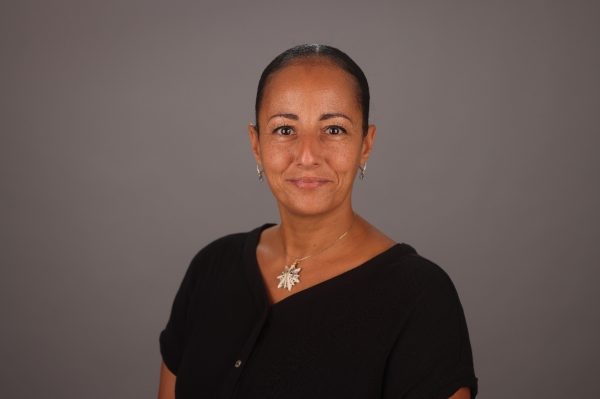
A physician who returned to her first passion. A young woman who spent months in archives searching the faces of strangers. Both are BFA candidates at UH Mānoa, and their work filled the gallery walls with art that says more than it shows.
The UH Mānoa Department of Art and Art History opened its annual Bachelor of Fine Arts program senior exhibition on April 28, presenting capstone work from students whose portfolios passed a rigorous faculty review.
The exhibition featured students who submitted portfolio work for faculty review the previous year. Wendy Kawabata, associate professor of art and chair of the drawing and painting area, said the entire department evaluates each submission before extending an invitation to the BFA program’s final capstone semester. The exhibition draws students, faculty, and community members each year for a glimpse at the work that emerges from years of dedicated study. For many of the artists on display, it marks their first opportunity to present a cohesive, large-scale body of work to the public — a milestone that carries the weight of both personal achievement and professional debut.
The BFA is the more specialized of the department’s two undergraduate studio degrees, requiring deeper focus within a single discipline — drawing and painting, ceramics, glass and metals, or photography. Kainoa Gruspe, a former BFA student, went on to complete his MFA at the Slade School of Fine Art in London and is currently showing at the Whitney Biennial in New York City, two of the most prestigious venues for art in the world.
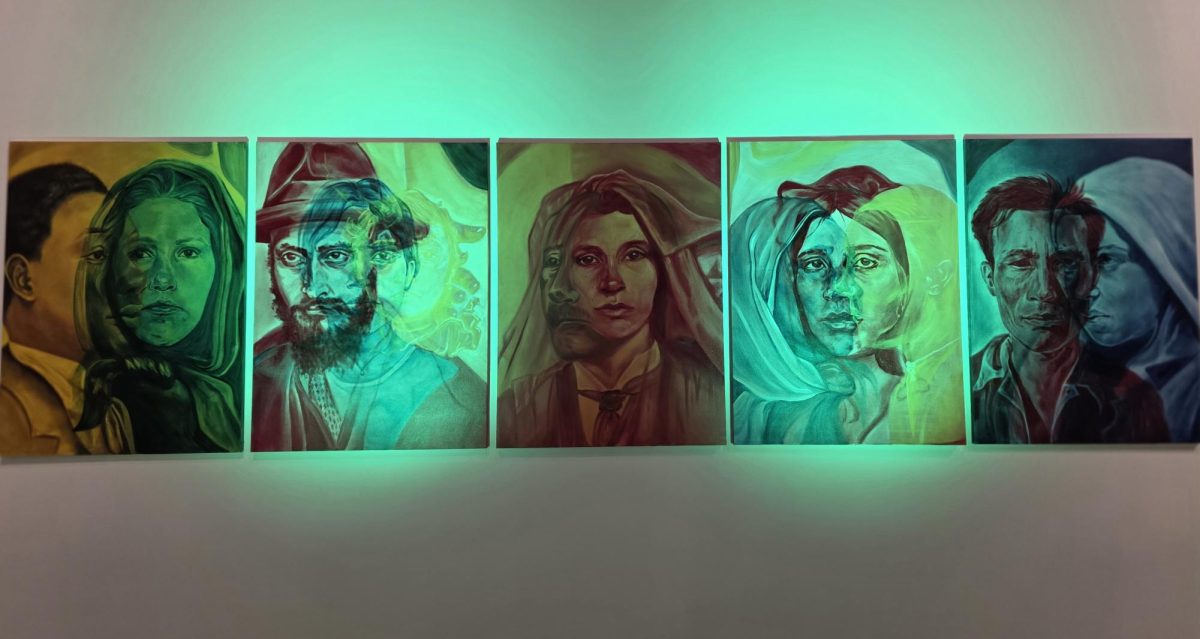
Among the many works presented in the gallery, two artists’ work commanded a second look. Malia Ohira’s series, “Single Pulse,” began with a question she could not come to peace with for months: who has the right to decide who deserves to be painted?
“I was faced with the struggle of choosing who to paint, and what it means to select someone, especially someone you don’t necessarily know,” Ohira said. “I feel like everybody deserves attention. Who am I to say who should be painted, when I feel like everyone deserves to be represented?”
Ohira resolved the question by going as far back as the photographic record would allow — to Ellis Island in 1905. Working from archives photographed by Lewis Hine and Augustus Sherman, she dedicated her capstone to a piece inspired by more than a century of American immigration history.
Each painting layers multiple portraits on a single panel in primary colors — red, yellow and blue — treated to respond to ultraviolet light. Under the light, some faces shift and transform. Others fade until they are almost gone.
“The shifting colors and disappearing and reappearing faces draw attention to the fact that people are disappearing from their homes every day,” Ohira said, “they are living in fear of being deported.”
She explained that the color choices were intended to highlight individual facial features rather than emphasize skin tones, allowing viewers to focus on shared human characteristics. Her goal was to underscore the universal desires and needs that connect people regardless of their background or appearance.
“I want to show how this isn’t a new issue,” Ohira said. “I’m just trying to connect the past to now.”
Each painting took approximately 18 hours to complete. The ultraviolet fixtures arrived two weeks before the show, delayed in shipping, so two panels were completed without the technology central to their effect. In each painting, the subjects’ eyes align along a shared horizontal line — at least one figure meets the viewer’s gaze directly while another looks away.
“I’m not a specialist,” Ohira said. “I’m just someone who cares. I want to open a door for people to talk about it more.”
Right next to Ohira’s piece, the paintings of Sophia Tran stopped visitors for different reasons. They are formally beautiful — Islamic geometric patterns layered beneath a crashing Pacific wave, a desert landscape with a bare fractured tree, a swirling vortex of purple and green. But the story behind them is what made visitors stop completely.
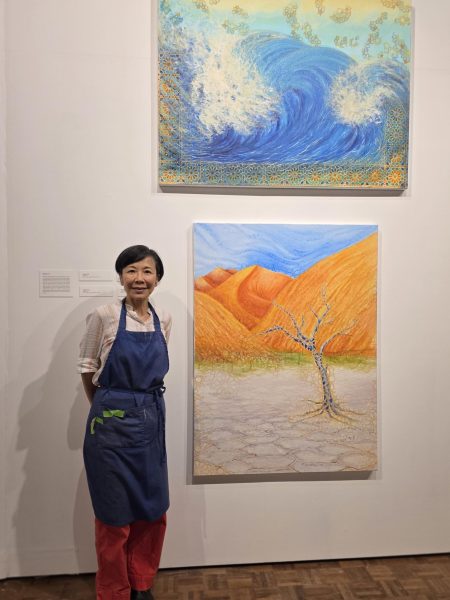
Tran is an infectious disease physician and a non-traditional student — one who returned to school after an established career in medicine.
“For as long as I can remember, as soon as I could hold a pencil, I was drawing,” Tran said. “And then my father was not keen on the idea. So, I became a doctor.”
She pursued medicine for decades. But the call toward art never left. And then COVID arrived.
“I told myself: if I make it out of COVID alive, I’m going to art school.”
She kept that promise. She took a break from practicing medicine to attend UH Mānoa’s art program full time. The work she produced is the result of a lifelong alchemy — two passions carried separately for decades, finally brought together. Her love of Islamic art began at the Alhambra in Granada, Spain, deepened in Morocco, and crystallized at the Metropolitan Museum of Art in New York, where she stood beneath a vaulted geometric ceiling and told a friend, ”It is like looking at infinity.”
The second passion is organic chemistry.
“When I was learning about organic chemistry, I saw a symmetry in the organic molecules and the designs of Islamic art,” Tran said. “And I think that it’s just so profound.”
The connection came first in a dream the night before her organic chemistry exam as a pre-medical student. Molecules lifted off the page and spun around her in the dark — some clockwise, some counterclockwise, shimmering.
“It was beautiful,” she said. “I woke up scared. But I just thought it was such a beautiful dream that I didn’t want to wake up from.”
She received an A-plus on her test and that dream is now on the wall.
Tran’s artist statement described the series as dissolving “the artificial boundaries between the sacred spirit and the physical molecule,” weaving Islamic geometric tradition into the structures of chemistry to invite a dialogue between two ways of contemplating the divine. Each canvas, she wrote, is “a map of the human heart’s enduring search for meaning.”
“This is the first time I’m able to bring the two together in a way that’s very meaningful to me,” Tran said. “Had I pursued art as a young person in my 20s, I wouldn’t have had this understanding, this appreciation for the wonder of the universe.”
Two artists, two journeys. One excavated more than a century of history to say something urgent about today. The other spent a lifetime moving between science and beauty before finding they were the same thing.