

By the middle to the end of the semester, the signs of stress are everywhere at University of Hawaiʻi at Mānoa.
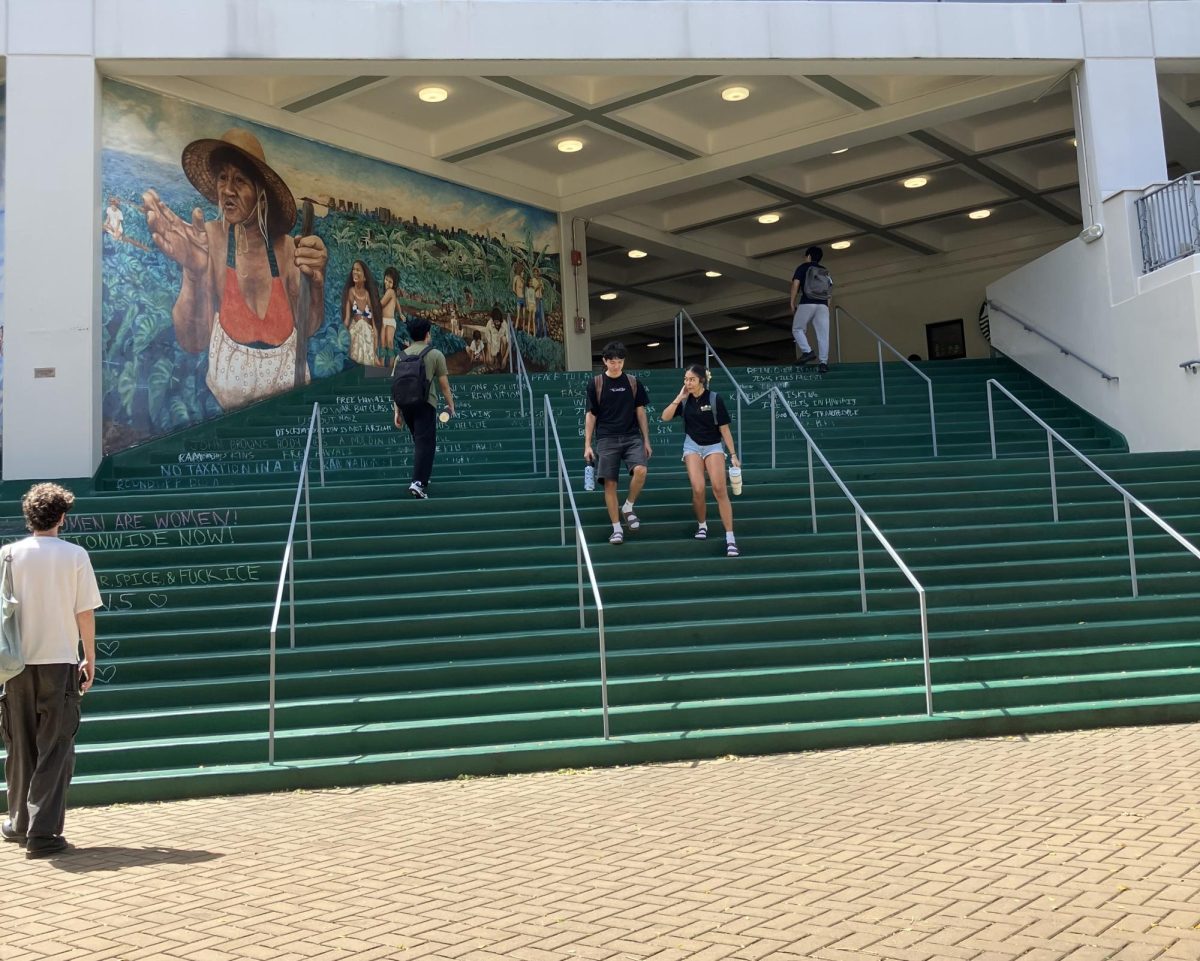
With piled up requirements and exams, students rush across the campus holding coffee cups. Tables at the Hamilton Library are filled with laptops, chargers and energy drinks. Phones buzz with deadline notifications as many students remain glued to their screens. For some, it becomes a routine to wake up tired and still push through classes. Stress has become such a normal part of college life that students barely notice how overwhelmed they are unless it reaches a breaking point.
But the sensory room at Kuykendall Hall 106 offers something unfamiliar on a bustling college campus: silence and stillness.
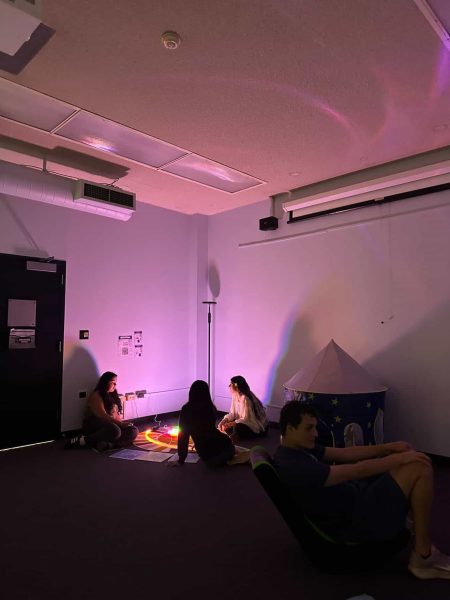
Soft rays of light glow against the walls like waves, tactile objects spread across the tables, and comfortable chairs are placed around the room along with stress-management items designed to help people regulate their emotions and decompress. But beyond these, the room represents the recognition that students are overwhelmed and overstimulated.
Through a partnership between the Center on Disability Studies (CDS) and the Office of Faculty Development and Academic Support (OFDAS), the sensory room is a part of CAMP+U, a project focused on helping students succeed during their college experience, particularly students with learning differences and disabilities.
“Our commitment here is around ensuring student success and well-being and with a particular focus in supporting students with learning differences to be successful through the post-secondary experience,” said Holly Manaseri, the principal investigator of the project.
The main purpose of the sensory room is to give people a quiet and calming space where they can manage stress, regulate emotions, and take a break from overstimulation.
But according to the organizers, the space is not only for one specific group of people.
“We know that a well-designed sensory space can benefit everyone. So whether someone is managing stress, anxiety, sensory or emotional overload, or just needs a quiet space to reset and pause, everyone can benefit from having access to the sensory space,” said Manca Sustarsic, an evaluator for the project.
The idea became important as mental health concerns continue to rise.
According to the National Alliance on Mental Illness, around 14,000 adolescents in Hawaiʻi experience serious thoughts of suicide every year, and 17,000 experience major depressive episodes annually. On adults, approximately 50,000 report serious suicide thoughts each year.
In 2023, the Centers for Disease Control and Prevention reported that 40% of U.S. high school students felt persistently sad or hopeless, 20% seriously considered suicide, and 9% attempted suicide. In 2024, Mental Health America reported that over 60 million adults in the U.S. experienced some form of mental illness, and more than 14 million adults reported serious thoughts of suicide. These numbers show that the mental health crisis is growing in the state and across the country.
For many, stress no longer appears only during finals week. It exists constantly because of academic pressure, financial worries, and social expectations. Hence, students sometimes cope with it in an unhealthy way for temporary escape.
Sustarsic believes that life itself has become overstimulating. “I think it’s just the overstimulation from the rather fast paced life that most people lead and the high expectations that students may have,” she explained. “So perhaps that external pressure combined with some internal struggles, depending on individuals and their needs, of course, but that could create a sense of just overwhelming anxiety and stress.”
Today, people are surrounded by constant stimulation. Students often respond to stress by scrolling through social media for hours, drinking excessive caffeine, or distracting themselves online instead of actually taking time to slow down.
Manaseri believes that many of these habits happen automatically because students aren’t giving themselves enough time to process how they feel. Manaseri also explained that the room also helps students become more aware of their stress.
“This is like an opportunity for folks to actually become also very aware of your own body and your own response to stress,” she said. “We can re-regulate. You know, we don’t have to always just kind of go through a state of dysregulation. We can learn about it. We can process it.”
What makes the sensory room different from those habits is the kind of experience it creates. The sensory experience encourages people to slow down and actually process what they are feeling.
“A sensory room allows you to really just be yourself, be present, not have anywhere to rush, not have any pressure around you,” Sustarsic said.
The room is intentionally uncluttered and quiet. The calming atmosphere and gentle sensory elements create an environment where visitors can pause without feeling overstimulated.
Unlike the busy campus, the sensory room is designed to be low stimulation. The calming atmosphere is created through carefully selected sensory elements, like lighting and tactile objects. According to Sustarsic, these features were not chosen randomly. They studied visitor responses through surveys and focus groups to understand which elements helped people feel calmer and more regulated.
“What we found through our research is that people experience a lot of fluorescent lights in daily lives, be it in a classroom, in the office space, maybe in a cubicle,” she said.
For many students, faculty, and staff, daily life usually happens indoors under artificial lighting, and that not everyone has access to natural light or peaceful outdoor environments during the day, Sustarsic explained.
Hence, the sensory room attempts to recreate a softer atmosphere through dim lighting and nature-inspired projections. One of the most popular features is the Aurora projection, which creates slowly moving colors on the walls. Visitors consistently describe the low-light environment as calming and it also supports their self-regulation.
“Having a space where you can have dim lighting, colorful projections, like gently moving patterns on the walls, like the Aurora projection, which is also a natural or nature-inspired element can actually create a sense of calm and peace that pretty much any human being can relate to,” she said.
Tactile elements also ranked among the highest-rated features in the room. Sensory strips, NeeDohs, textured objects, and putty provide physical sensory input that helps visitors release stress and anxiety. Part of the reason that tactile items are so popular is because people spend their time indoors and on screens for long periods of time, giving them less physical sensory experiences.
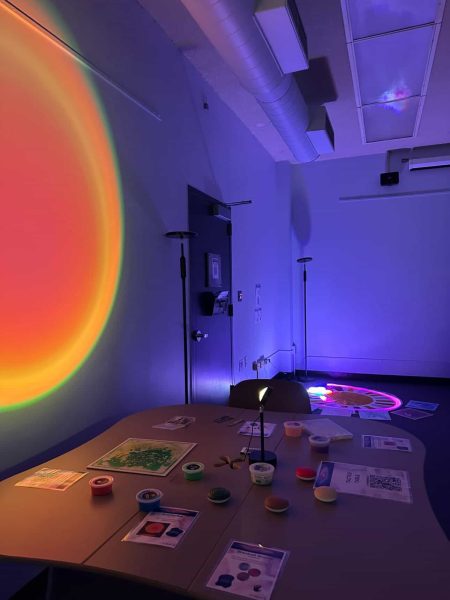
According to the data collected from the sensory room, the space has become an important resource for the campus community. During the 2024-2025 academic year, 82% of visitors were students, and faculty and staff also regularly used the room, making up 11% and 6% of visitors.
Survey responses also showed positive feedback. People said they used the space for stress relief, emotional regulation, quiet reflection, and even studying when other places on campus felt too distracting. Visitors enjoyed sensory items they could touch and hold, which helped them release stress. But perhaps the biggest change happened emotionally.
The emotional impact of the room was one of the strongest findings. After spending time inside, visitors reported feeling calmer, happier, and more relaxed. At the same time, feelings of stress, anxiety, nervousness, overwhelm, and tiredness decreased significantly.
The findings stayed consistent including this year, and could also point into something larger; a need for more sensory-friendly spaces across campus in the future. It has become part of an effort to support mental health, well-being, and inclusivity for students, faculty, and staff alike.
Another important part of the space is the sense of community it creates.
“There is something about the sensory space, about the collective social experience as well,” Manaseri said.
She explained that while many unhealthy coping mechanisms can feel isolating, the space gives students a chance to pause alongside others who may be feeling the same way. Rather than the tools themselves, the experience is about creating an inclusive space.
“It’s less about the design of the objects, but it has been, always about the experience, about an inclusive experience,” said Manaseri.
In recent years, universities around the world have recognized the importance of sensory-friendly environments in supporting student mental health and academic success. CDS hopes that the project can continue expanding across the University of Hawaiʻi system through guided tours, and they also want the room to be affordable and easy to recreate at other campuses.
Sustarsic explained that they regularly welcome class visits, student organizations, and faculty groups into the sensory room, “We invite class visits, organized groups like student classes, associations, as well as any organized faculty groups and visits to come in where we provide about a 15 minute overview of the sensory benefits and key findings because we really want to share back, you know, to kind of close the loop and so that people are aware of the impact that the spaces have had.”
She added that the guided tours received positive feedback from students and instructors, and that the visits also help alter classroom dynamics and bring people together, “To support everyone’s well-being and bring the class together with their instructor, breaking a bit of that hierarchy, right? Where the instructor, somebody that students look up to and sometimes feel like, oh, they don’t have the stress that we have, but leveling the plane field a bit and just coming together as human beings.”
Manaseri described how they use a mobile sensory kit that can be packed, transported, and set up in different locations. Many of the sensory items are portable, allowing them to create pop-up sensory spaces around Hawaiʻi, including partnerships with Leeward Community College, Kauaʻi Community College, Honolulu Community College, Windward Community College, Kapiʻolani Community College, and UH Hilo.
“We really had a vision, but it takes committed partners that could say, even if we don’t have a permanent space, we can do these pop up events and make sure that we are meeting our campus needs. And our vision is to make sure that every campus in the UH system would have a kit and work with us for supporting technical assistance to implement these other campuses,” Manaseri said.
The space has become important especially during exam season, when stress levels are often at their highest. Both Manaseri and Sustarsic pointed out that people should not feel guilty for taking breaks.
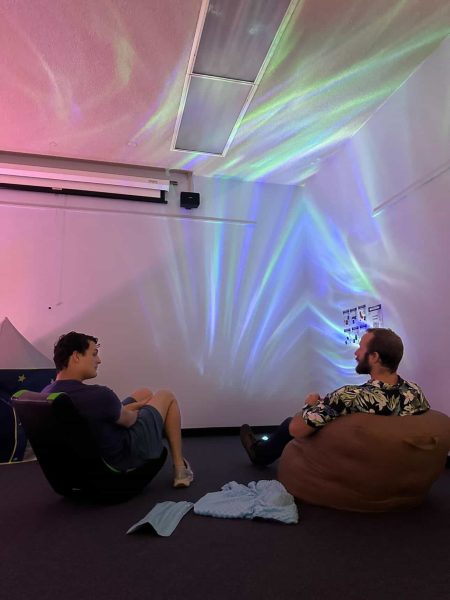
“This is a really important topic that we all share, these experiences about stress and about the stress cycle. And so being able to acknowledge that and looking for the ways that you can learn what works best for you to process that is really important. You’re not in that alone,” Manaseri added.
“It’s okay to take a break,” Sustarsic said. “It can be really healthy and beneficial to take an intentional break.”
She encouraged students to put their phones away, spend time with friends, listen to music, or just simply do what makes them happy, “I think you will come back stronger, and more ready to tackle any issues that may be on our way, but really collectively, we’re all in this together.”
Manaseri also encouraged students to reach out for support instead of carrying burdens alone, “Share when you’re struggling and feeling struggling out with someone. Don’t hold that all by yourself.”
In a campus where people are constantly moving from one responsibility to another, the sensory space offers stillness. The sounds are quieter, and the pressure of the outside world fades, even if it’s only for a short while. Supporting mental health does not always need complicated solutions. People simply need a safe place to pause. And as the exam season approaches and stress continues to affect people, it’s important to allow oneself to take a break.
“Take a break. Rest. Reset,” said Manaseri.