

Graduate students from around the world gathered at the East-West Center from Feb. 12 to Feb. 14 for the 25th annual International Graduate Student Conference, a student-run event focused on the Asia-Pacific region. Founded in 2002, the conference brings together emerging scholars to share interdisciplinary research in Hawai‘i. This year’s theme, “Legacies Through Time: Rethinking the Past, Confronting the Present, Shaping the Future,” invited participants to examine institutional and historical inheritances, environmental and ecological change, artistic and linguistic traditions, contested histories and future-making across disciplines.
The 25th milestone year drew 140 presenters representing 66 universities across 29 countries, reflecting record interest and a highly competitive abstract process, according to organizers.
Steven Bell, program coordinator at the East-West Center and one of the conference’s organizing leads, said the event began as a student initiative.
“It was started by graduate students at the Center who said we want to share what we’re learning and what we’re engaged in with other students across the Asia-Pacific region,” Bell said. “They came up with this idea of inviting other graduate students to come to Hawai‘i to share their research with each other.”
He described the conference as a flagship event within the Center’s education program, which emphasizes student leadership and experiential learning.
“One of the philosophies of the education program is students leading and learning by doing, and this exemplifies that,” Bell said.
Sophie Sidhu, who also works in the Center’s education program and serves as a conference organizing lead, said the interdisciplinary structure distinguishes IGSC from many traditional academic gatherings.
“A unique feature of this conference is that it is interdisciplinary and structured in panel sessions that cover a wide variety of topics,” Sidhu said. “Presenters are really engaging and learning from one another and seeing things from a new perspective or taking away ideas that might strengthen their own research.”
Day one began with a conference orientation, followed by simultaneous panels examining topics such as language and memory, Indigenous futures, health systems in the Asia-Pacific and gender and state power in modern China. Additional sessions addressed authoritarian legacies in Southeast Asia, performance across time and space and the role of youth culture and social media.
The afternoon concluded with workshops and discussions on human-nature relations, Indigenous knowledge and emergent political legacies in East Asia. An evening Creative Projects session at Hale Hālāwai featured artistic and multimedia research presentations.
Sidhu said the quality of discussion throughout the conference stood out.
“You see it inside the conference sessions with the kinds of questions that students are asking and the robust nature of the discussions,” she said. “Then the engagement outside of the sessions, the liveliness and those pieces, especially at the creative presentations.”
Day two continued with panels on post-conflict peacebuilding, decolonial education futures, material culture preservation and transpacific political imagination. A poster session expanded opportunities for one-on-one scholarly exchange, while a roundtable examined museum labor and care work in the Asia-Pacific.
Beyond formal panels, organizers introduced expanded programming to foster connection. A Friday Opportunity Fair brought academic departments and institutional partners together with participants, offering information about graduate programs, research pathways and internships.
“It is a great recruiting tool,” Bell said, noting that students often make academic and professional connections that extend beyond the conference. “Departments who are looking for talented graduate students are here and the students can interact with them.”
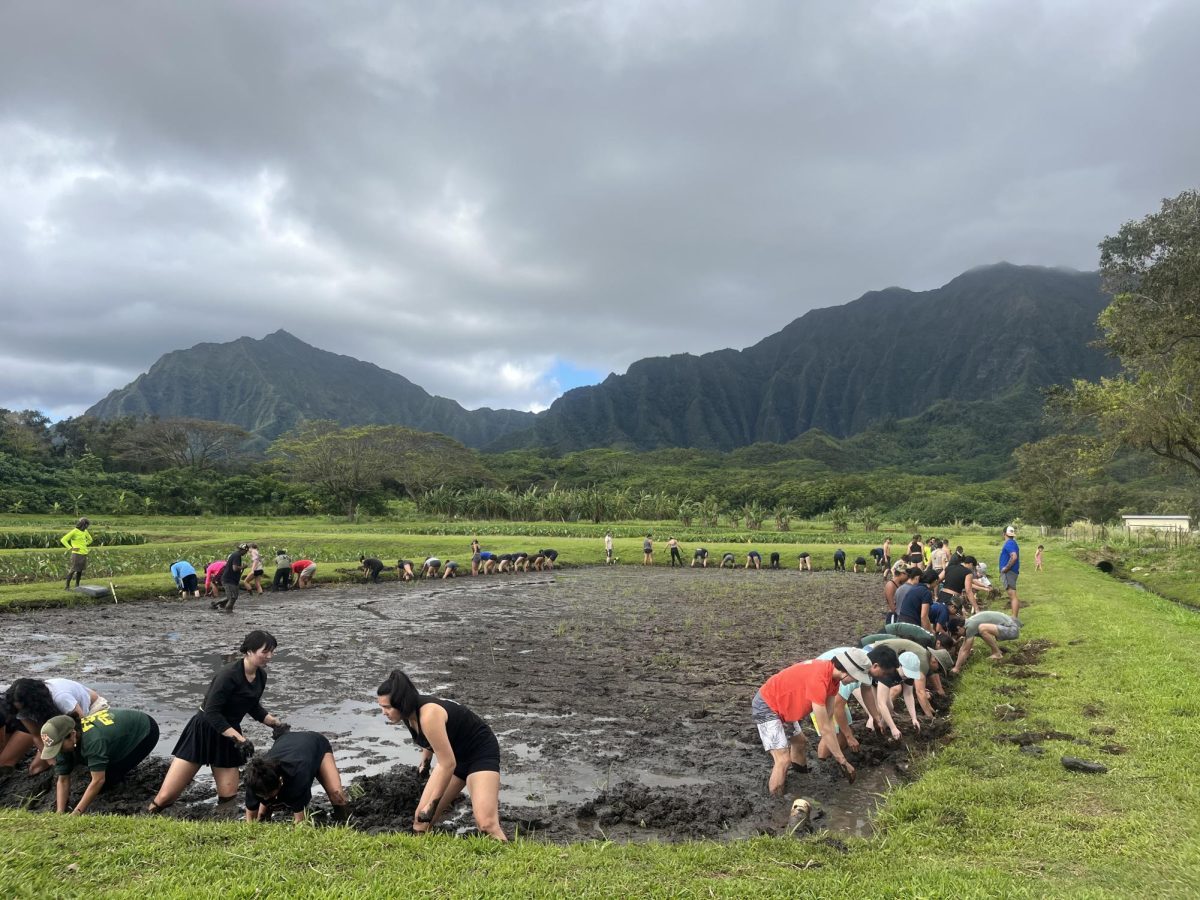
Pre- and post-conference activities also encouraged these informal exchanges. Participants attended events including a visit to Mānoa Heritage Center, a mock trial exercise, an art gallery experience and a steel guitar performance. Organizers said the goal was to help students build lasting connections across disciplines and regions.
“Our goal is that students meet each other and make connections,” Bell said. “Go see the city together, hang out with each other. We want this connection across the region and across disciplines.”
This year’s conference also marked the first time undergraduate students were formally invited to present alongside graduate researchers. Sidhu said the expansion reflects a commitment to widening access to academic presentation experience.
“I think this is an excellent opportunity for graduate students as well as this year’s innovation of inviting undergraduate students to share their research, to practice presenting and most importantly to network,” she said.
Student leadership remained central to the conference’s structure. The 2026 conference was co-chaired by Tien Nguyen, a master’s student in theatre from Vietnam, and Oliver Lilford, a master’s student in Pacific Islands studies from Australia. The co-chairs began planning more than a year in advance, first shadowing the previous year’s team before taking the lead.
Nguyen said the organizing team prioritized broad disciplinary access when designing the program.
“We try to have a theme that can reach as many disciplines as possible,” Nguyen said. “We also expanded the presentation format to not only paper but also poster, workshop and creative work presentations.”
With the University of Hawai‘i at Mānoa Graduate Student Organization serving as a communication partner, Nguyen said the outreach team worked closely with campus departments and partner institutions to widen participation.
“Our communication team always reaches out to departments and institutions at UH and asks them to notify their students about the conference’s theme, abstract submission deadline and the event days,” Nguyen said.
Organizers measure success through both quantitative and qualitative indicators. Nguyen said the number of abstract submissions, presenter participation and engagement across in-person and virtual formats all factor into post-conference assessment. Returning participants are another key metric.
Looking ahead, Nguyen said the team hopes to deepen collaboration with graduate student groups to expand local participation.
“We hope to reach out to GSO sooner and perhaps create additional joint initiatives to promote the conference to UH’s graduate students,” Nguyen said. “While we have a lot of UH students participating this year, the number could definitely be higher every year.”
One new initiative this year was the Opportunity Fair, which invited departments and institutional partners to promote programs directly to participants.
“It was the first time that we organized the fair, so there is still room for improvement,” Nguyen said.
In future conferences, organizers aim to reduce participation barriers by creating more sustained spaces for scholarly exchange.
“We hope to see more UH students participate in the conference,” Nguyen said. “And we also hope to create more spaces for students to exchange their ideas and keep fostering connections beyond the conference.”
For Bell and Sidhu, the sustained growth of the International Graduate Student Conference signals continued demand for cross-border academic dialogue in the Asia-Pacific region.
“What is harder to quantify but very visible is the quality of engagement while you are here,” Sidhu said. “You see it in the rooms, in the questions and in the conversations that continue beyond the sessions.”