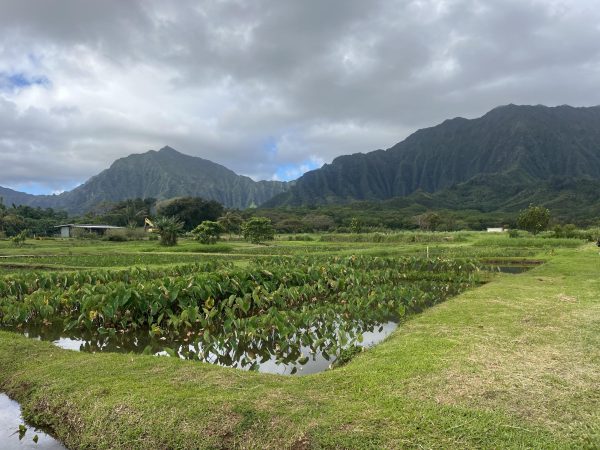
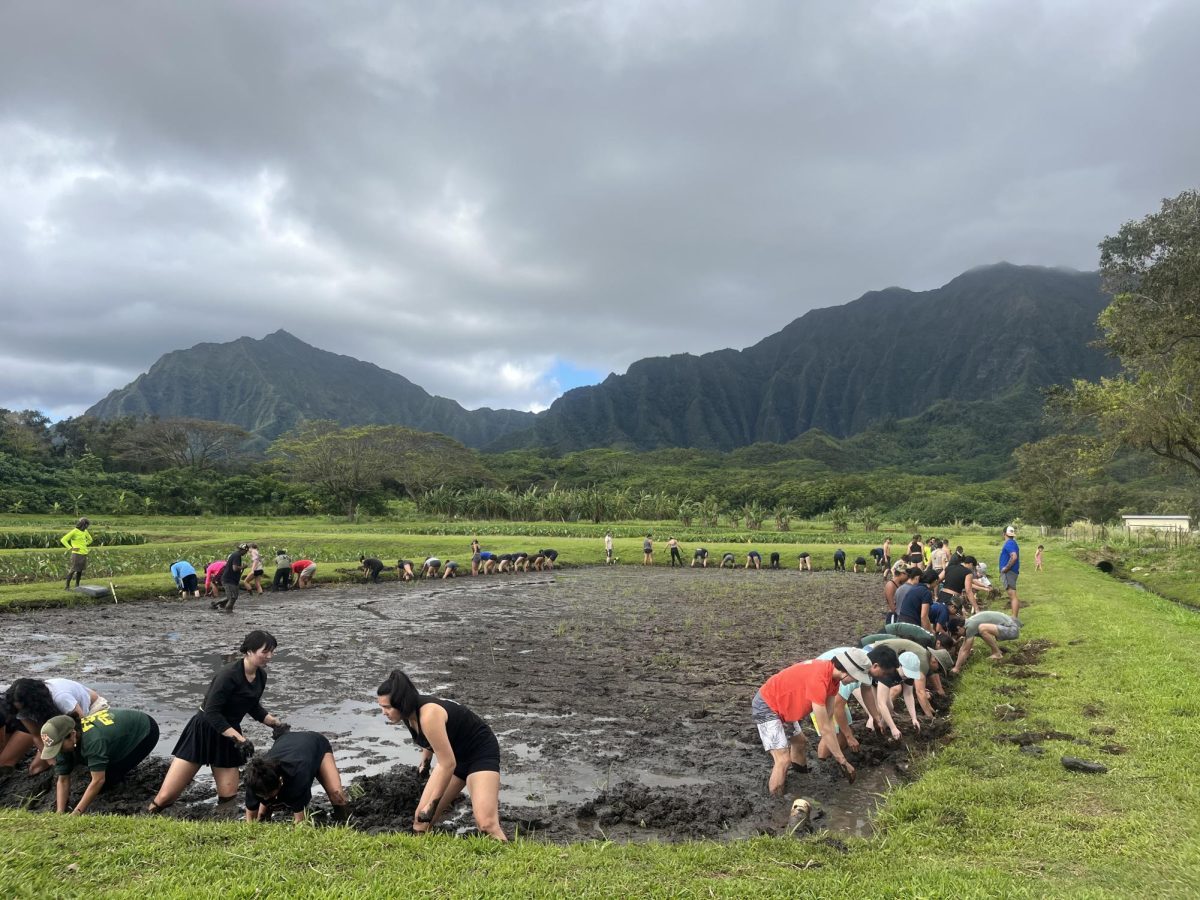
Some clips show students knee-deep in loʻi. Others capture students reflecting on what they’ve learned after long days working the land. The collection of histories is a patchwork of links, Google Drive folders, old class submissions, half-finished video files, each one holding a different version of the same story. Many were filmed years apart, by different hands, for different classes.
“There’s videos everywhere in different arrays of finishedness and quality,” said Ruben Campos, a student support specialist and program coordinator at the University of Hawaiʻi at Mānoa. “We have dozens of student films that have followed the experience of working through Malama I Na Ahupua’a.”
Individually, the clips document something powerful: students connecting to ʻāina, to community, to a sense of responsibility that extends beyond the classroom. But together, they remain scattered, difficult to find, easy to overlook.
Campos has seen how those experiences can change people. The challenge, he said, is making sure others can see it too.
Now, he’s trying to bring those stories into one place, by building a YouTube channel for the Mālama I Nā Ahupuaʻa (MINA) program.
As a program offered at the University of Hawaiʻi at Mānoa, the development of a MINA YouTube channel marks a new step in expanding its reach beyond those who physically participate, but its purpose goes beyond visibility. In Hawaiʻi, where more than 90% of food is imported, disruptions from extreme weather, supply chain issues and recent natural disasters have exposed how fragile that system can be. Programs like Mālama I Nā Ahupuaʻa (MINA) place students directly into restoration sites such as loʻi kalo and fishponds, where they learn the traditional practices that once sustained entire communities, and have been proven to work today.
The hands-on work offers a way to contribute to local food systems, support environmental restoration and build relationships with the people and places around them. It also creates a community, students working side by side with cultural practitioners and community members, learning not just how to care for the land, but why it matters.
Organizers say the YouTube channel is intended to show what participation actually looks like and why it’s needed now. By highlighting student stories and the realities behind Hawaiʻi’s landscapes, the platform aims to encourage more people to step out into active stewardship, connecting individual action to larger issues of sustainability and responsibility in the islands.
Campos works closely with Mālama I Nā Ahupuaʻa (MINA) while also participating in the program himself. Originally from Southern California, he came to Hawaiʻi for graduate school and has since become deeply involved in service-learning efforts that MINA has to offer.
Through that work, he’s become increasingly aware of how Hawaiʻi is portrayed online and in popular culture, and how often the history behind those landscapes are left out of view.
“After I decided to stay here long term, I started really rethinking my position and what it meant to be here in the first place,” Campos said. “What would it mean to actually stop just taking from Hawaiʻi and trying to give back to it? MINA has that deeper impact of helping you figure out why you are here.”
For Campos, the goal is to show what students do to take care of the land, and how those experiences shape them. He said he’s seen firsthand how working on the land can shift students’ perspectives.
“We have so many years of amazing high level student impact, high level community impact, but actually committing to that is super important,” he said. “Angling this towards YouTube, where you can get longer form media, will increase the depth of understanding people have.”
The Problem: Moving Beyond the Paradise Image.
But for Campos, the issue isn’t a lack of capturing meaningful experiences – it’s what happens to them afterward.
Despite years of student involvement, many of those stories remain scattered across platforms, never fully reaching beyond the people who were there to experience them. Without a central place to collect and share them, the depth of that work can be easily lost.
At the same time, the broader image of Hawaiʻi continues to be shaped by surface-level portrayals. Scenic landscapes and “paradise” imagery dominate online spaces, often without acknowledging the labor and care required to sustain those environments.
Campos believes this disconnect makes it harder for students, and the wider community, to recognize their role in that work. The gap in visibility comes as participation in programs like MINA has shifted in recent years. While the program continues to engage students each semester, founder and director of civic engagement Dr. Ulla Hasager said involvement has not been as consistent across campuses as it once was.
“We used to have many more students from different institutions involved,” Hasager said, noting that the program historically drew a broader mix of participants.
She said that has since changed.
“We have about 160 kids in total participating in MINA, and I think it’s incredible that it really worked. We have very little funding, and we still don’t have enough funding, so we create as many opportunities as we can,” she said.
For Hasager, the challenge is not only bringing students in, but helping them understand why the work matters. Without broader awareness, the program’s impact can remain largely limited.
Campos highlighted where the urgency lies: the stories are already there, but without a way to bring them together and share them widely, they risk being overlooked at a time when they may be needed most.
As climate change intensifies across Hawaiʻi, Campos said traditional ahupuaʻa systems offer an example of how Indigenous land management practices can strengthen Hawaiʻi’s environment and reduce damage during natural disasters.
“We wouldn’t have seen the results that we saw if the ahupuaʻa systems were still fully intact,” Campos said. “Lahaina might not have happened. On the North Shore, areas where there are still functioning ahupuaʻa systems were able to weather the storms with little impact because the water flowed the way it was supposed to through streams and ʻauwai instead of building up.”
Those examples expose what Campos sees as the larger purpose behind programs like MINA: connecting students to long-standing systems of community prosperity rooted in Hawaiian knowledge and practice.
“In terms of crisis communication, the crisis is climate change and settler colonialism and how they’ve impacted this place,” he said. “What I hope people see is that this program can connect them to real community resilience projects that have existed for generations.”
The Solution: Bridging the Stories Together
The idea of creating a YouTube channel is about giving existing stories a place to live.
“We haven’t done a good job committing to putting them in one place,” he said.
The channel, still in its early stages, is intended to serve as an ever-evolving archive of student voices, worksite experiences and learning collected over time. Some of the content will come from past semesters and workdays, while other videos will be created moving forward, building a continuous record of the program’s impact.
The focus will be on capturing the moments that define the experience and the process of working in spaces that require both physical effort and cultural awareness. For Wailea Tupou, an undergraduate student and coordinator in the program, those moments are where the impact becomes most visible. She referenced the final reflection as one of the moments that speaks most to her, as it ensures that students did not just show up to the workdays for points or a good grade.
“The final reflection is about having meaningful discussions and being mindful of everyone’s positionality and actually talking through the importance of community and education,” she said. “Everyone can reflect on the time they had throughout the semester, all the different sites they got to visit and they got to share their own experiences. We have students that are in such diverse majors and programs, but we really get to see their growth, and it is such a collective growth.”
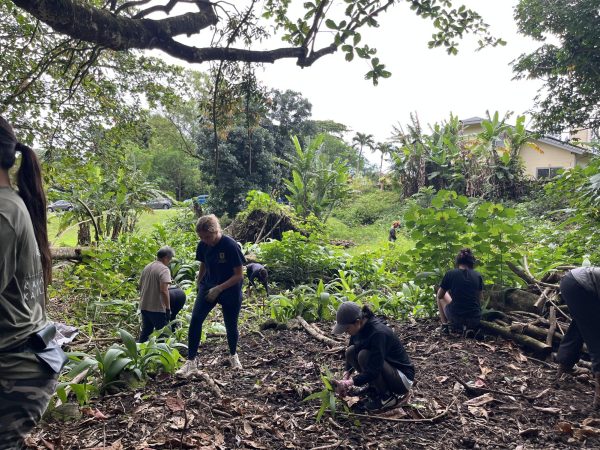
That growth often begins with understanding the land itself. At Kaiāulu ‘o Kahalu’u, a new worksite for MINA students this year, learning is rooted in observation and relationship.
“We take time to kilo (observe) the area and see what the ʻāina needs done at the time,” said Hiʻiaka Jardine, co-founder of Kaiāulu o Kahaluʻu. “We hope that each person walks away feeling more grounded to ʻāina and feels a kuleana to care for it.”
Tupou reiterated that view.
“MINA reminds us that aina is also the people that malama or take care of it. There’s so much strength in understanding sustainable practices, even though we are often stuck in classrooms and in doors,” she said.
Capturing that kind of experience, and making it meaningful to someone who hasn’t been there, are the channel’s central goals.
Campos said YouTube offers a way to do that more effectively than other platforms. While social media sites like Instagram can quickly share images or short clips, they often don’t allow for the depth needed to explain the work behind them.
“Youtube is perfect for that, and it is also just the homebase, and one goal we have is eventually moving to shorter form videos and different platforms.”
The Obstacles: Challenges of Translating ʻĀina
But turning that idea into something tangible has proven to be more complicated.
One of the biggest challenges is time. Much of the program’s focus remains on in-person work coordinating service days, supporting students and maintaining relationships with community partners. Organizing, editing and uploading videos becomes an additional layer of work that competes with those priorities.
“It is always about time and attention, right? We’re busy teaching a billion classes. So much of our work is actually just going out and being in Aina with students,” Campos said.
There is also the issue of the material itself. The existing videos vary widely in format and quality, spread across different platforms and accounts, making it difficult to compile them into a cohesive collection.
More difficult, however, is the question of whether the experience can be captured at all.
MINA is built on direct engagement, being physically present, working with the land and learning from community members. Campos said translating that into something viewed on a screen can feel restricting.
“There’s still this kind of ongoing resistance toward just reproducing stereotypical imagery about Hawaii and to let people into places who haven’t done the work.,” he said, explaining that watching a video is not the same as being there. “MINA is not about distance, it’s the exact opposite.”
Concerns about representation are what Campos is most nervous about. The places where students work are beautiful scenic locations but also active cultural and environmental spaces. Sharing them online without proper context risks reinforcing the same narratives about Hawaii that the program is trying to challenge.
“The point of these spaces is not that they’re just beautiful, but they’re actually being worked on. So that it’s not just like, oh, this natural beauty. People put effort and time into these places. And it is one that is actively being displaced,” Campos said. “We want to make sure all that is said about these places is done, not just to highlight the beauty, but to highlight the work and the learning that students do. So we really do need a good foundation to do that.”
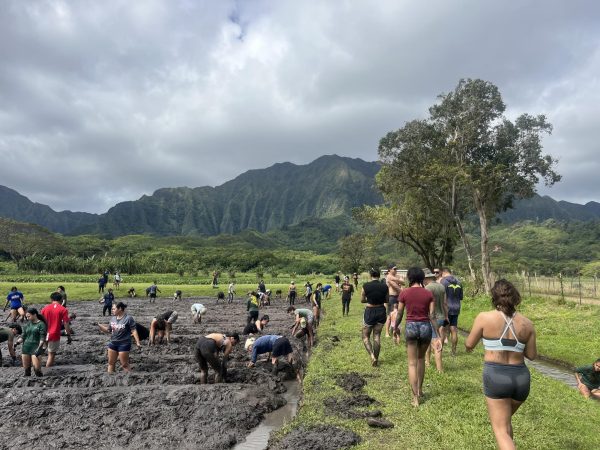
Community partners see those stakes firsthand. The work done in areas like Kaiāulu o Kahaluʻu carries impact beyond what is immediately visible.
“The work we do in ma uka or the uplands has the ability to impact everyone downstream, and we are one step closer to restoring the complex agricultural system left to us by kūpuna. ” Jardine said, pointing to the broader environmental effects of restoration efforts.
Research from the Pew Research Center shows that YouTube remains one of the most widely used platforms among young adults, particularly for learning-based and informational content. With over 2.5 billion users, according to The Global Statistics, experts say that reach can make it a powerful tool for programs trying to build engagement, if used carefully.
Media scholars studying digital storytelling argue that video platforms allow for a level of narrative depth that traditional outreach methods often lack. According to ResearchGate, long-form video, in particular, gives space for context, reflection and lived experience, elements that are central to programs like MINA.
Youjeong Kim, a journalism professor at the University of Hawaiʻi at Mānoa whose research focuses on immersive media and digital communication technologies, said that distinction is part of what makes YouTube especially effective for community-based programs. Originally from South Korea, Kim studies how online media platforms shape engagement, education and human connection.
“YouTube is really strong for telling a full story,” Kim said. “Since it’s longer-form, you can build context, emotion and creativity in a way that’s hard to do on Instagram or TikTok.”
While platforms like TikTok and Instagram are effective for grabbing attention quickly, Kim said YouTube allows organizations to sustain engagement and communicate deeper meaning.
“For a program like MINA, you can show the cultural, environmental and community impact more clearly,” she said. “Also, videos stay searchable over time, so they keep educating and bringing in new participants even months or years later.”
Kim added that authenticity is often more important to student audiences than polished production value.
“Students want to see people like themselves, not just polished promotional videos,” she said. “If they can picture themselves in that experience, it’s much more engaging.”
That emphasis on relatability aligns closely with MINA’s approach. Rather than creating highly produced promotional content, organizers say the goal is to document genuine moments of learning, reflection and connection to ʻāina.
For Campos, that potential is exactly what makes the platform worth pursuing, but also what raises the stakes.
Cultural experts and community practitioners caution that increased visibility comes with responsibility. Sharing place-based knowledge online, especially in Hawaiʻi, requires careful attention to how stories are framed and who is telling them.
Educators say online platforms can serve as an entry point. When done thoughtfully, they can introduce audiences to ideas, practices and communities they might not otherwise encounter, and potentially motivate deeper, in-person engagement.
Tupou sees the channel in that light, not as a replacement for the work, but as a bridge.
“It just solidifies the reasons why being sustainable and knowing your land is super important. With how MINA is framed, we get to interact with the stewards of these places and we get to understand their aina from their point of view,” she said.
Community Voices: The Impact Beyond the Classroom
MINA has become more than a service-learning requirement for many students, through loʻi restoration, fishpond work and conversations with community practitioners.
Tupou first became involved through an ethnic studies course at the University of Hawaiʻi at Mānoa. What began as occasional participation eventually turned into a leadership role after a former coordinator recognized her interest in ʻāina-based work.
“The biggest thing that I have learned and relearned and continue to learn is the ingeniousness of the ecosystem and knowing the perfect balance for everything to flow in abundance,” Tupou said. “It is in the name MINA.”
Tupou said the program pushes students beyond campus life and into relationships with the communities sustaining Hawaiʻi’s landscapes.
“With MINA, you get to step outside, you get to interact with amazing community members who are living and breathing the work that is helping all of us,” she said. “We all need to be more sustainable.”
For Ella Shapiro, another student coordinator, that connection to ʻāina became deeply personal. Originally from a rural area on Hawaiʻi Island, she said moving to Oʻahu left her feeling disconnected from both community and place.
“This year has been the best year I have had, and I really think it is largely because of the MINA program,” she said. “Getting back to ʻāina and building a relationship with Oʻahu was needed.”
She said working alongside community organizers and returning to the same restoration sites helped reshape her understanding of the island.
“We here have a very untrue perception of Oʻahu of it being just city,” she said. “But no, Oʻahu has some of the most abundant areas, thanks to these incredible people that work every single day to sustain these places.”
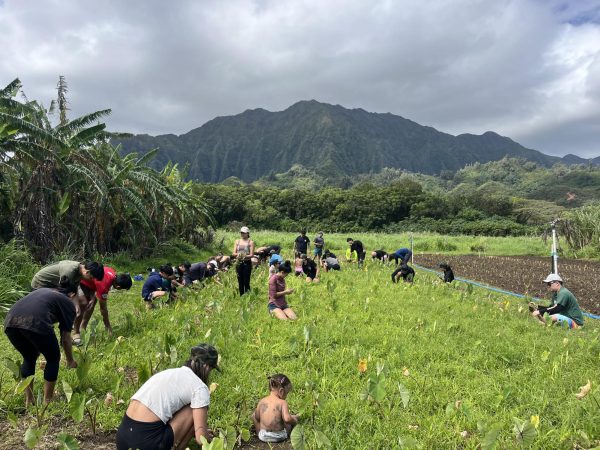
Students say much of the learning comes directly from elders and cultural practitioners. At Kaiāulu o Kahaluʻu, Jardine teaches participants about traditional place names, land features and sustainability practices tied to the area’s loʻi system.
“We feel that by saying the names, we perpetuate them and allow people to feel more deeply connected to their community,” Jardine said.
Jardine said restoration work also carries environmental impacts that extend beyond the immediate site. Native forest restoration and traditional agricultural systems can help reduce erosion, improve water retention and eventually contribute to local food production.
“The whole system was built to feed, not just people but the entire ecosystem,” she said.
For student participant Ta’Lor Corley, MINA offered a way to connect classroom learning with lived experience. Corley joined the program while taking Hawaiian studies courses and said the hands-on work deepened both cultural understanding and personal responsibility.
“Native Hawaiians have the utmost respect for the land and it is everyone’s responsibility to care for it,” Corley said. “Take care of the land and the land will take care of you.”
Corley said the experience also strengthened ties within her own family, who now attend workdays together.
“Working on the ʻāina will humble you, while bringing you closer with the community,” she said. “It instills values and helps one gain an appreciation for the land and the work put into it.”
For MINA, the challenge now is figuring out how to translate that experience without diluting it, using digital tools to expand awareness while still honoring the relationships and responsibilities at the core of the work.
Building the channel has been less about launching something new and more about finally organizing what already exists.
“I would just love to have a series of kind of definitive introductory videos,” Campos said, describing a vision that has yet to fully take shape. “A place where people can post and see themselves within the work that they do.”
He imagines a platform where each semester adds to the last, where students can look back at earlier cohorts and recognize a shared experience, even if each story unfolds differently.
“And even if the story that they’re all sharing is always the same, that it impacted them in this way, that’s important,” he said.
For now, that vision remains in progress.
Campos hopes to launch the YouTube channel at the beginning of the next school year. But as of right now, there is no finalized archive. Just a growing collection of footage and an ongoing effort to piece it together.
Campos said part of the difficulty lies in the nature of the program itself.
“You watch a couple videos, you’re not going to get a real sense of the program,” he said. “They’re meant for students to get a sense of where they’re at, how they might feel motivated from watching them.”
Still, he continues to return to the same idea: that even an incomplete window into the experience is better than none.
The goal, he said, is not to replace the work, but to invite people into it.
Because while the channel is still being built, the stories it will carry have been years in the making and are still unfolding.
“It displaces that individualist kind of focus, so a lot of students start to recognize that anybody can be involved in these and that just a little bit of time will really change you. It’s absolutely connected and has a real impact,” Campos said. “Those are the kinds of stories that we’ve gathered, and we hope more people will come out and be a part of it.”