
Signs depicting a bloody fetus, a disembodied baby head, and a woman sitting by a toilet covered in blood were set up in UH Mānoa Campus Center on March 3.
Undergraduate student Sadie Ekedal was on her way to class when one of the pro-life sign-carriers offered her a pamphlet. Ekedal said no thanks.
The activist responded, “‘Oh, so you want to kill babies?’”
This wasn’t the only altercation between students and anti-abortion protestors at UH Mānoa on March 3 and March 4.
UH Executive Policy 10.206 grants rights to speech and assembly to all, provided that they follow guidelines. But when messages are seen as divisive, students are left wondering whether the best option is to debate, scorn, or even physically retaliate.
Some students responded to the pro-life messages through lengthy conversations and debates, others chose physical acts of defiance, such as kicking over or stealing signs.
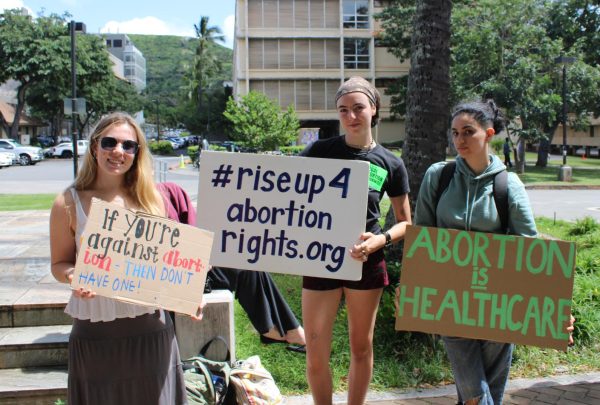
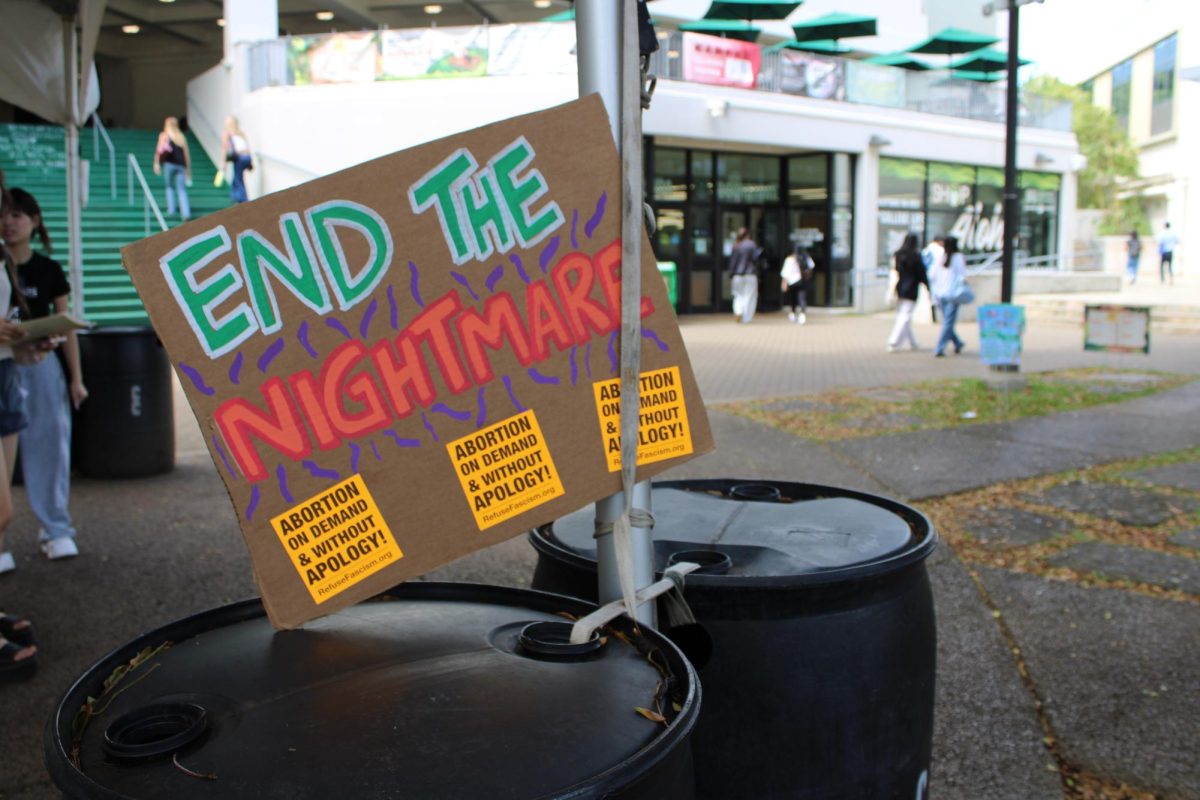
On March 5, Members of College Democrats at UH Mānoa anchored a responding pro-choice demonstration. Students gathered in the courtyard outside of the campus center courtyard to voice their support for reproductive rights, raising signs that encouraged “abortion, on demand, without apology.”
While most students responded positively to the pro-choice message, others expressed disagreement both verbally and physically. One student poured water to erase messages left in chalk by pro-choice demonstrators.
Graphic Imagery and Steep Claims Spark Strong Reaction
Matthew Newton of the pro-life group Project Truth said the group brings visual displays to college campuses to spark discussion.
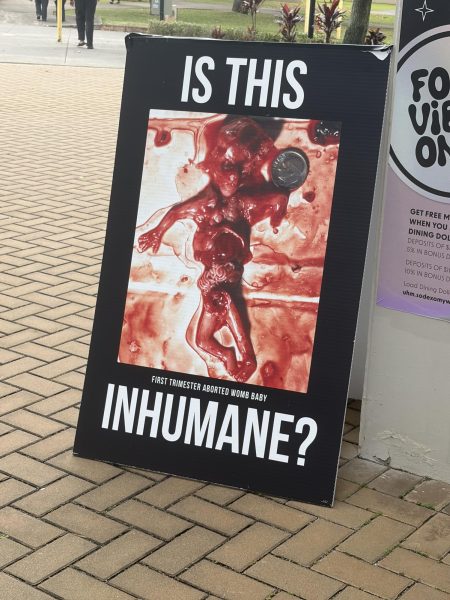
“We want students to see the reality of what abortion is,” Newton said.
Beth Smith, another member of the group, said they believe college campuses are an appropriate place for these conversations.
“It’s a place of education, and this is a way to educate young people,” Smith said. “We want to show the truth that abortion takes the life of an innocent human being.”
Newton said universities provide a “marketplace of ideas” where students can debate controversial topics and challenge each other’s perspectives. Newton claimed that his group’s demonstrations had influenced the views of students in the past.
Smith described an experience of speaking to a young woman on a college campus who was about to get an abortion. He claimed that two years later, he returned to that campus and the same young woman thanked him for being there, saying that she had changed her mind about her abortion and now had a 2-year-old son.
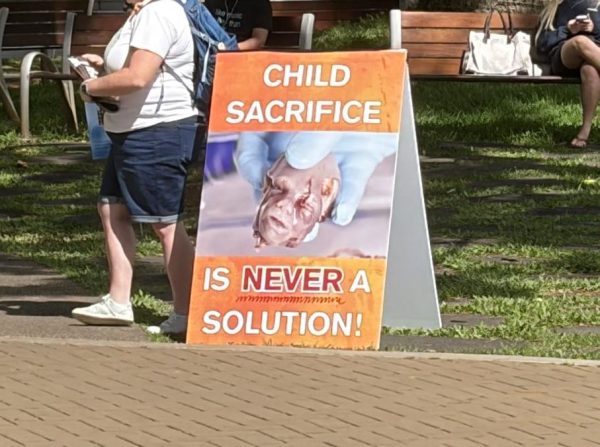
A controversial aspect of the pro-life demonstration was graphic imagery on their signage. While the displays drew attention, some students were more inclined towards outrage than academic debate.
Averi Peoples, a psychology student who helped to organize the pro-choice response, said the imagery used by the anti-abortion activists went beyond simply expressing their viewpoint. Rather, he opined that the group was trying to scare and anger people.
“I was shocked that those images were even allowed on campus,” Peoples said.
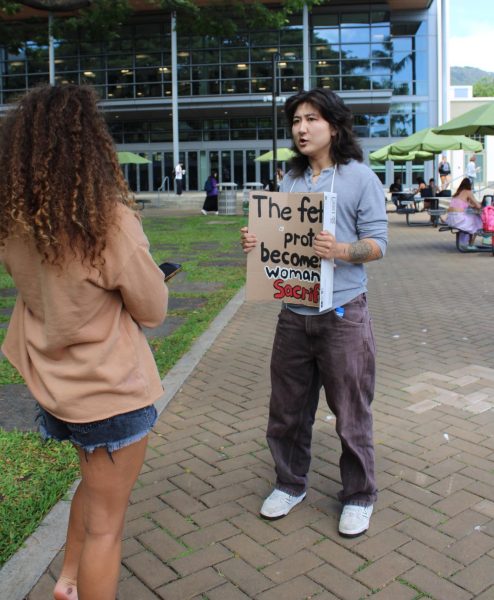
Ekedal, who went on to participate in the pro-choice rally, had a similar reaction. She said that the signs targeted women and other minority groups.
Some students said their encounters with the pro-life group went beyond conversation and academic debate. Ekedal described tense exchanges with demonstrators, claiming that they directed accusations and confrontational remarks toward students who talked to them or simply passed through the area.
“The man was verbally throwing out accusations to people, calling them murderers,” Ekedal said. “He was so aggressive and his tone was completely demeaning and condescending. He called me and several other women emotional and silly.”
She added that when she asked about his credentials or educational background, he refused to answer.
Ekedal contacted campus security after her interaction with the group, stating that she believed they posed a threat to students’ safety. She said campus security responded, but told her that there was little they could do unless the situation escalated further.
Many students cited rumors that the pro-choice group claimed they had permission to be on campus for the month of March. The UH Meetings and Events board confirmed via phone call that the group had not registered with the school to be on campus, but was demonstrating under their rights to free speech.
“I am all for free speech,” said Ekedal. “But when it becomes a public safety concern, I think they [campus security] should be taking it more seriously.”

The UHM College Democrats table at the following pro-choice rally was led by Amelia Sofos, the group’s president and a double major in political science and peace & conflict resolution.
Sofos said that behavior she witnessed was harassment rather than protest. For her, observed interactions between students and demonstrators raised concerns for student safety. Sofos said she took issue with the “repeated harassment” of students that she both witnessed and experienced.
“The anti-abortionists would follow after students if they refused one of their handouts and would also spew hateful messages as the students walked away,” Sofos said. “This type of behavior creates an unsafe environment on campus, and it’s unacceptable.”
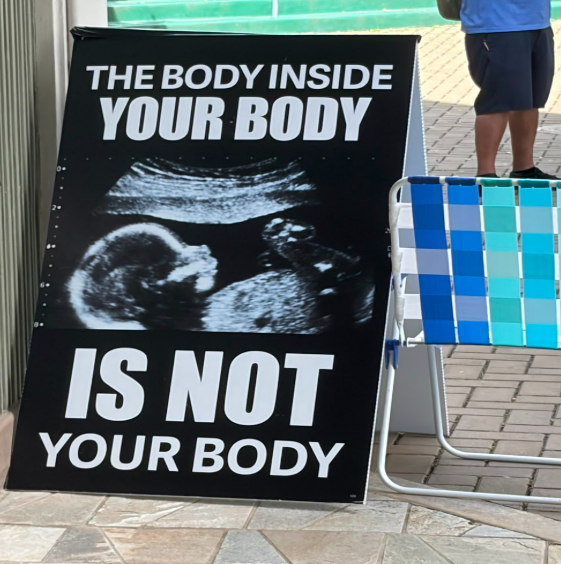
Frustration with the display led one student to take one of the activists’ signs, an action that called the attention of multiple campus security personnel.
The student, who requested anonymity for fear of retribution, said the decision was impulsive.
This student said that the display was so provocative because many young people believe strongly in bodily autonomy and reproductive rights. He said that, at times, Hawaiʻi can feel isolated from political ongoings on the continental U.S.
Demonstrations on campus made the issue feel more immediate to him, connecting local events to broader national debates over abortion rights.
“It just makes you want to do something about it,” he said.
The student argued that the graphic imagery and misinformation related to abortion were intended to appeal to emotion rather than encourage scientific discussion and structured debate.
A Rapid Student Response
Handwritten signs rose above the crowd in the campus center courtyard when a group of students gathered beneath the afternoon sun to demonstrate their support for reproductive rights.
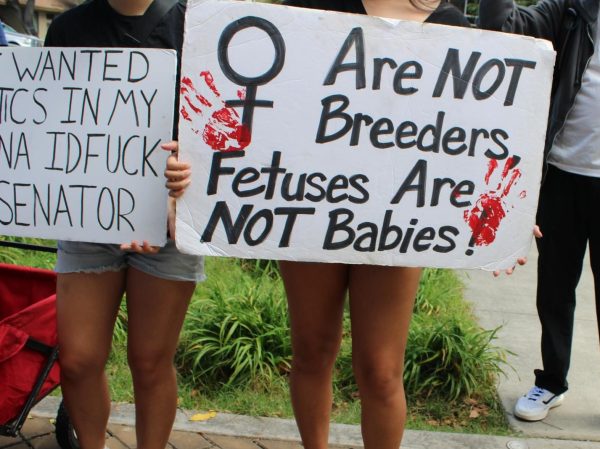
Participating students said that the pro-choice rally was about more than responding to the pro-life activists. It was an opportunity to publicly support reproductive rights and encourage others to speak out. Students who attended the rally said they wanted to show solidarity with one another and reclaim a sense of safety on campus.
Ava Dodhi, a junior majoring in marketing, said participating in the rally was part of speaking out for the community.
“It’s our duty as citizens to make our voices heard,” Dodhi said. “I want to be a part of that.”
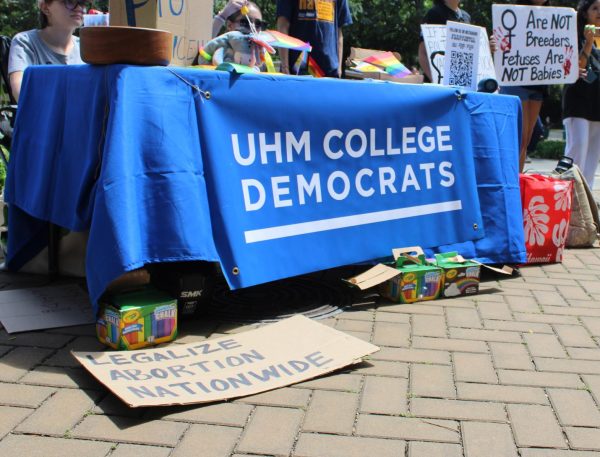
Ekedal said the demonstration was meant to counter the atmosphere created by the previous protest.
“We are out here showing people that this is a safe space, something that the anti-abortionists took away,” Ekedal said. She added that she hopes students who encounter similar demonstrations are not influenced by what she described as misleading information.
Others connected the rally to broader political concerns. Sofos said students felt a responsibility to speak out in defense of rights that they believe could come under threat.
“It’s important to stand up for your rights, and the rights of others whenever they are being threatened,” Sofos said. “In Hawaiʻi, abortion is legal. In fact, we were the first state to legalize it in 1970. But that doesn’t mean that we can’t end up like Texas or Idaho, or any of the states that have extreme abortion bans.”
Sofos believes that student activism plays an important role in shaping the future.
“We’re the ones who will inherit this world next, and a lot of us don’t like what we see around us currently,” Sofos said. “But we have the power to change things. Every act of resistance or protest pushes us toward a better future.”
Generation Action, a student group that works to increase access to reproductive healthcare on campus, called for the demonstration initially. These plans changed when the pro-life group left campus after two days of demonstration.
While some viewed this departure as a victory, others said the broader fight for reproductive rights extends beyond a single protest or the presence of outside activists. Sofos said the issue cannot be viewed as an isolated incident.
“Any attack on reproductive rights is an attack on reproductive rights everywhere,” Sofos said, emphasizing that “the fight for reproductive rights doesn’t stop when anti-abortionists aren’t actively threatening or harassing students.”
Before and After Roe: A Storied History of Abortion Rights in Hawaiʻi
Reproductive freedom has always been a crucial pillar in women’s history. Debates over abortion rights in the U.S. have been tied to the broader women’s rights movement for decades.
Throughout the 20th century, activists on both sides of the issue have mobilized around questions of bodily autonomy, healthcare access and the legal status of abortion.
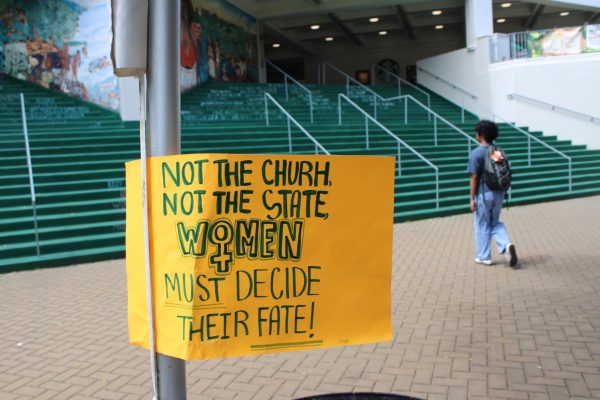
In 1973, the U.S. Supreme Court ruled in Roe v. Wade that the Constitution protected a woman’s right to terminate a pregnancy, effectively legalizing abortion nationwide. This marked a major turning point following a national movement that pushed for the legalization of abortion.
The debate over abortion rights has deep roots in Hawaiʻi. The state became the first in the nation to legalize abortion through legislation in 1970, three years before the U.S. Supreme Court’s decision in Roe v. Wade. The state allowed physicians to perform abortions at a patient’s request, making Hawaiʻi an early leader in reproductive rights policy.
“I was at the first demonstrations for choice at the state capitol back in 1970,” said Carolyn Hadfield, a leading member of Refuse Fascism Hawaiʻi. “We were the first state to win the right to abortion. At that time, it was a huge movement that even included a lot of the Catholic church women.”
Dr. Leanne Kealoha Fox, a Native Hawaiian public health scholar who studies health equity and indigenous well-being, uncovered evidence from archival research that shows that access to reproductive care has always been a key part of protecting the health and autonomy of Native Hawaiian communities. This archival research includes Hawaiian language newspapers, journals, and conversations with traditional Hawaiian healers.
In an interview with the Hawaiʻi Public Radio, Fox said the history of abortion in Hawaiʻi extends long before 1970. Historical research suggests that reproductive health decisions such as abortion were part of traditional Hawaiian medical knowledge and cultural practices.
Fox cited the Hawaiian words for abortion, ʻōmilo or milo or milomilo, as evidence that supports the notion of abortion being a fundamental part of the history of Hawaiian healthcare
Fox told HPR that abortion care was never a new or contemporary practice in Hawaiʻi–it is embedded in the history of the Hawaiian people.
“I think Hawaiʻi is special and very advanced in that we were the first state to legalize abortion,” Dodhi said. “To shame abortion on this campus is anti-Hawaiʻi. It’s so deep in the culture. It is pro-abortion, pro-health care, pro-human rights, pro-civil rights.”
For nearly five decades, the Roe decision served as the legal framework governing abortion access across the country. Pro-life group member Newton described this history as the catalyst for his opposition to abortion, claiming that abortion is comparable to mass genocides, like Nazi Germany, and other instances of inequality such as slavery.
“We call ourselves abolitionists because it’s like the abolitionists of slavery,” Newton said. “Since 1973, over 63 million babies have been aborted, and we consider that to be a genocide of people that should never have been killed. We are pro-life because we never want this to happen again. These are human beings with equal value.”
Indeed, there are 60-65 million abortions a year in the U.S., according to estimates made by the Centers for Disease Control and Prevention and the Guttmacher Institute. However, the claim that this is a genocide of human beings was met with strong disagreement from attendees of the pro-choice rally.
Dodhi said they viewed this statistic as 63 million instances of pregnant peoples’ lives being protected, stating that “killed” is an inaccurate term for cells being removed from a uterus.
Ekedal concurred with Dodhi’s belief and expressed concern over the use of the term “genocide,” emphasizing that groups that preach pro-life sentiment are often silent regarding the genocide, as declared by the United Nations, that is actively taking place.
Peoples rejected the group’s description of themselves as “pro-life,” arguing that the label fails to account for what happens after a child is born. He instead referred to the movement as “pro-birth.”
“It is actually about controlling the uterus,” Peoples said.
The legal landscape shifted dramatically in 2022 when the U.S. Supreme Court issued its decision in Dobbs v. Jackson Women’s Health Organization, which overturned Roe v. Wade and determined that the Constitution does not guarantee a right to abortion, returning the authority to regulate the procedure to individual states.
For many advocates, the ruling renewed fears that abortion rights could be stripped away.
“What we are experiencing now is fascism,” said Hadfield. “A big part of that is the attack on women and the strengthening of anti-choice.” She emphasized that this makes speaking out now more important than ever.
Students involved in recent demonstrations say the ruling has also influenced activism on college campuses. Ekedal said encountering anti-abortion activists at UH Mānoa reminded her of the protests that followed the overturning of Roe.
Public health concerns were central to the abortion rights movement. Before Roe v. Wade, many procedures were performed illegally and in unsafe conditions. Researchers estimate that between 200,000 and 1.2 million illegal abortions occurred in the U.S. each year.
Hadfield stressed that making abortion illegal does not stop the procedure.
“People need to know that there are people out there speaking out. I also think people have to hear more about the history of the times when there wasn’t choice. How many young girls and students were actually dying,” Hadfield said. “Women are used as incubators and end up dying.”
The demonstrations also raised questions about how the university should respond when political activism on campus becomes graphic or targeted. Dodhi said the displays left them deeply unsettled, particularly because of the potential impact on students who may already be facing difficult personal decisions.
“I was extremely disturbed. This is misinformation, it is propaganda,” Dodhi said. They added that the messaging could be especially harmful on a college campus, where many students are navigating relationships and sexual health for the first time, emphasizing their belief that the decision to have an abortion is personal and private.
“I hope that students will realize that there are groups here on campus who are pro-choice, who are pro-LGBTQIA+, who don’t agree with the hateful rhetoric we’ve been seeing spread on campus lately,” Sofos said. She added that she wants students to know there are organizations that can help them get involved in activism and organizing efforts on campus.
“UH needs to care more deeply about the implications of our autonomy being infringed upon,” said Dodhi. “A neutral stance is not enough anymore.”