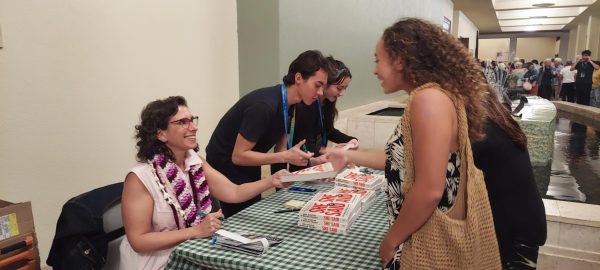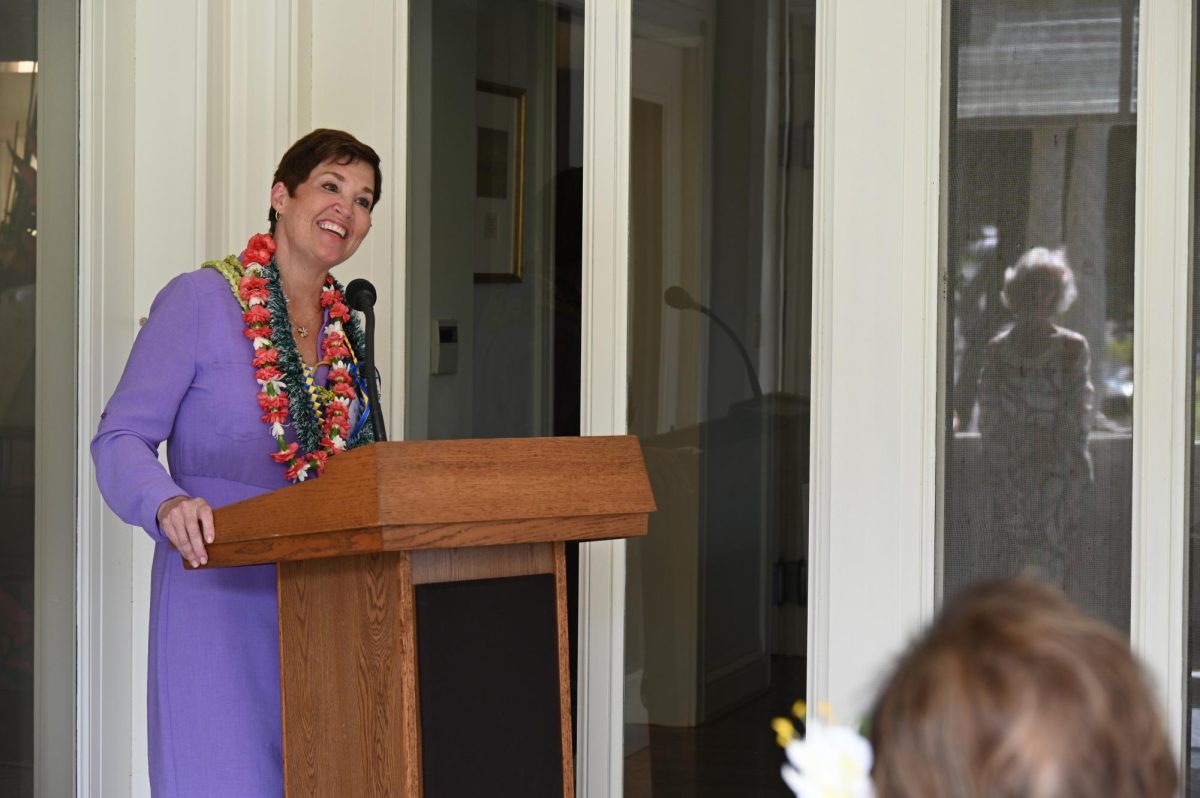


On Feb. 12, Pulitzer Prize–winning journalist Jodi Kantor addressed a packed audience in Seto Hall at ‘Iolani School, delivering a candid assessment of journalism’s future amid political division, rapid technological change and declining public trust in media.
Speaking as part of the Better Tomorrow Speaker Series, Kantor reflected on the challenges facing the press, the responsibility of reporters in a democracy, and the pressures confronting a generation coming of age in what she described as a chaotic information environment. The event was moderated by Yunji de Nies, co-host of Hawai‘i News Now, and hosted in partnership with the University of Hawaiʻi Foundation and Unbound Philanthropy.
The conversation with Kantor began with her journey into journalism. Long before reporting on presidents and Supreme Court justices, she was a young reader eagerly waiting for the newspaper to arrive. Growing up before the internet, she said the paper landing in the driveway always held a certain drama, like an invitation into another world, and she devoured every periodical that came to her house.
But even with that early exposure, she struggled to imagine a future for herself in journalism. She admired the work, but initially, it did not feel like a path she could claim. There were few female bylines at the time, and she felt pressured to pursue a stable, higher-paying profession. Law appeared to offer that security. But in law school, she began rethinking what success actually meant. Did the work itself feel meaningful day to day? She concluded that true success lies in feeling satisfied and connected to what you do every day, and she did not feel that about law.
“I admitted to myself that I really wanted to be a journalist,” she said. “I had no clips to speak of, I hadn’t done the right internships. All I really had was a conviction that I could do it and then I had to at least try.”
To accomplish what she has in journalism, Kantor had to push through resistance; unanswered calls, repeated refusals, and sources unwilling to speak. She made a point to recognize journalists across the country, including those who have yet to break a major story, expressing her hope that they feel the same encouragement she has received throughout her career.
“If people reject me, if I have a tough day at the office, I still feel that I have a huge group of people behind me,” she said.
De Nies then asked how she maintains that conviction while working for months on a story that may never be published. Kantor said critics often try to discredit reporters, telling them they are either naive or bad for pursuing the story.
She pointed to her investigation into Harvey Weinstein as a defining example. As she approached female Hollywood executives, she was met with skepticism and condescension. Some told her sexual harassment was simply part of the movie industry’s long-standing “casting couch” culture, dating back to the early studio system.
Those moments of being warned, lectured, and labeled irresponsible led to a deeper question: How do you keep going when people insist you are naive or even wrong? Although Kantor can recognize when these labels are being thrust upon her in conversation, she also has the ability to listen and understand.
“It’s important to take what they say into consideration. Journalism isn’t perfect. It’s a really powerful tool, even really righteous journalism can hurt people in its wake,” Kantor said. “I think working for an institution that supports you is conjoined with being totally schooled in the values and trade craft of journalism.”
Kantor’s reporting on the Weinstein story helped reignite the #MeToo movement globally, giving credibility and visibility to survivors’ accounts and prompting many more women across industries to come forward with their own experiences. When asked how she assesses where the #MeToo movement stands today, Kantor pushed back against the idea that it has faded, arguing that claims of its demise are greatly overexaggerated.
“President Trump has fermented an enormous political and cultural backlash against #MeToo, a very powerful one. And yet, women keep coming forward. The revelations have never really stopped,” Kantor said.
Kantor said one of the most striking aspects of the long-running Epstein scandal is the sustained public concern surrounding it. At the core of the #MeToo movement, she explained, is a sense of compassion for women who have experienced abuse. Across political lines, many people have expressed outrage at the substantial evidence showing the exploitation of young, vulnerable women.
“I think it’s really good that people are still feeling that impulse,” Kantor said.
Cynthia Reves, a journalism and English teacher at McKinley High School, is deeply involved in Hawai‘i’s student journalism community. She described Kantor’s talk as inspiring and encouraging, particularly on the value of journalistic craft.
“It resonated with me because as a journalism teacher, she made me see the value of the basics I teach,” Reves said. “Journalism is a craft and that’s the other part of why I teach journalism: my students who don’t become journalists will become consumers of journalism and they will have an understanding of what goes into good journalism.”
Kantor acknowledged that journalism may seem uncertain right now, but emphasized that the work is built on proven methods. She said she feels supported by The New York Times and grounded in a long-standing tradition of reporting. The techniques she uses have been passed down through generations of editors, and allows her to feel confident in her persistence.
The next question turned to the state of journalism itself: What is happening to the media landscape across the country? De Nies pointed to concerns closer to home, noting that Hawai’i may be on the verge of becoming a “news desert,” with newspapers growing thinner by the week. The fear, she explained, is losing organizations and the craft of journalism.
Kantor acknowledged that journalism is facing significant instability nationwide. Resources are limited and public trust has been strained. Yet she stressed that the stakes extend far beyond the industry itself.
“The worry is that when those institutions go away, we lose a collective truth,” Kantor said.
Reflecting on Hawai’i’s uniquely close-knit culture, Kantor expressed hope that the state would not lose what she described as a guiding common truth—the necessary basis for having debates and solving problems. Without that shared understanding, she suggested, communities are left without direction.
“If you don’t know what happened, you’re really nowhere,” she said.
Her advice to young people about pursuing purposeful work echoed a question she once had to answer for herself: When did her own reporting truly make an impact? Kantor thought back to when she received an email in 2013. The message was from a woman responding to a story Kantor had written years earlier, a piece she had considered relatively modest.
The 2005–2006 article focused on how difficult it was for new mothers, particularly hourly workers, to breastfeed or pump at work. Kantor highlighted the class divide between white-collar women with paid leave and lactation rooms and hourly workers who had neither the time nor space.
The reader told Kantor that after reading the story, she spent seven years developing a solution: the world’s first mobile lactation pod. Today, Kantor said, thousands of those pods are in use across the country.
“It was so incredible to me that something unequivocally positive had happened as a result of this reporting,” she said.
The talk left a strong impression on the students in attendance, offering both inspiration and a reality check about the challenges of journalism today. Students shared how Kantor’s insights shaped their perspective on the profession, the responsibilities of journalists, and the importance of truth in society.
Alyssa Francesca Salcedo, a recent graduate of the University of Hawai’i at Mānoa with a journalism major, said that Kantor’s words offered reassurance about pursuing a career in the field.
“It’s difficult to see what’s going on in the world through social media and news and then feel extremely cynical because you don’t feel like you have enough power for change. But people do have power when they stand on something together,” said Salcedo.
She cited the ongoing public response to the Epstein files as an example of how collective action and the power of information can make a difference, even in chaotic circumstances.
Madeline Nicolas, an 18-year-old senior at ‘Iolani School and a student journalist, also found the talk impactful. She said attending was “super imperative,” especially at a time when she feels youth voices are often overlooked and journalism’s role in honoring truth is underappreciated.
“I didn’t expect it to be as blunt as it was. Of course, it really showed why this talk was called ‘Truth and Power,’” Nicolas said.
Despite acknowledging the difficulties, Nicolas found Kantor’s message motivating, and it pushed her to question her priorities and shift what she thinks her community should prioritize.
“Even though the world of journalism is not perfect and it is a hard path to choose, seeking the truth is something that is beneficial for the whole community. Without it, all of our institutions of knowledge and our trust would be taken away. It just really solidified my idea of how integral journalism is to democracy,” she said. “It is important to have these talks because it really sets goals and standards for what we need to strive for to fix what’s wrong with our society.”
Kantor closed the evening by reflecting on the enduring power of newspapers and journalism in a democracy.
“Newspapers are time-tested tools for having difficult conversations,” she said. “It’s not an attack, it’s not an act of aggression. It’s an act of connection with other human beings, saying something really difficult happened here, and this is going to be our common ground to analyze these facts and discuss what happened in a mature and productive way.”
For Kantor, this is the highest purpose of journalism, and it is why these institutions must be preserved.
“I feel the challenges of doing so acutely, but I also think we are too stubbornly committed to these ideas to ever accept that they could go away,” she said.