
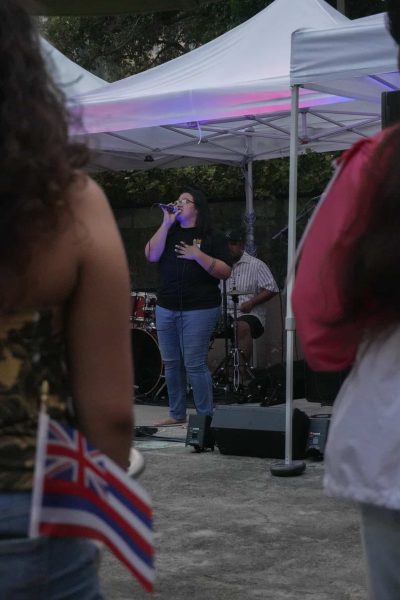
The sound of mele filled Mānoa Gardens as students, families, and community members gathered under the afternoon sun to celebrate Lā Kūʻokoʻa, Hawaiian Independence Day. What began as a casual campus concert quickly transformed into a vibrant space of connection, learning, and cultural pride where even passersby found themselves swept into the energy of the crowd.
(Kye Kukahiko)
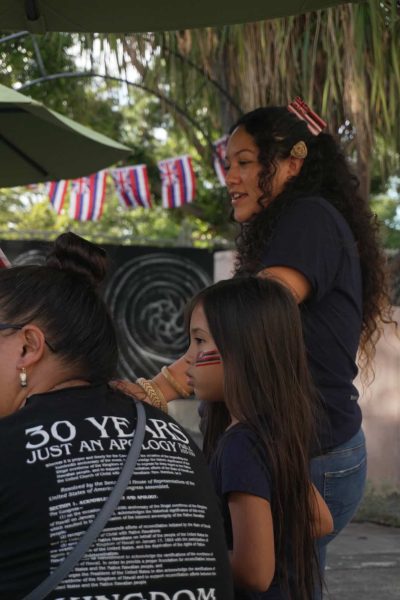
Since 1843, Lā Kūʻokoʻa has been celebrated for generations across the Hawaiian Kingdom as a day of national pride and sovereignty. Nearly 180 years later, that legacy lived on at UH Mānoa, where many gathered for a campus celebration filled with live music, Hawaiian trivia, and community fellowship.
On November 21, Native Hawaiian Student Services coordinated a concert in the Manoa Gardens honoring Lā Kūʻokoʻa in partnership with Associated Students of the University of Hawaiʻi at Mānoa. This year’s celebration marked a decade of efforts by NHSS to honor Lā Kūʻokoʻa through music, education, and collective engagement. Organizers hoped not only to celebrate independence, but to cultivate a space where Hawaiians and allies alike could feel welcomed, informed, and connected.
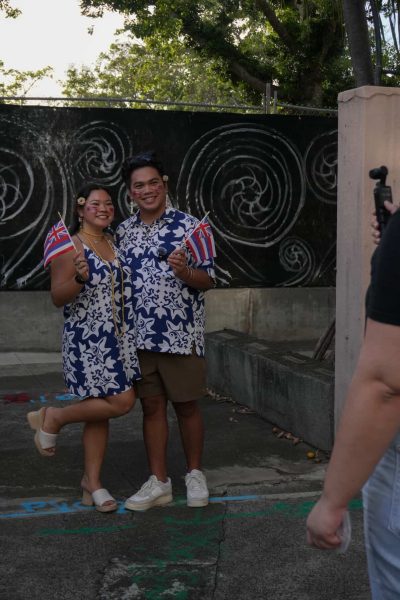
The courtyard was bustling with activity, marked by a stream of Hawaiian flags draped across the entrance and tiny flags placed at every table, free for anyone to wave as the music began. A wide range of people filled the space–young children, UH Mānoa students, alumni, families, and community members, all gathering under the same sense of celebration. Visitors were greeted by volunteers offering Hawaiian flag tattoos, stickers, and small pieces of Lā Kūʻokoʻa merch at a NHSS booth before signing in, creating an atmosphere of festivity and belonging.
(Kye Kukahiko)
For many, the environment felt immediately welcoming. Lauren U’ilani Vierra, a junior attending her first semester at UH Mānoa after transferring from community college, said she felt drawn in by the sense of familiarity and support around her.
“I knew that there were going to be a lot of people likeminded to me attending so it would be a safe, cozy vibe. It was such a good time,” Vierra said. “Everyone felt so comfortable. It was a smaller area but there was tons of community there. So inviting, people were great to dance with.”
As Kuulei Music and Ikaakamai opened the show, the crowd slowly eased out of their shells into dancing, eventually gathering in small groups throughout the venue. The atmosphere only grew more energetic as NHSS presented an educational game of Hawaiian trivia for the night, where attendees could race to answer the question and win a prize. Kalawaiʻa Nunies, the research center and program assistant for NHSS, was one of the leading organizers for this event. He made clear that intentional, education-driven programming carried out at events such as these is central to NHSS’s mission.
“We wanted people to understand why NHSS’s programming is so important and we thought about how we could incorporate education into the concert,” Nunies said. “What I found really neat about trivia this year was that there were a lot of keiki that answered the questions, and to me that just shows that the next generations are getting more educated about our histories. It makes me super happy to know we are a part of that.”
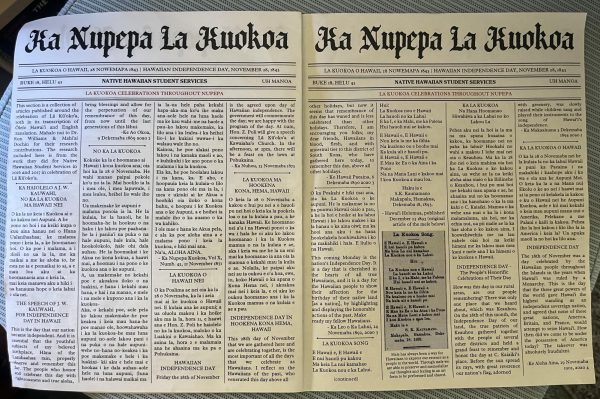
Extending that focus on learning, NHSS also revived the spirit of historical Hawaiian print culture by creating an old-style, Hawaiian-themed newspaper in preparation for Lā Kūʻokoʻa. The paper offered students a compact but information-filled overview of La Kuʻokoʻa’s history. Inside, readers found a timeline tracing the holiday’s first recognition in 1843 and other major dates, summaries of international treaties affirming Hawaiʻi’s sovereignty, and brief profiles of influential figures who shaped the kingdom’s diplomatic legacy.
Afterward, Sudden Rush shifted the vibe entirely, drawing nearly everyone to their feet with their blend of hiphop/rap and Hawaiian themes. The excitement peaked when Big Island-based band Kanaka Fyah made a surprise appearance, ending with a performance of the iconic “Only Jah Jah Knows,” sending a ripple of cheers across the space.
For Vierra, moments like these highlighted why the event mattered beyond entertainment. Coming from a campus with “a lot less in-person community aspects,” she said the concert helped her feel more connected at UH.
“I think I have an interesting point of view coming from community college, so this was a great opportunity for me to become more familiarized with people in spaces that I wouldn’t have normally inhabited. For people who are not super in the loop, this is a great chance for them,” Vierra said.
She added that seeing well-known artists up close as well as important student figures at school also made the cultural experience feel more accessible.
“There were pretty big names over there, and it shows that these people are also just like you. It fosters a lot of curiosity, especially for people who are diaspora or locals who might not have had these opportunities before,” Vierra said.
Behind the Scenes
Experiences like these did not happen by accident. They were the result of thoughtful planning by NHSS and ASUH, the two groups that brought the Lā Kūʻokoʻa celebration to life. Both NHSS and ASUH approached the Lā Kūʻokoʻa celebration with many shared purposes.
Hosting the Lā Kūʻokoʻa celebration is not just an annual tradition for NHSS; it is an act of community-building grounded in education and historical continuity. Nunies explained that this year marked a full decade of NHSS organizing Lā Kūʻokoʻa events, a mission shaped by their commitment to Native Hawaiians.
“One of our main goals is to give opportunities for Hawaiians to come together and celebrate,” Nunies said, noting that the celebration is meant not only for Hawaiian students but also for supporters and the wider community.
Visibility was also central to NHSS’s Vision. Hosting the concert in Mānoa Gardens, one of the campus’s most public spaces, allows NHSS to “hold space for Hawaiians on campus” in an empowering way, according to Nunies.
“You would think living in Hawaii, this must be a native Hawaiian place of learning but sometimes there are challenges with holding space. Being able to do so in such a public area like Manoa gardens felt nice to remind people that they are on Hawaiian lands at the end of the day,” Nunies said.
Nunies explained that this matters deeply in a university where many Native Hawaiian students may feel isolated or underrepresented.
“It can be super intimidating for many Hawaiians because generally, there’s not a lot of us on campus, but creating that avenue for Hawaiians to see what campus life can look like encourages people to return to school and get involved,” he said. “These events are really powerful in that way. The basic principle of fitting in, being able to find that group and belong is a very big deal, especially for students trying to navigate college.”
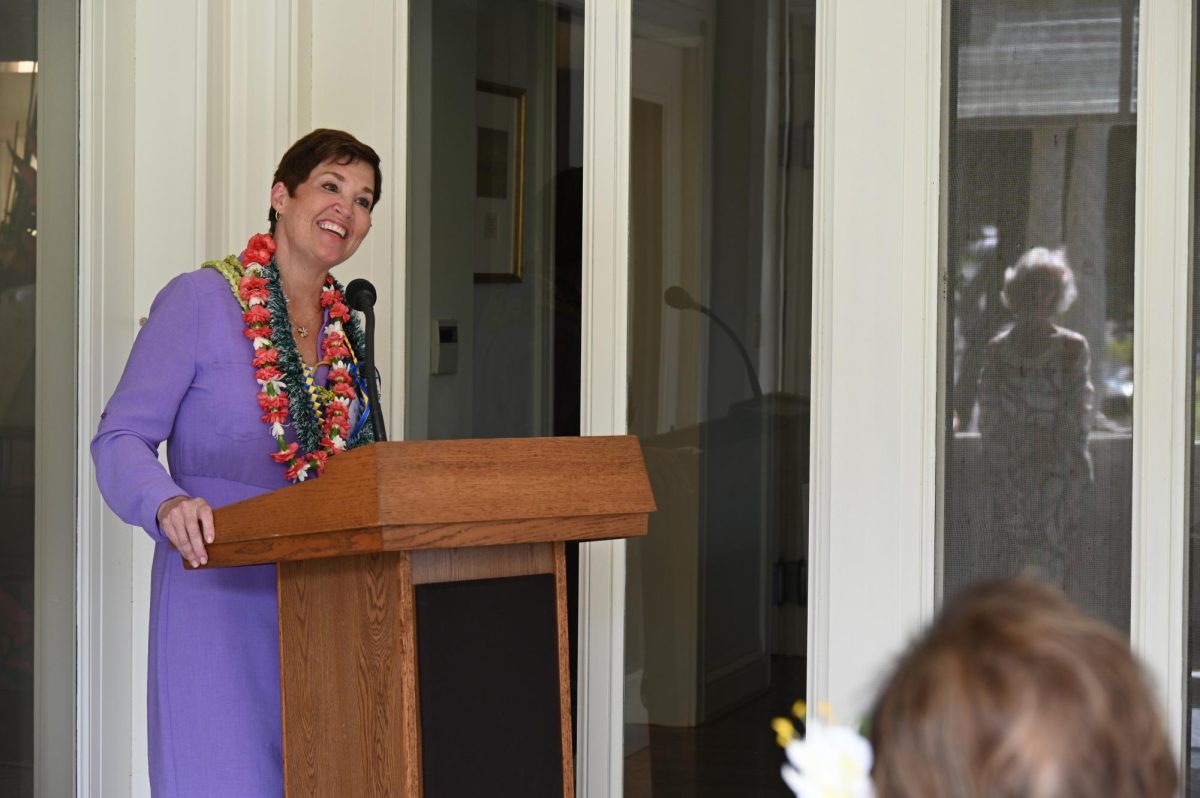
Leading ASUH’s contribution was President Hema Kealohanuikaiama Watson, whose leadership has been instrumental in supporting this event for the past three years, if not longer. For him and ASUH, supporting the event is both a cultural responsibility and a political statement. Watson explained why supporting Lā Kūʻokoʻa is a priority for ASUH.
“We do this because simply, we believe in Lā Kūʻokoʻa,” Watson said. “We understand that Hawaii is a sovereign nation and that recognizing the Independence day of the Hawaiian kingdom is essential to perpetuating that truth. Giving the students an event where they can enjoy themselves, hear good music from local artists, and celebrate Lā Kūʻokoʻa is a part of that.”
Hema Watson explained that backing events such as the Lā Kūʻokoʻa concert and the recent Red Hill Forum is a crucial way for ASUH to demonstrate its stance as a student government. He said that without making clear statements through their funding decisions, ASUH wouldn’t be fulfilling its purpose.
“Supporting these events allows the organization to promote our opinions and express our emotions and beliefs within our funds,” Watson said.
ASUH acted as sponsor to the event, providing the funding and logistical support needed to bring the lineup of local artists to campus, ensuring the celebration could be enjoyed by as many students as possible.
“When ASUH funds these kinds of events like Lā Kūʻokoʻa, it means we value them. We show that we care about them, that they are important,” Watson said.
Both organizers acknowledged the challenges that come with producing an event such as this– particularly costs and concerns about turnout–but this year exceeded expectations, with an estimated 200 attendees filling the courtyard throughout the afternoon. Both Nunies and Watson agreed that the goals put in place for the event were hit spot on.
“We had a great lineup, Ikaakamai, Kuulei Music, Sudden Rush and even a surprise appearance from Kanaka Fyah. ASUH feels that we met all the goals that we set out for, we had a great performance, a large attendance and it was enjoyed by everyone there,” Watson said.
Kuulei Kanahele, known in the music world as Kuulei Music, carried out a set that blended cultural homage with contemporary resonance and shaped the atmosphere of the concert. For Kuulei, the performance carried a much deeper purpose. She said she felt grateful to participate in this event, noting that celebrations across Hawaiʻi, from institutions to families and individuals, reflect a growing collective effort to reclaim and honor Lā Kūʻokoʻa.
Her gratitude was closely tied to the purpose behind her performance. Performing for Kuulei is part of a larger movement, to honor and revive traditions rooted in mele aloha ʻāina.
“The songs that we selected for this event were Mele Aloha ʻĀina – songs of our love for this land and her people. Ikaakamai and I both are part of a long legacy of musicians who write the soundtrack of the revitalization of our cultural consciousness,” Kanahele said. “Many of the songs we sang this year are 130+ years old; they were written and published in old Hawaiian Language newspapers that are now preserved through new melodies and meaning for this time.”
Kuulei shares about her broader responsibility as an artist.
“Being able to perform these songs really is a fulfillment of my function to uplift, educate, and inspire the next generation through music,” she said. “Seeing young people sing and dance along to these songs of resilience is a living representation of our national identity and collective brilliance. The crowd’s enthusiasm reinforced that purpose.”
Kuulei also connected her performances to Hawaiian wellbeing more broadly. She shared about Dr. Keaweʻaimoku Kaholokulaʻs “Pou Kihi Framework” which expresses that Native Hawaiian Health is grounded in four foundational pillars. One of which is Ke Ao ʻŌiwi, or Native Hawaiian Space, where Hawaiians feel safe to be Hawaiian in Hawaiʻi.
“When we mainstream cultural preservation, we normalize the mass celebration of Hawaiian holidays, and uplift our hearts in joy for the brilliance of our kūpuna, it is an indicator of our holistic wellbeing as a community at large,” she said.
“Beyond music, Lā Kūʻokoʻa 2025 has been a call to action for us to remember the ways that Hawaiʻi is different from the rest of the world; our priorities are aloha for our ʻāina and for our people, not greed, not materialism, not capital gain,” she said. “Like Timoteo Haʻalilio and the delegates that were sent out to secure the international recognition of our sovereignty, we are called to take up a position of service to continue to care for each other now and forever more; that is what it means to kū ʻokoʻa.”
Reflecting on Legacy
While the UH Mānoa celebration was lively and full of music and movement, the event carried a significance that extended well beyond the courtyard. 30 years after Britain and France formally recognized the Hawaiian Kingdom as an independent nation in 1873, the holiday had already grown into one of the Kingdom’s most widely celebrated national occasions, marked by flag ceremonies, school programs, mele aloha ʻāina printed in newspapers, and community gatherings and festivals that affirmed Hawaiʻi’s political strength and shared identity. According to Nunies, NHSS builds its programming around historical research, ensuring that every event they put forward reflects ways Hawaiians have interacted or celebrated in the past.
“When we look into our histories of how Lā Kūʻokoʻa was celebrated, the example we pulled for this event is from 1873, which was the 30th year of Lā Kūʻokoʻa being celebrated. They had a concert-like celebration at the Hawaiian hotel as well,” Nunies said. “These things are not new to us, it was very Hawaiian to come together and celebrate with mele.”
In these ways, UH Mānoa’s Lā Kūʻokoʻa celebration becomes more than a single afternoon of festivities; it becomes a link in a long chain of remembrance.
“I think events like this contribute greatly to recognizing the sovereignty of the Hawaiian nation and the culture of Hawaii. Having these events allows students to engage with the culture and with the history of Hawaii in a way that sometimes would be difficult to do in a classroom setting,” Watson said. “A lot of students can feel uncomfortable or threatened or even feel it is not as interesting, but when we are able to have musicians come in and play and honor these histories, then people can become more inquisitive on their own and allow themselves to learn the histories that they might not have otherwise tried to.”
Looking forward, organizers and attendees alike reflected on what this celebration meant to them and what it could grow into. For Native Hawaiian Student Services, the hope is that Lā Kūʻokoʻa at UH Mānoa continues to evolve into an even more visible and collaborative annual tradition. Nunies said that valuable events like this can be for community members searching for accessible ways to connect with their Hawaiian identity.
“It can be so challenging at times for community members to find ways to participate in their Hawaiian identity, and events like these are an amazing first step for them,” Nunies said. “It’s an eye opener, you get to meet other people who have experienced those same kinds of things, build connections, friendships, etc.”
Nunies hopes for broader institutional support and increased partnerships to expand the event’s reach. “Maybe this is something the university could look at… with its support, it could solidify the celebration’s place in actual programming throughout the year,” he said.
More collaborations, he added, would allow NHSS to grow the level and quality of programming offered.
Students share that sense of momentum. Vierra said she would “be down to go to anything like this in the future.” For her, events like Lā Kūʻokoʻa matter because they give students space to relax, learn, and find belonging, an aspect of campus life she believes is easy to forget but very needed.
“NHSS managed to hit two different angles, fostering education and making it fun and all around engaging,” Vierra said.
ASUH President Hema Watson echoed this forward-looking vision. He expressed hope that future student governments continue to champion Lā Kūʻokoʻa and invest in its growth.
“I hope we can continue to have these concerts every single year,” he said.
While he believes the event already “does amazing” work, he envisions opportunities for expansion, from more giveaways and merchandise to additional activities and interactive elements that spark student interest and pride.
Ultimately, the Lā Kūʻokoʻa celebration at UH Mānoa did more than bring people together for an afternoon of music–it reaffirmed a living legacy.
“I really hope this encourages people to come out to more Hawaiian events,” Nunies said. The day’s energy and collective pride suggest that many will.