
The clock strikes 12:56 p.m. as you pull into one of the last open stalls near Kennedy Theatre. It’s the closest lot to your building, and you’re already running late for your 1 p.m. class. You quickly pay for 30 minutes of parking through the JustPark app and rush off, hoping to extend your session once you’re settled.
But when you try, an error message flashes across your screen: “Unable to extend session.” You cross your fingers, praying there isn’t a little green ticket waiting under your wiper when class ends, but there it is. Another $40 gone, money that could’ve gone toward textbooks or tuition. For many UH students, this isn’t just bad luck, it’s a daily struggle in the ongoing parking crisis on campus.
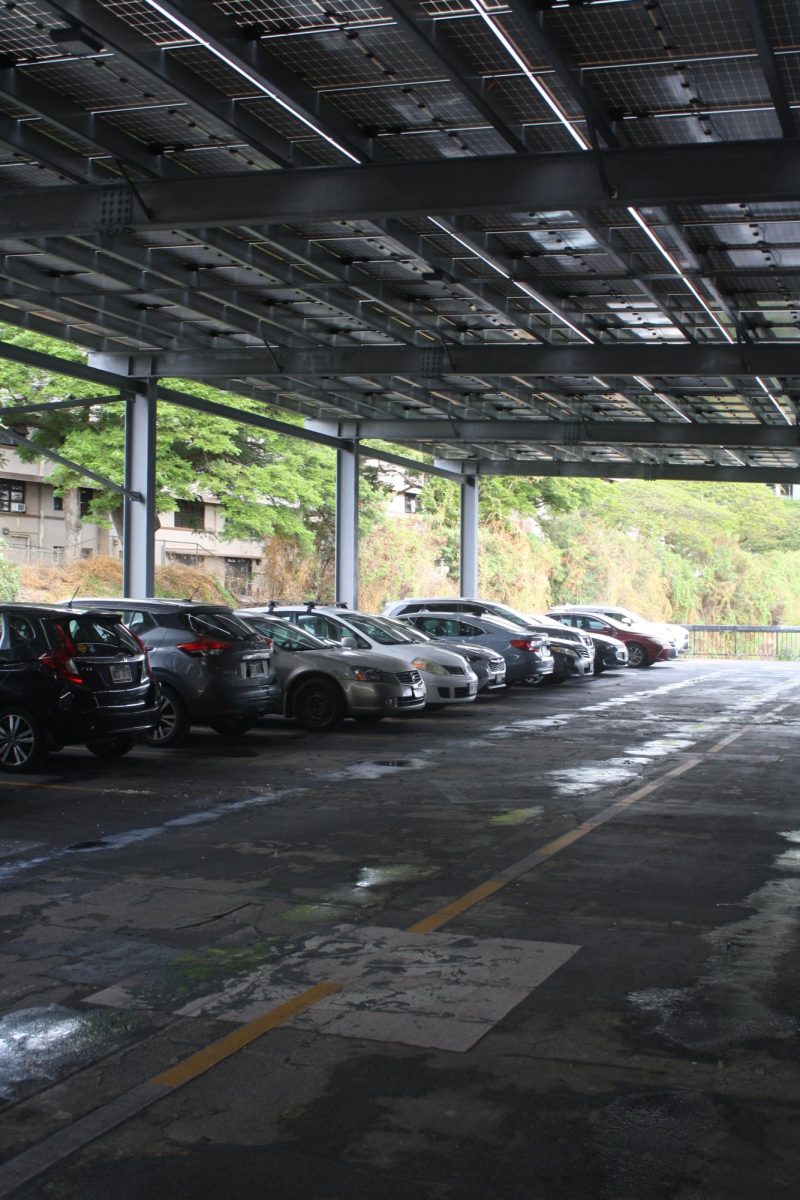
Parking has been a problem at the University of Hawaiʻi at Mānoa for decades. According to the commuter services website, UH Mānoa welcomes nearly 25,000 faculty, students, and staff, as well as visitors to campus everyday. However, there is a very limited inventory of 5,000 parking stalls across the campus. Here, around 80% of students live off campus, making commuting a daily reality for a giant portion of the student body.
Despite new technology and rising parking fees, students and staff continue to face the same struggles, limited availability, high costs, and unreliable tools meant to help. As the university’s population has grown, its parking capacity has remained nearly the same. This mismatch has led to increasing frustration, especially as permit costs continue to rise from around $300 per semester a decade ago to $400–$500 today. The university states that these fees fund maintenance and modernization efforts, yet many students say they’ve seen little improvement in stall availability or structure conditions.
In November, the Mānoa Mirror newsroom conducted a survey to hear how students feel about campus parking. The survey was used to gain more insight on the frustration levels of commuters when it comes to factors such as parking prices, parking availability, effects on student lives, and grievances with the JustPark app.
Respondents responded that they are extremely overwhelmed because of the issue of parking at UH.
“There are so many commuters and never enough spots. Some days the structure closes before 8:30 a.m. I shouldn’t have to get to school at 6 a.m. for a 10:30 a.m. class just to have a chance at parking,” one UH commuter said. “Driving should make getting to school easier, but parking is honestly the most stressful part of being a UH student. Even with a pass, I give myself 20 extra minutes because I know I’ll struggle to find a stall.”
The problem isn’t new. UH Mānoa’s campus layout dates back to the 1960s, when the university underwent major expansion but was never designed to accommodate today’s volume of vehicles. As the campus grew academically and residentially, parking infrastructure failed to keep pace. What was once a minor inconvenience has evolved into a defining aspect of UH Mānoa’s commuter experience, one that continues to challenge students and administrators at seeking a sustainable balance between access and affordability.
JustPark: Convenience or Complication?
JustPark, a newer app used by students and staff since 2023, lets drivers pay for, extend, and manage parking sessions quickly and conveniently. Users download the app, enter a location-ID (or enable location services), select their parking duration, register their license plate, and complete payment, all through their smartphone. On campuses like this one, the app replaces traditional pay stations in certain visitor lots and supports cashless, contact-free transactions for more efficient parking. This partnership between UH and JustPark started out as a three-year contract as a way for UH to replace the paystations with modern technology, according to the Manoa Mirror.
According to Brent Suyama, spokesperson for UH Mānoa Commuter Services, JustPark was introduced to “reduce the amount of manual processing our staff must handle and provide accurate, time-stamped transaction data.” The app is fully integrated with UH’s internal parking systems, letting staff verify payments in real time by matching license plates and zone information. It was also designed to improve the user experience by offering multiple payment methods via app, phone, or web, along with expiration reminders and digital receipts.
However, many students report persistent frustrations with the system. Some say that extending their parking sessions often triggers app errors, resulting in avoidable tickets.
Brooke Reed, a junior double majoring in business management and marketing, explained that parking becomes extremely costly when she’s on campus for a full day which is often a reality for her. She said the system won’t allow her to pay for more than three hours at a time, and once that limit is reached, she has to wait before extending her session. During that forced waiting period, she’s received multiple tickets, despite having no control over the situation.
“The JustPark app is better than the paystations, but it is still crazy expensive and a lot of students cannot even afford to park on campus because of the fees and the tickets,” Reed said.
Suyama acknowledged these challenges, explaining that the most common issues come from incomplete transactions or incorrect license plate entries. “When this happens, our team reviews the transaction manually and works with JustPark to verify or correct the information,” he said.
Unfortunately, this has not been enough to fully deal with the issues the JustPark app causes.
“The JustPark app is supposed to make things easier, but half the time it glitches when I’m trying to extend my session,” a UH commuter answered in the survey. “The JustPark app took my money, glitched, and I still got a ticket. I didn’t have time to stay and wait because I had class.”
Despite these bumps, UH is working with JustPark to improve reliability and communication between the app and UH’s internal systems. Upcoming updates are expected to include clearer zone information, better messaging for failed payments, and interface improvements. As Suyama notes, mobile parking systems like JustPark are “the type of program that most motorists are familiar with and use out and about,” but their success ultimately depends on how well they serve the students who rely on them daily.
“Many users appreciate the convenience, and we also monitor feedback from users via email, telephone, and appeals who experience challenges so we can work toward improvements,” Suyama said.
Rising Costs: Paying More for Less
Parking costs at UH Mānoa have steadily increased over the past six years for students, employees, and moped users alike. According to UH Commuter Services, student semester permits rose from $166 in 2019–2020 to $234 in 2024–2025, a 41% increase. Employee surface lot permits climbed even more sharply, from $750 to $1,299, a nearly 73% jump over the same period. Even moped and motorcycle permits saw consistent hikes, with student moped passes increasing from $40 to $75 per semester.
Afternoon permits, once a more affordable alternative, have also gone up, from $32 to $52 per month. UH officials say these increases are necessary to fund maintenance, operations, and repairs to aging parking structures. However, many students argue that despite higher costs, parking availability and convenience have not improved, leaving them paying more for the same limited access.
“Commuter Services feels more like a profit center rather than a service. That’s where the priorities seem to be, not with students,” a UH commuter responded. “They understand parking is a problem, but they make money from it, so nothing really changes. Parking has already cost me so much: tickets, fees, and daily passes add up fast.”
Cathleen “Cate” Matsushima, Daily Operations Manager for UH Mānoa Commuter Services, oversees the day-to-day management of parking operations on campus. She explains that Commuter Services operates as a self-sustaining auxiliary enterprise, meaning it does not receive tuition or state funds.
“UH Mānoa Commuter Services does not ‘make money,’” Matsushima clarified. “All revenue collected goes directly back into supporting commuter services, including funding staff positions, paying outside vendors, and maintaining and operating parking facilities.”
This funding model shapes how parking resources are prioritized. Matsushima shared that employee parking permits are open to all staff, while student permits are assigned based on class standing, giving graduate students and seniors priority due to limited space.
“This approach is designed to ensure that those who are further along in their academic programs and often have more on-campus responsibilities, have greater access to parking,” Matsushima said.
Even so, many commuter students have felt a lack of prioritization from the UH administration and Commuter Services, emphasizing that having a vehicle is something that should enable students to have an easier time getting to their classes, which is of utmost importance for their education and should be a number one priority for UH.
And yet for many, it has become a barrier with numerous negative impacts on student lives, affecting their personal lives and even their education.
“I have to wake up at 4 a.m. every day just to beat the traffic and guarantee a spot. My entire day is planned around parking. I lose sleep just trying to avoid getting turned away,” one survey respondent said. “I’ve actually skipped class because I couldn’t find parking, even after leaving two hours early.”
“Some days I just stop going to school because the frustration isn’t worth it,” another survey respondent said.
Reed also testified to the inconvenience of the current parking system, asserting that a lot of the time, you cannot really control when your classes are or what classes you’re able to register for, and it’s just so frustrating when you have to drive around for 30 minutes to find parking.
“It has definitely affected my attendance, my grades so on and so forth during my schooling at UH,” Reed said.
What UH Is Doing to Address the Parking Shortage vs. What Students Say Needs to Change
To address current challenges, Commuter Services has introduced new initiatives, including discounted afternoon parking passes and additional student stalls in Mānoa Valley. Matsushima offered some alternatives, stating that students can also park in outlying zones such as the Dole Street Structure and Institute for Astronomy lots, with free shuttle transportation to the main campus.
“Commuter Services is always looking at alternatives. They added the parking in Mānoa Valley this semester as well as the afternoon passes that allow students to buy into a lower priced pass for noon and on as parking is available in the structure,” Matsushima said. “Student permits are available in Zone 25 (Institute for Astronomy by Noelani Elementary School) and Zone 22 (Dole Street Structure between Hawainuiākea and Kanawai Park) and the free rainbow shuttle provides transportation from these locations to the main campus.”
Looking forward, UH Mānoa has proposed a new 1,500-stall parking structure near the Center for Korean Studies, though construction depends on future state funding. Matsushima also emphasized that UH’s broader sustainability goals play a major role in decision-making. The university continues to promote alternatives like car-sharing, the Biki bike program, and expanded shuttle services to help minimize the environmental and community impact of campus transportation.
“This project remains a priority in the university’s long-term planning, and more information is available on page 49 of the UH Mānoa 6-Year Capital Improvement Projects Plan,” Matsushima said.
According to Matsushima, parking used to be even more difficult than it is today. For years, Matsushima said, the Lower Campus Parking Structure filled up before 8 a.m., forcing students to arrive extremely early just to find a stall and now, the structure usually reaches capacity closer to 10 a.m. Those shutdown windows shrink as time goes on.
“This was accomplished by changing the daily operation practice by utilizing a team to manage the structure like an event. It becomes full generally from 9:30 a.m. to 11 a.m,” Matsushima said. “Our goal is to ensure we make every stall count.”
While UH highlights both recent improvements and long-term strategies, student perspectives offer important context about how these changes are actually being experienced in real time. For many commuters, parking remains one of the most taxing parts of attending UH Mānoa. Survey responses show that students still struggle with long search times, early-morning arrivals, and rising costs.
They’ve offered their own suggestions on how the university could better address the issue.
“I feel like we should not even have to pay for parking if we are already paying thousands for tuition. It’s ridiculous,” Reed said.
“They should at least make it easier for us by allowing us to pay for however many hours we need straight up.”
Many of the proposed solutions by student respondents centered on affordability and fairness:
“Cheaper semester rates and longer time for the money we spend on JustPark. $3 shouldn’t only cover 30 minutes.”
“Parking shouldn’t make students go broke. Even $2 a day would be more reasonable.”
Students also suggested better integration with public transit to ease demand on the lower campus structure:
“Promote the bus more, and expand the U-Pass to the community colleges. Or, if the rail actually reached UH, that would also solve half the problem.”
Others pushed for park-and-ride alternatives:
“Build a parking area near a bus line. Lots of us would park there and ride in.”
Some students argued UH should rethink its development priorities entirely, especially when it comes to balancing dorm expansion with commuter needs. More parking structures instead of new dorms, one student respondent said, would offer more support for local students who commute rather than mainland students that romanticize life in Hawai’i staying in dorms.
As one student put it: “They prioritize where they get the money from – so pilaū.”
“If UH wants students to succeed, it has to start with helping us show up.”