
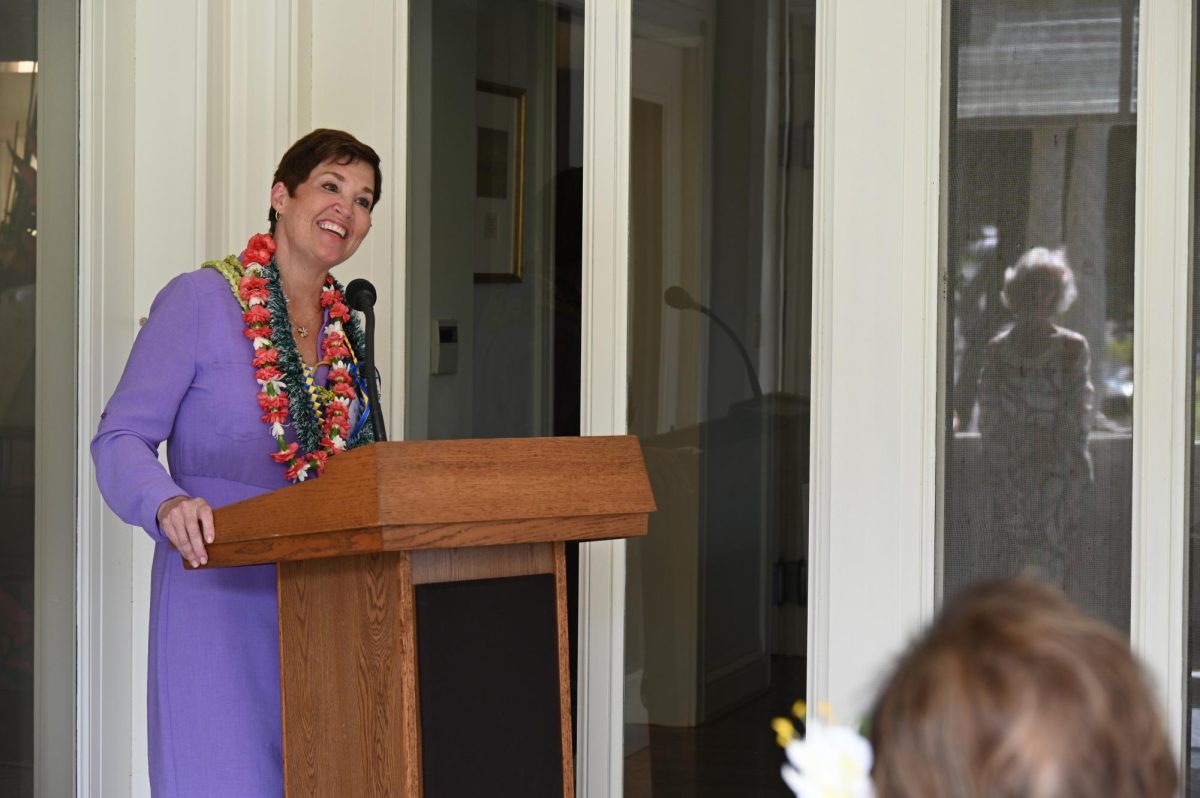
About two dozen Mānoa Valley community stakeholders gathered at College Hill on May 27 for a welcome reception honoring Wendy Hensel, just over a year into her tenure as the 16th president of the University of Hawaiʻi system. The event, hosted by the nonprofit Mālama Mānoa, was framed as a community welcome. By the end of the afternoon, it had also become a working conversation about the building they were standing in.
Linda Legrande, who sits on the board of directors at Mālama Mānoa, opened the reception with a brief history of the nonprofit. Founded in January 1992 by Mary Cooke and Helen Nakano, Mālama Mānoa now counts roughly 4,000 members and has spent more than three decades documenting the valley’s historic homes, leading stream cleanings, and cultivating the working relationships with the university that brought Hensel to the porch that afternoon.
Over the course of about 40 minutes of remarks and Q&A, attendees raised issues that have long defined the relationship between the valley and the university.
Then, as expected, the conversation turned to College Hill itself, an estate with an undecided future
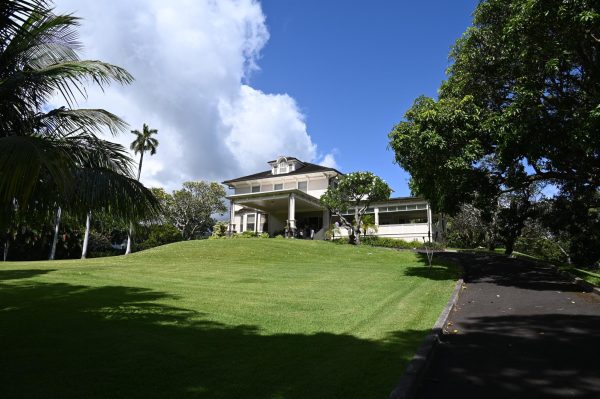
The house was built in 1902 by Frank C. Atherton, a Castle & Cooke executive, and his wife Eleanore. Designed by architect Walter E. Pinkham, the 16-room residence sits on a 2.6-acre property in Mānoa, on land originally part of Punahou School’s holdings — the source of the College Hill name. After 60 years as the Atherton family home, the heirs donated the property to the University of Hawaiʻi in 1963 to serve as the UH president’s residence. It was added to the National Register of Historic Places in 2002 as well as in the Hawaiʻi State Register.
Hensel was candid about how preliminary the conversation around the building’s future was. “Honestly, we’re in the pure idea generation phase and haven’t gone much beyond that,” she said. “In part because a year in is not very much time.”
She also confirmed something the room sounded surprised about: she does not live at College Hill. “It actually was not offered as part of my employment,” Hensel said, “in part because the rest of this lovely area of the house is in serious need of investment and renovation.”
Hensel laid out two directions the early conversations have taken, without committing to any of them. One was to renovate College Hill as a dedicated event space, “something like we are having today, but becomes much more of a venue for events that can hold larger crowds,” she said. A second was to restore it as a functioning president’s residence.
She added that the conversation was open to new ideas. She named two limits on any decision. The building must remain part of the university, she said, and any changes must respect the surrounding neighborhood.
“We are sitting right in the middle of many of your backyards, and it cannot be a destructive thing,” Hensel said. “Those conversations must happen and will not go forward without significant additional conversation.”
College Hill has served as the official residence of UH presidents since the 1960s, and it sits within walking distance of most of the homes Mālama Mānoa was founded to protect. Legrande noted in her opening remarks that the valley contains more historic homes than anywhere else in Hawaiʻi, and that the relationship between the building and the neighborhood has long been a working one — the university’s emblem was once mowed into the front lawn, and the UH flag flew from the porte-cochère.
Piʻikea Miller, the first vice president of Mālama Mānoa, said in a written response that the board had not formally discussed all the questions raised at the reception but that she could share her perspective based on extensive board conversations.
For Mālama Mānoa, Miller said, the priority is preservation. “We would like to see College Hill maintained as an important historic feature of the community,” she wrote. “Whether it’s used as an event space or a residence is really up to UH.”
She placed the building within the wider mission the organization was founded to carry forward. Many of Mānoa’s historic homes have been lost to development over the years, she said — “an irreplaceable part of Mānoa’s history” that contributes greatly to the special nature of the valley. Few communities on Oʻahu, she noted, have Mānoa’s density of historic homes.
“College Hill is a very visible and significant part of this historic legacy,” Miller wrote. “And it’s not just the home — it’s also the grounds and beautiful landscaping. To lose College Hill would be heartbreaking for Mānoa.”
Hensel told the room that any decision about College Hill would not move forward without continued community conversation and repeatedly invited Mānoa stakeholders to bring ideas forward now, while the discussion is genuinely open. “If you all have ideas, we’re going to start having the conversation more openly,” she said.
Miller said Mālama Mānoa has seen effective community input take the form of town halls or online surveys.
Any material change to College Hill’s use would ultimately require approval by the UH Board of Regents through its Committee on Planning and Facilities, the body that approves the university’s capital plans. That body has not been asked to consider College Hill.
Dan Meisenzahl, the University of Hawaiʻi spokesperson and director of UH Communications, said that the building is not in the university’s current capital priorities. “At this time, there are no plans to invest in College Hill or change its current use,” Meisenzahl said. “The property is maintained in good condition as a ‘showpiece,’ but it would require significant investment to renovate it for modern living as a residence.”
The Board of Regents approved the university’s current six-year Capital Improvement Project plan in November 2022. The plan, which runs from fiscal year 2024 through fiscal year 2029, allocates roughly $1.85 billion systemwide, with $985 million earmarked for UH Mānoa. The bulk of the Mānoa funding is requested for student-facing facilities: the renovation of Sinclair Library into a new Student Success Center, for which $41 million was appropriated in FY20; a roughly $50 million renovation of Kuykendall Hall, one of the campus’s top five classroom buildings; the Snyder Hall replacement; and a $78 million Central Administration Facility and parking structure at the intersection of East-West Road and Maile Way, planned in conjunction with the Hawaiʻi State Department of Transportation to ease morning rush hour traffic.
Meisenzahl said the university’s current focus is on the student experience and on high-use student buildings. He also noted that UH Mānoa is now working toward additional student housing beyond what the November 2022 plan reflects, although specifics have not been publicly released.
For Mālama Mānoa, the welcome reception was framed throughout as the beginning of a working relationship more than a ceremonial moment. Miller acknowledged the spirit in which Hensel had engaged with the community. “We’re grateful to President Hensel for her willingness to engage with the community, and her commitment to maintaining College Hill for the future,” she wrote.
Hensel ended the afternoon at College Hill with an offer that applies as much to UH community members as to the neighbors she was addressing. “I read every email that you send me,” she said. “It may not be immediate, it may take me up to a week or so, but I read all of them personally. We want to know what you’re thinking.”
For students at UH Mānoa, whose campus borders the property and whose tuition and fees flow into the same institution making these decisions, the building’s future may be a small question in the wider picture of where UH puts its money over the next six years. But it is one of the few questions the university is still genuinely open about. The conversation, Hensel said, will continue.