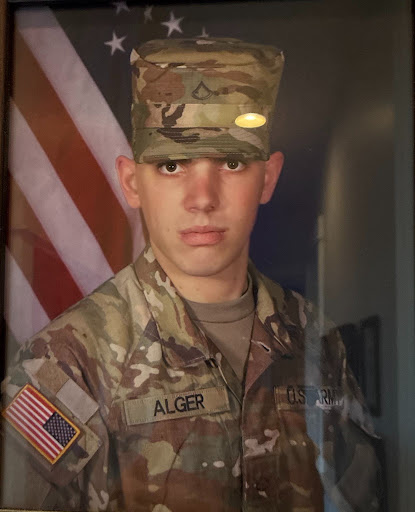
I am just about to finish my first year of college at the University of Hawai‘i at Mānoa, but I am not a typical freshman on campus.
I had to go back home and live with my parents after my honorable medical discharge from the United States Army after suffering a traumatic brain injury (TBI) and a major injury in my lower back, legs, and feet. Being medically discharged from the military after my accident wasn’t easy. Adjusting to living with your parents and feeling like you’re returning to your childhood isn’t a feeling I wanted to return to as an adult, especially after my service. It felt isolating and confined like I had never been there before. I felt like a ghost just floating around trying not to be confronted or recognized.
I enlisted and went off to basic training and advanced individual training, “AIT,” in 2021. I was part of a community and lived with other people who knew exactly what I was enduring. I lived, worked, and went through hardships with friends that became family.
At 22 years old, I never imagined that I would be given no other option. Navigating the transition back to civilian life and figuring out my new life with my injury was difficult. I had to spend nine weeks in a wheelchair with a boot on my right foot and a cast on my left foot. I had to move my bedroom to the first floor because I could not get upstairs, learn how to transfer in and out of a wheelchair, and adjust to living in pain.
I found myself sleeping through the day and staying up all night with friends. I was barely able to function and didn’t start looking for a job or school while focused on my VA claim appointments that would help to improve my disability rating.
Disability ratings are a percentage given to individuals that acquire service-connected injuries during the time of service. In my case, I had a broken lower back, both legs and both feet broken, in addition to a Traumatic Brain Injury (TBI) that I continue to manage from my time in the service.
Around my discharge, in February of 2023, I felt like I didn’t have much support from the Army. I thought that my parents, family, and friends didn’t understand what I was going through, physically or mentally. I struggle making friends as I am more closed off from sharing my past experiences, making me push them away even farther.
It led to many nights wondering if I made the right decision to come back home. Sometimes I wished I could go back in the Army as it gave me structure and purpose. I had something new to do everyday as a mechanic and also with other experiences like traveling the world and getting to make new experiences.
Something changed when I moved to Monterey, California, in September of 2023. While living in Monterey I felt like I was able to find myself, being able to go outside and enjoy the nature, or communicate with other local veterans or even car enthusiasts, as that was one reason I moved to Monterey. It was extremely big on the car culture, and that made me feel connected because of my past being a mechanic for the Army.
I fell in love with the views of the ocean and adored the car culture and being close to family. The ocean was an outlet for me to go and be at peace, clearing my head, and connect with nature during difficult times after the service. It felt like an escape from reality, not having to worry about a single worry in the world. I enjoyed that I was able to live on my own and focus on my life while still being able to go visit my family if I wanted. Knowing that they were close gave me the courage to be able to stand on my own two feet again and have structure and purpose for myself.
That love for the beach brought me to Hawai‘i, to start college, to study computer engineering, and to try to reorient my life to a future I could believe in.
I needed a change as I felt trapped and isolated being back home with my parents. I became connected with the Veteran Affairs Office, which helped me join therapies and groups that would get me outside. I was able to talk with other individuals that understood what I was through. The support system I found through the VA consisted of veterans and civilians that were familiar with the military structure. This helped because it made me more comfortable and open up to discuss what is currently going on in my life.
Through the VA, I was able to see a licensed doctor to go over the service-connected disabilities. These appointments can be difficult, because the doctors are evaluating every claim that was put in, while trying to determine the percentage to give for the disabilities that are being seen. I kept going to these appointments for about a month, trying to increase my rating by getting the most amount of percentage for all my disabilities. Getting a high rating is important, because that’s how monthly compensation is determined.
I eventually received a permanent and total disability rate of 100%, which meant I could never reenlist in the uniformed services again. This was hard as I had to come to terms that my military service is over. It felt like a big hole from my life has dissipated in the distance, leaving me with just memories that once gave me purpose, structure, and a clear path to follow.
That didn’t stop me from moving on to new goals in life. UH Mānoa stuck out to me mostly because it was new, and a path that I would be able to start a new life and new adventures. I never expected my path as a United States Army Soldier to come to an end, making me feel overwhelmed and stressed at the next new part of my life. It could either be to enter the workforce, or to go to college and get my degree.
I chose to join the United States Army to serve my country and feel like I had purpose in the world, while others went off to college to get their degrees. The Army gave me purpose by always having something to do whether it’s physical activities, ranges, or even just working in the motorpool. The structure of the military is like a steeping ladder, and while every gap in between the rungs is difficult, the very next rung could be a promotion or medal.
That got cut short by an incident during training that left me a disabled Veteran.
I still have trouble explaining my injury to professors, doctors, and even my family. It took time to adjust to the civilian lifestyle, I struggled with the habits that I learned in the military. Holding on to the structure in civilian life is difficult as it is more lenient and relaxed, making it easy to fall in a rut.
I got used to waking up at 4:30 a.m., staying alert at all times, and even feeling distant from civilians. These feelings have carried over into my college experience, making it harder to talk with classmates or adjust to the college environment.
While other young adults started college and began their lower-division courses, I was obtaining my education and skills for my career as a diesel mechanic. Since I am no longer active duty in the military, these skills are not useful anymore in my daily life.
When I moved to O‘ahu in March of 2024, it was strange to start again in a new place where I didn’t know anyone. I was living in Aiea in a house with four roommates who I met over Facebook who also served in the military. I tried to reenter the workforce by working for Porsche, Hawai‘i.
I decided I wanted to go back to school to eventually find myself in a career that I desire and ultimately feel useful and happy living life. This narrowed down my search for degrees, and computer engineering really sparked my interest.
On my first day of college I felt nervous and uncomfortable, and sitting in the classroom felt confusing and unfamiliar. I was used to the military where everything was structured and I knew the chain of command.
To me, school is different because it is individual, rather than a community, leaving me feeling confused about where I have to be or what I have to do. It made me feel like I should’ve put school off even more and focused on finding a job instead. It made me feel ashamed and like I failed again.
The decision to join the military and the workforce, rather than attending college, made me feel like I missed a lot with my education. Starting school with younger classmates makes me feel like I fell back and had to learn everything over again, like I was starting my freshman year of high school. I had to re-learn how to manage my time more effectively with juggling school and life. Trying to find proper times to study, asking for help, or communicating with classmates are difficult as well.
I would sit there quietly in class as others knew the answers right away, but I blanked and quickly rushed to answer the questions.
At first this made me very discouraged. When going to class in person, I feel alone and invisible, like a ghost to everyone else. It’s not because no one talks to me, but I feel like I have nothing in common with my peers, or that I’ll be looked at as weird for trying to join a conversation. I sit there, quietly and patiently, waiting for the professor to explain the lesson, and waiting to quickly get out of class as I do not like to be in crowded classrooms for too long.
As soon as I step out, I’m finally able to take a deep breath. When I inhale the fresh air, I feel relief.
Being a student veteran can be stressful at times due to the amount of course work. In the military, I was used to working in teams and solving problems together. Being a student means I have to solve each problem alone. This is difficult at times because I have to remember deadlines, turn in assignments, and do class activities as well. This becomes overwhelming as the structure from being in a team and leaning on each other is gone, although it has not stopped me from developing healthier studying habits, time management, and the confidence in myself.
This shift felt isolating. Without the built-in support system I had in the military, I’ve had to adapt and navigate challenges in a completely different way.
I feel that the college environment is strange to us veterans, because our previous lives will be frowned at, or looked down upon. This also is because being a disabled veteran can be taxing on the body, because I’m not just being looked at for who I am, but I’m being judged and misunderstood from being a disabled veteran at 25 years old. Not all veterans show signs of disabilities or injuries from the service, because it is uncomfortable to talk about.
As a veteran, I juggle time, classes, and appointments with the VA that can cause absences from class. This affects my stress levels, grades, and even how teachers perceive me. At times it can seem like I’m not fully committed, but I’m putting in the most effort I can.
It took me about a year to figure out and to ask for help. I reached out to the Kokua program for the UH campus. The Kokua program is a service for individuals that have a disability to be able to seek help and guidance through during the college experience.
Help from this program includes discussions about the necessities I need to be able to succeed in my classes every term. It can provide extra time to be able to focus and complete assignments, quiet spaces to take quizzes or exams, and help with communicating with professors. This program is not just for Veterans, but for all individuals that suffer any sort of disability.
I have also used the campus veteran center to seek help with registering for classes and other issues. I really appreciate UH Mānoa because there are so many resources to consider, and all I have to do is ask. The staff and other students put in these roles are very helpful, tactfully looking and explaining the material or issue at hand, making it very easy to understand and be successful in completing the task. Having access to this support has also made me a more outgoing student by being able to go and look for the resources that will benefit me and help me succeed in my schooling.
I feel lucky that I am a veteran because there are many sources that help me to get my degree.
Many people wonder how veterans or active-duty service members go to college and pay for their tuition. I use the G.I. Bill, a program granted through Veteran Affairs that allows qualified individuals that are serving or have served to obtain their degrees and continue their lives after their service. This allows Veterans, active-service members, or their family to be able to go to college or trade school.
I am also able to use another program called Chapter 33 VR&E, which requires a disability rating of 100% for use. This program helps veterans through their college career, helping them register for qualified classes, get supplies, and providing meetings to discuss class information or other issues. After finishing college, the program will help me find a job to start my future career. The program makes school feel like a job itself and structures it similarly to military standards, which feels familiar to veterans and keeps us on track toward our goal of graduating.
Even though the support from the counselors is helpful, I can still feel doubtful, stressed, and uncertain. When I first returned home from the service I had no purpose or plan and no clear path to follow. It was difficult for me while transitioning to civilian life as I felt lost without a clear path, making me feel overwhelmed.
Being back in school has given me a sense of purpose, and going through each class has taught me a new skill that I can proudly use in my future career. I may still be adjusting, but continuing to move forward and being reassured makes me feel like I can achieve the goals I once felt over certain about.