
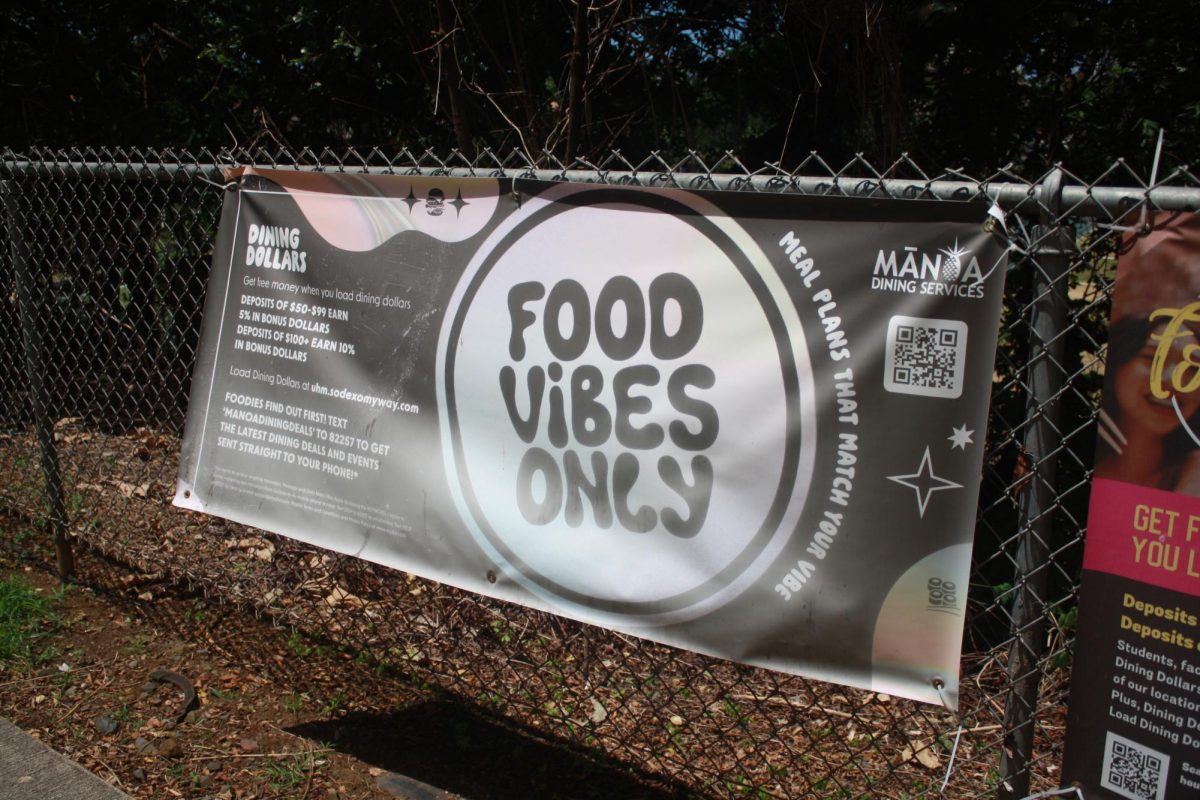
The campus food provider for University of Hawai’i at Mānoa, Sodexo, will be increasing prices by 7% in the next academic year. Despite a lack of clarification from the UH administration on whether this price increase is to maintain the dining experience or improve it, hardly any students sought to share their thoughts in public forums, including recent town hall meetings about the topic.
“We held two public meetings and presented the proposal to ASUH (Associated Students of the University of Hawai‘i), while also sharing materials with the Campus Center Board and Graduate Student Association,” said Marc Nakamoto, vice president of Campus Operations. “We continue to gather student feedback through annual surveys and ongoing conversations throughout the year.”
But the email for the town hall meeting was sent just a day ahead of time, leaving students with little notice to attend. Surveys are also solely advertised via email and usually offer no incentives to encourage students to participate. No emails have clearly broken down where this money is going and how it will be used.
“I wish they would just tell us everything we need to know in the email,” said Devyn Miranda, a freshman at UH Mānoa. “I don’t have time to attend those meetings, especially when they’re so last-minute.”
Mānoa Dining Services and Student Housing Services have announced that the price increase allows UH to invest in enhanced dining options, welcoming spaces, and wellness initiatives. These press releases leave the impression that this price increase is to improve the dining experience at UH Mānoa.
“This proposal reflects inflation-driven pricing, essential operational expenses such as labor costs, and follows a year in which no increase was implemented,” Nakamoto said. This statement leaves the opposite impression of press releases, that this price increase is to maintain the current dining standard.
The handling of the price increase has raised concerns by ASUH members about whether important financial decisions can be made without actively seeking student input.
“Many students have issues with their current dining experience,” said Tuleen Zidaeh, vice president of ASUH. “But none of them will speak up.”

At Brigham Young University–Hawai’i (BYU), campus administrators are implementing a 3.5% increase in meal price for the next academic year for inflation purposes, which is half of the increase that UH is adopting. Throughout the year, BYU has given students opportunities to share their thoughts on their dining experience.
Last year, a student-managed group at BYU worked with the President’s Council to send out an estimated 1,700 surveys about the student dining experience, gathering data and using it to inform decisions that affect the entire campus.
“It’s a group effort,” said Abraham Manutai, BYU’s Food Services director. “Part of it is through surveys and the other part of it is a council that will eat with our students to get feedback every weekday.”
ASUH leaders have made it their mission to have student voices heard in dining decisions. They sent out a food insecurity survey, for example, to give UH Mānoa students leverage in future discussions on the potential price increase.
“I wish more students would speak up,” said Zidaeh. “If they came to ASUH, we would advocate for them.”
ASUH survey results revealed that students wanted different dining hall hours and more variety in the menu for those with dietary restrictions. It showed that more than half of respondents needed food to be available from 8 p.m. to midnight, despite the fact that UH dining halls currently close at 8 p.m.
Sodexo is no longer open to feedback on this proposal; the last survey closed March 25 and the last meeting to hear from students was held April 15. All these opportunities to speak up were announced via email.
But meetings do pop up on occasion, and while there is no price increase-specific feedback form, students can submit their thoughts using Sodexo’s general feedback form.