


Recruiting students to the UH Mānoa may seem as simple as selling a dream vacation, but the approach is more strategic.
UH admissions officials adjust their recruiting strategies depending on whether they are local, from the mainland or from another country. For local students they focus on pitching academic opportunities, for mainland students they emphasize academics with activities to do around O‘ahu, and for foreign students the recruiters highlight prestige and the university’s reputation.
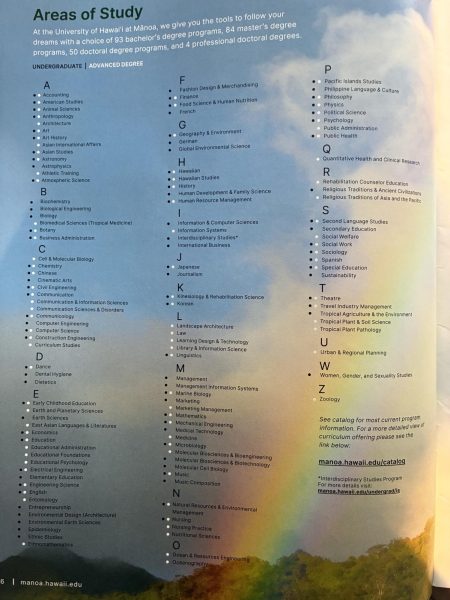
Even UH’s recruitment material reflects their in-person approach. Local students will receive a shorter but academically heavier brochure that highlights classes and research opportunities, as mainland audiences receive a longer and more visual and experience-driven brochure.
Across all audiences, there does remain one constant. Academics comes first, all additional information such as lifestyle and location is used to support the foundation of UH academics.
“We have to very much keep in mind the audience that we’re talking to, whether it be a resident student versus a continental student, or even an international student,” said Garett Inoue, the director of admissions at UH Mānoa.
For students who are already familiar with Oʻahu and have called the islands home for a majority of their lives, UH takes a different approach. Recruiters focus on explaining and sharing academic opportunities and other activities, such as clubs and programs available for students.
“For local students, we don’t focus on necessarily the things that Hawaiian islands can offer,” said Inoue. “We really talk about our programs and different services and clubs and organizations that they can get involved in.”
Local students are familiar with the island of Oʻahu and its environment, Inoue said, so what those students need is clarity on how the university can help them achieve academic goals. This includes sharing information about majors, research opportunities, and campus amenities.
A big jump
However, students joining from neighbor islands are still facing a big adjustment by moving to Oʻahu.
“A resident student could actually be from a neighbor island, (and) to them a transition to Oʻahu is still kind of a big jump,” said Inoue.
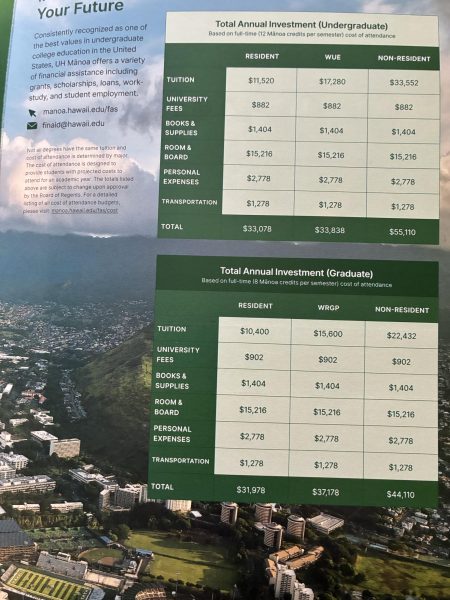
“I’m from Maui, and it still felt like a big move,” said Carl Kasper, a Mānoa freshman from Maui. “But the in-state tuition was a huge deal breaker, and once I moved out here I was pretty comfortable off the jump.”
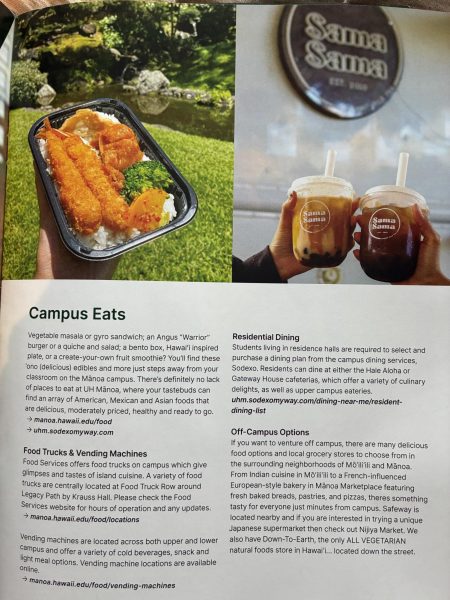
For this reason, recruiters at UH make sure to highlight a sense of community and belonging at Mānoa by sharing information about surrounding neighborhoods, the proximity and access to Honolulu, and other activities accessible and close to campus. The recruiters emphasize the supportive community at UH while trying to show how the transition to UH isn’t as intimidating as it may seem.
“I was comfortable with moving, but they did reassure me about opportunities outside of campus such as places to check out,” Kasper said.
Life on Oʻahu
For mainland students, the recruitment strategy expands to address both incoming student curiosities and concerns. As academics remain the central focus of the recruitment, it is also followed by details about life on Oʻahu.
“We do focus on our programs, and then again, proximity, because some of them may be familiar with landmarks,” Inoue said. “They’ll ask us, ‘How far are you from the airport or Waikiki?’”
Questions like those help reveal a big difference between mainland and local students. Mainland students often view Hawaiʻi as a destination, not necessarily a place to study. This requires admissions recruiters to translate the living plus school experience as a reality and not a dream.
With mainland students one of the main concerns is isolation, also known as “island fever.”
“One of the biggest things we get asked is about being stuck on island,” Inoue shared. “And so we talk about that… students have an opportunity to explore Oʻahu, but you can fly to another island, every island is unique.”
UH recruiters will also address misconceptions of limitations such as resources and opportunities.
“We have to break down the myth that we don’t have the same opportunities as the mainland, academically and for activities. We have Target, we have Costco,” Inoue said.
Recruitment becomes informational and corrective, Inoue said. Recruiters reassure incoming students that while the experience at UH is unique and different, it doesn’t require sacrificing accessibility to opportunities.
“Every interaction I had when touring the school went really well,” said Owen Wenger, a sophomore at UH who moved from Washington State. “Also the business school was said to be really good.”
With Hawaiʻi’s global reputation for its natural beauty, admissions officials and recruiters don’t lead with that topic of Hawaiʻi. Instead, they utilize Hawaiʻi’s nature to highlight academic conversations instead of replacing them.
“We don’t make that our central portion,” Inoue said. “I think that people know we’re an island… but if the conversation comes up then we will kind of talk about that.”
When the topic does come up, the environment becomes a critical academic asset. Students interested in specific fields such as marine biology, geology, geography, and astronomy, plus many more, are introduced to research opportunities unique to Hawaiʻi.
“If they have an interest we talk about the different research opportunities,” Inoue said. “If they’re doing things like geology, we talk about the big island and their volcanoes… if they are interested in astronomy we talk about the telescopes on Big Island.”
With those majors referenced and beyond, students at UH are exposed to hands-on learning opportunities tied to Hawaiʻi’s ecosystems and environments. Still, Inoue emphasizes that academics always come first when trying to recruit.
A complex pitch
For international students, the recruitment is a more complex pitch. The transition from abroad to UH isn’t just geographic, but also logistical and cultural.
“A foreign country for them is oftentimes a bigger jump than from the continental U.S.,” said Inoue.
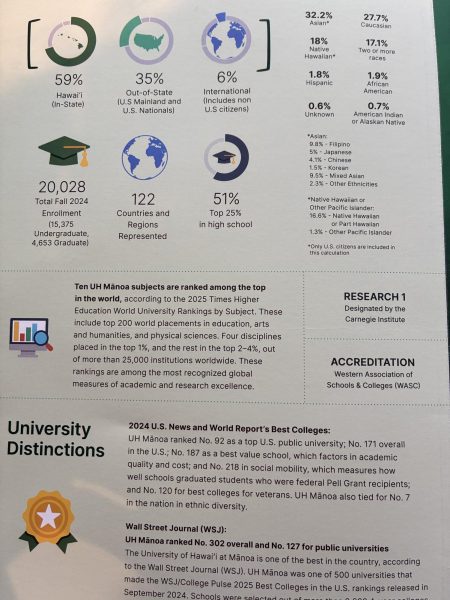
UH relies on a specific and strategic international recruitment process that includes a team that travels abroad and shares the opportunities at UH according to the tailored country. For exchange students, prestige and university reputation carry a heavier weight than opportunities around the island.
“A lot focuses also on prestige and good research opportunities,” Inoue said.
For students coming from abroad, safety is also a major concern.
“We talk about the safety on campus and Hawaiʻi as a state being a safe environment,” Inoue said.
Financial aspects also play a major role. International students are faced with higher tuition and restrictions on employment. Recruiters have to clearly explain available support and opportunities for these students.
“We will even talk about what are the things they can do to help defray from the cost of non-resident tuition,” Inoue said.
With recruitment, there are pros and cons. Recruiting from UH comes with its clear advantages and disadvantages.
“The major con is distance… even for people from California, it’s distance,” Inoue said.
The distance does make travel more expensive and can contribute to a student’s hesitation to leave the mainland for college. But the distance also contributes to what makes UH a unique university.
“We have things that other institutions don’t… we teach the most foreign languages in the nation… we have unique programs like Hawaiian studies and astronomy,” Inoue said.
There is also a cultural aspect that helps UH stand out.
“There’s a community here. We respect the land, and there’s a lot more collective feeling,” Inoue said. “We are more like a family.”