Headline: Ball’s legacy takes flight with national recognition
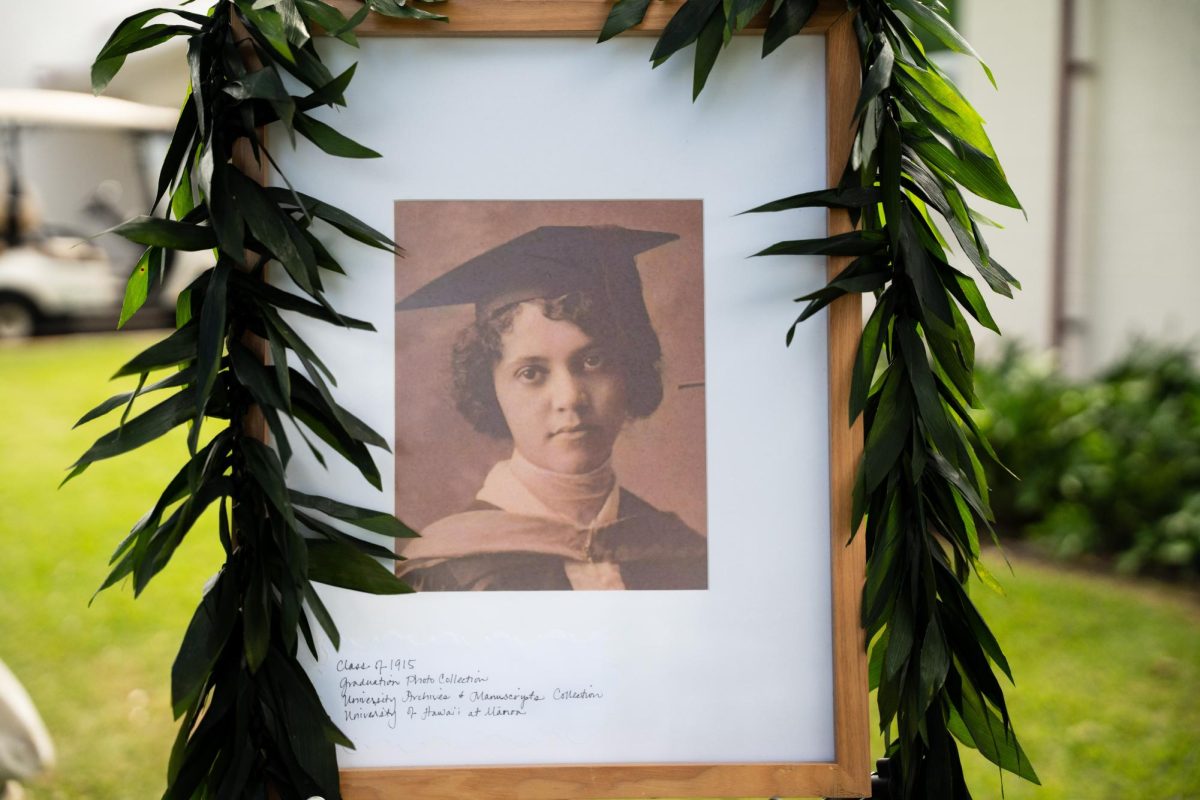
A celebration of gratitude and excellence took place on the UH Mānoa campus, honoring Alice Augusta Ball, the first African American woman to earn a master’s degree and the creator of the first effective cure for Hansen’s disease.
On Feb. 26, students, faculty, and community members gathered at Bachman Hall near the chaulmoogra tree for the fourth annual Alice Augusta Ball Day. The event was organized by The Sister Circle at Mānoa in partnership with the UH Office of the President and the UH Mānoa Office of the Provost and later followed by a remembrance walk.
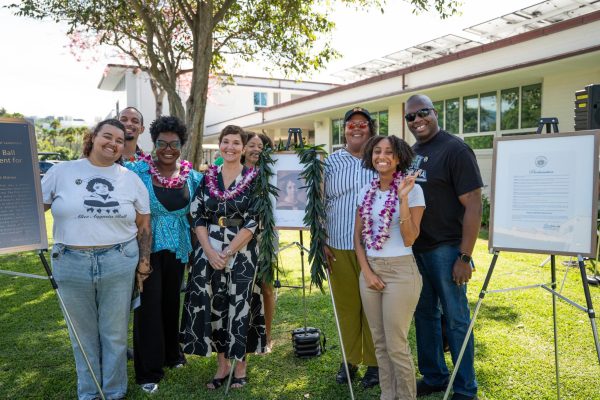
The ceremony was held earlier to allow everyone to participate, as it would have fallen on a Saturday. The day was first observed on Feb 28 after former Gov. David Ige issued a proclamation in 2022 recognizing it in her honor. The first observance was marked on Feb. 29 (Leap Day) in 2000 by Gov. Mazie Hirono, but it was later moved to allow for annual recognition.
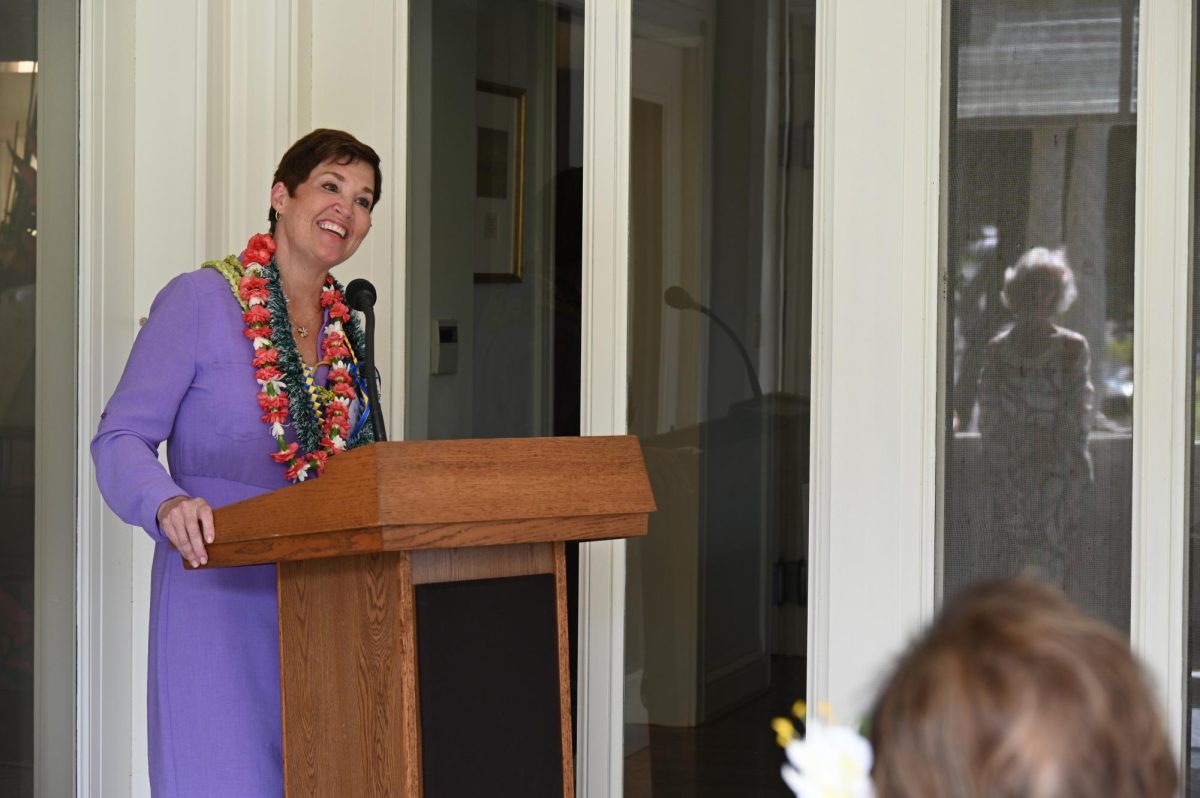
Katrina-Ann Kapā Oliveira, interim vice provost for Student Success, presented the National Historic Chemical Landmark Designation on behalf of the American Chemist Society.
“Getting to recognize her not only on the university and state level, but on a national scale, is a huge accomplishment, not only in recognizing her legacy, but in how she contributed as a Black woman in STEM and in higher education at a time when you don’t see a lot of people represented from our community.” said Niya McAdoo, co-founder of The Sister Circle of Mānoa.
The ceremony was emceed by Dr. LaJoya Shelly, and a gracious oli was presented by representatives from the Hawaiʻi Papa o ke Ao Native Hawaiian Place of Learning Advancement Office and the College of Tropical Agriculture and Human Resilience’s Native Hawaiian Place of Learning Coordinator.
Remarks were delivered by UH President Wendy Hensel, Phillip Williams, interim dean and professor of chemistry in the College of Natural Sciences, DeGray Vanderbilt, founding member of Ka ʻOhana O Kalaupapa and student speaker Raven Kelly, who spoke on behalf of Alice Ball’s groundbreaking scientific contributions, among others.
President Hensel said she first heard the story of Ball when she started her position.
“I wish I had heard it earlier, but it shows how many powerful stories in history go untold,” she said.
She added that Ball’s contributions go beyond simply giving someone their flowers.
“The legacy is far bigger than just recognizing her contributions. It’s about seeing how access to education for people who might not otherwise have it can transform generations,” Hensel said.
Rayven Kelly, a marine biology undergraduate student and a U.S. Navy member, said she was honored to speak on behalf of the student speaker.
“It’s hard being a Black woman in science because we make up such a small portion and the stem fields are predominantly white. Our work is often gone unacknowledged or it’s not recognized. So it’s really inspiring to hear her story as it pushes me to continue forward and eventually open some sort of path for other young black girls wanting to go into STEM,” Kelly said.
Other attendees including UH Mānoa students Douglas Martin and Magadelyn Rogers both came in support of Ball and also their community.
“She really inspired me to dig within myself to find what I’m really passionate about, and also to give back to my community.” Rogers said.
In 1866, around 8,000 patients diagnosed with Hansen’s disease were forcibly relocated to Kalaupapa, then a remote settlement on Moloka‘i. Over time, Ball’s method helped many patients recover and eventually return home. Now Kalaupapa is home to three residents, says Degray Vanderbilt, a longtime advocate for what happened in Kalaupapa and the people affected.
Vanderbilt says he wanted to ensure that neither Ball’s work nor the residents’ experiences are forgotten.
“Alice Ball was a visionary, and the cure she developed truly helped the people of Kalaupapa. Unfortunately, when you ask people in Hawaii about Kalaupapa and its history, many know nothing because it’s never been taught in schools. This is a great way to change that,” Vanderbilt said.
History
Ball’s family moved to the Hawaiian Islands with her family from Seattle, Washington, in 1902, with the purpose of aiding her grandfather’s arthritis. She attended the Princess Ruth Keʻelikōlani Middle School. After her grandfather’s passing, Ball returned to Seattle, before moving back to the islands to receive her master’s degree in chemistry from the College of Hawai’i, now known as the University of Hawaiʻi at Mānoa.
Ball taught at the school that she graduated from, where her work with extracting the ava plant gained attention by Dr. Harry T. Hollmann, the acting assistant surgeon at The Kalihi Hospital, who was working with Native Hawaiians and residents who contracted leprosy. Inspired by her methods with ava, Hollmann encouraged Ball to work with him to treat patients with leprosy.
“In Hawaiʻi I interested Miss Alice Ball, M.S., an instructress in chemistry at the College of Hawaii in the chemical problem of obtaining for me the active agents in the oil of chaulmoogra,” wrote Hollmann in his 1922 publication, “The Fatty Acids of Chaulmoogra Oil In The Treatment of Leprosy And Other Diseases.”
While still teaching at the College of Hawaiʻi, Ball developed a method where she takes the oil of the chaulmoogra plant and creates a water-based injection. Prior to her method, injecting the oil into patients would cause the skin to be bumpy and form blisters. Her method, being water-based, allowed the oil to be absorbed in the bloodstream.
“After a great amount of experimental work, Miss Ball solved the problem for me by making the ethyl esters of the fatty acids found in chaulmoogra oil,” said Hollmann in 1922.
She went on to develop the first effective treatment for leprosy, or Hansen’s disease, a breakthrough that helped patients in Hawaiʻi and eventually benefited people around the world.
Ball’s time at the College of Hawaiʻi intersected World War I. While teaching chemistry, Ball taught her students how to use a gas mask, during which she inhaled chlorine. Through this demonstration, Ball fell ill and moved back to Seattle, where she passed at the young age of 24 in 1916.
Tragically, Ball never published her work and contributions to treating leprosy.
Five years after Ball’s death, Arthur Dean, the second president of the University of Hawaiʻi at Mānoa, plagiarized Ball’s work and published it through J.T. McDonald, “Treatment of Leprosy With the Dean Derivatives of Chaulmoogra Oil—Apparent Cure in Seventy-eight Cases” in 1921.
He failed to properly credit Ball’s work in his publications, and for many years her contributions were largely overlooked.
Decades later, Paul Wermager, a reference librarian and head of the Science and Technology Department at the University of Hawaiʻi at Mānoa’s Hamilton Library, rediscovered her research and helped restore recognition of her groundbreaking achievements.