
Hawai‘i is one step closer to imposing heavy restrictions on ICE agents, as SB 3322—similar to California’s “No Secret Police” Act—passed in the House Committee on Judiciary & Hawaiian Affairs on April 1.
The bill would penalize all law enforcement officers for improper masking, failing to display identification, and interrogating, arresting, or detaining people without authorization.
SB 3322 has received substantial testimony from individuals, advocacy groups, and local businesses in support. Initial opposition came from some local law enforcement departments concerned over the bill’s scope and the practicality of implementation.
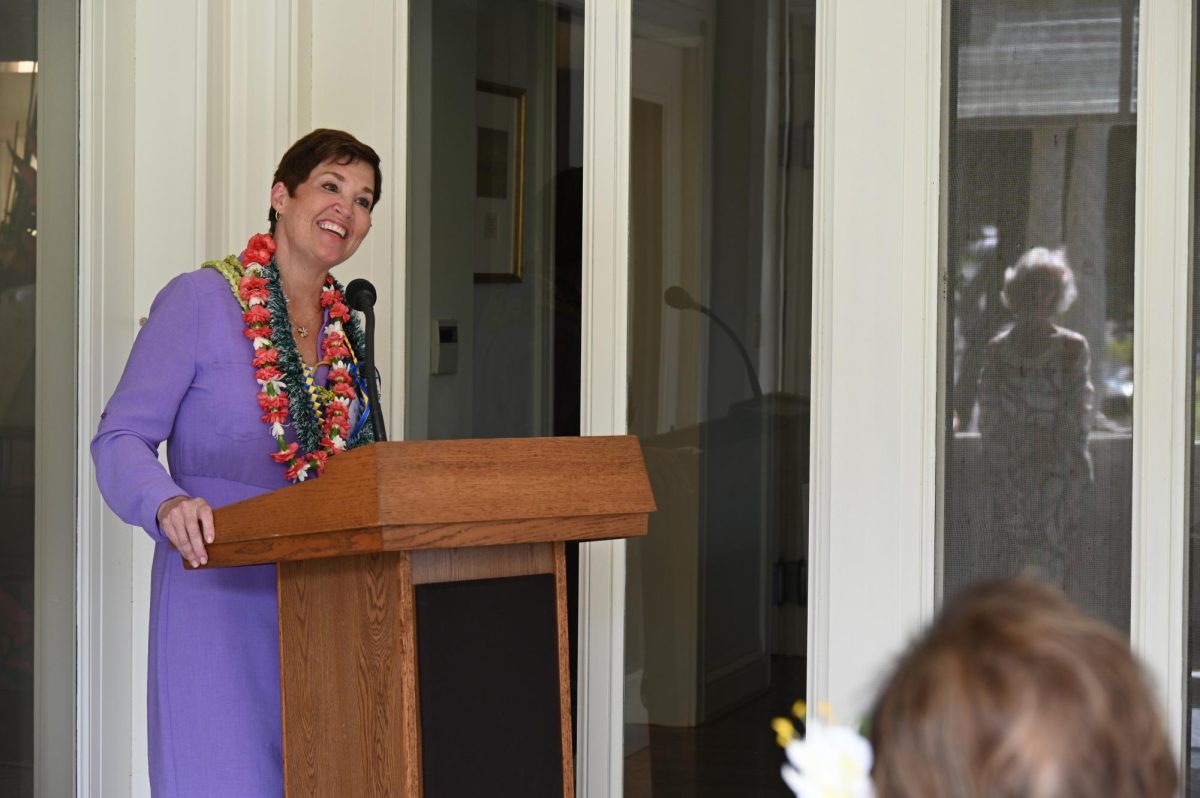
Hawai‘i State Sen. Karl Rhoads, the primary introducer of the bill, is an outspoken critic of President Trump and ICE agents’ violent actions under the current administration.
“Every state has a responsibility,” Rhoads said. “If we want to get out of this Trump presidency with a democracy intact, everybody has to do their part to push back against the abuses.”
Drawing the line
SB 3322 addresses one of the main criticisms of ICE agents, which is that many fail, or outright refuse, to identify themselves.
While conducting immigration enforcement, ICE agents have been seen wearing masks, often paired with sunglasses, to completely obscure their faces. On top of this, many do not wear visible badges or other forms of identification.
Without proper identification, a person may not be able to distinguish whether they are being detained by federal law enforcement or kidnapped by a stranger.
ICE impersonators have already been reported in Hawai‘i, most recently during the “No Dictators” protest on March 28. Fake ICE flyers threatening random searches were spotted throughout Makiki in late January.
“You shouldn’t have to live with that kind of fear all the time,” said Rhoads.
HPD: ‘‘We don’t work with ICE on immigration enforcement”
While the bill has received an outpouring of supportive testimony from individuals and activist organizations such as the ACLU of Hawai‘i, one notable group had originally risen in opposition: local police.
During the first round of testimony, the Hawai‘i County Police Department urged that the matter be handled by the Law Enforcement Standards Board rather than the state legislature. In the second round of testimony, Kaua‘i County Police Chief Elliott Ke wrote that the penalties for unauthorized civil immigration interrogation would be “extraordinarily serious and may have a chilling effect on lawful enforcement decisions made in fluid situations.”
In light of concerns about officer safety, several exceptions for masking were added to the most recent version of SB 3322, including for undercover and tactical operations.
“There is a role for anonymous policing in certain situations,” said Rhoads. “There’s no question it’s a balancing act.”
Rhoads and the Honolulu Police Department collaborated to revise SB 2203, a similar bill on facial covering restrictions for law enforcement officers. This language was incorporated into SB 3322.
Major Parker Bode, the HPD legislative liaison, gave a clear statement on the department’s stance on ICE.
“We’re not going to enforce immigration laws,” said Bode. “ICE has not asked us for assistance, and we don’t foresee that they’re going to ask us for assistance in the future. We don’t plan to assist them with immigration enforcement.”
While ICE is SB 3322’s main focus, the bill addresses all law enforcement officers, including those at the local level. However, HPD does not believe the bill, in its current state, would have a significant impact on its operations.
Bode also pointed out another distinction that sets HPD apart from ICE in regard to traffic stops, as referred to in the bill.
“We make traffic stops, or detentions, based off of our officers’ reasonable suspicion of committing a crime, not on their immigration status,” said Bode. “Nor, if we arrest someone, do we check their immigration status. So because we don’t check their immigration status, we don’t then notify ICE that we have somebody who’s of interest to them.”
Notably, the most recent round of testimony does not include opposition from local police departments. However, the police union, known as the State of Hawaiʻi Organization of Police Officers (SHOPO), did provide commentary that they were not satisfied with officer protections—or lack thereof—laid out in the bill.
Multi-state resistance
Hawai‘i is not the first or the only state to propose such restrictions targeting ICE agents.
California’s “No Secret Police Act” and “No Vigilantes Act,” which helped inspire SB 3322, were contested by the White House for applying restrictions only to ICE, not to all law enforcement officers. Current efforts to revise the acts to make them enforceable are underway.
New Jersey and Washington signed similar bills into law in March, and several other states have legislation in the works.
Rhoads explained that immigration enforcement itself is not the issue. He argues that, if done humanely, it can be a very popular position—even in Hawai‘i.
“If you’ve committed a violent crime, I’d be the first one to say, ‘Aloha, you know, go home. We don’t want you here,’” said Rhoads. Even so, he adds, “You do have due process rights as a non-citizen. That’s black-letter law.”
And when it comes to Trump, Rhoads has remained a vocal dissident.
In 2024, Rhoads introduced SB 2392 in an attempt to disqualify candidates from the ballot for violating the Insurrection Clause of the Fourteenth Amendment. While not directly naming Trump, the bill arose in response to his perceived involvement in inciting the Jan. 6 riot.
“For most of my time in the Senate, anyway, I’ve been introducing bills that could be that were trying to counteract the crazy stuff that he was doing,” said Rhoads.
This legislative session, especially, Rhoads thinks some form of a “No Secret Police” bill will pass, unlike previous attempts to counteract Trump’s leadership.
“This is a higher level of crisis than we had in the first term,” said Rhoads.
SB 3322 still needs to pass a third reading in the House of Representatives. Since its companion, HB 2540, is still alive, the two will likely head to a conference committee.