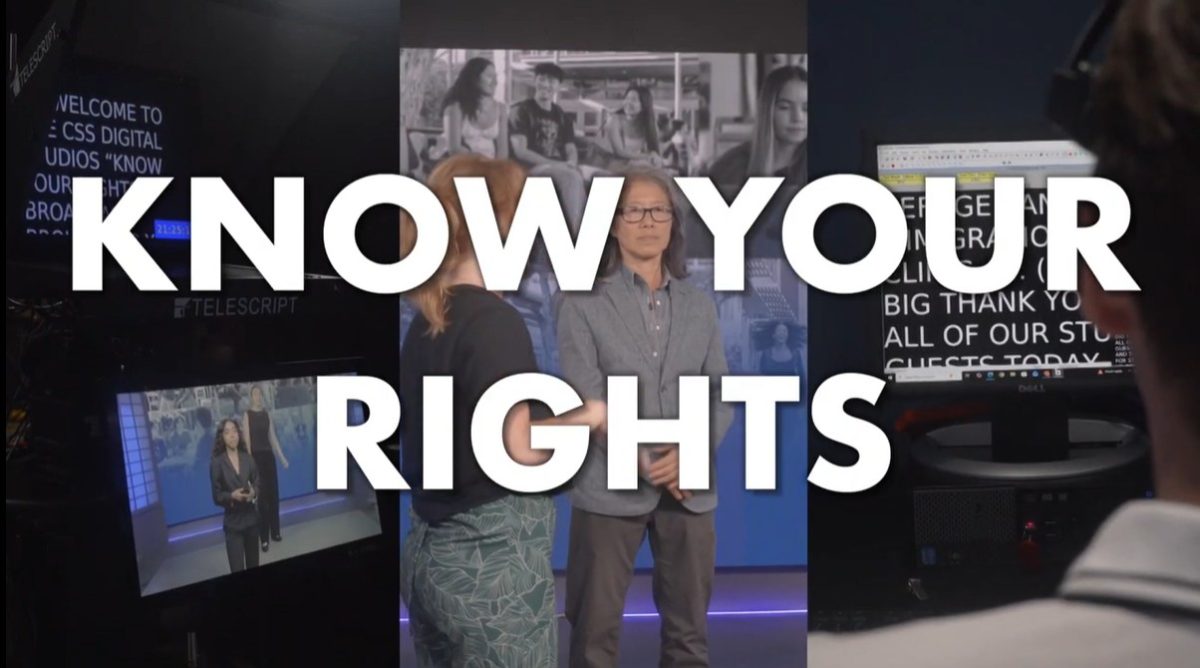
Gaye Chan of the O‘ahu Rapid Response Coalition has lived most of her life outside of the U.S. She said that the rights afforded to democratic countries are the biggest things citizens have to hold on to.
“All of a sudden,” Chan said, “they [these rights] might not be there.”
Chan added that recent actions taken by the Trump administration have exposed how little people understand their protections.
“Because we take [constitutional rights] for granted,” she said, “we don’t even know what rights we do have.”
Chan was one of the representatives from various organizations invited to talk on “Know Your Rights,” a student-produced broadcast at the UH Mānoa College of Social Sciences Digital Studios focused on spreading awareness of legal protections. The broadcast aired on YouTube on March 25, aiming to be a short but informational resource the public can refer to.
The project brought together legal experts and community advocates to share accessible information, sparked by growing concerns over actions by the U.S. Immigration and Customs Enforcement and policies during the administration of Donald Trump.
Heightened anxiety over immigration enforcement has left communities fearful and often uninformed about their rights. Recent high-profile incidents, such as the fatal shooting of Minnesota nurse Alex Pretti by agents from U.S. Immigration and Customs Enforcement have intensified public scrutiny around federal enforcement actions.
Reports of aggressive tactics, increased arrests, and confusion over the role of multiple agencies under the Department of Homeland Security have contributed to a broader sense of uncertainty. Advocates also point to conditions in immigration detention facilities and the detention of individuals, including U.S. citizens, as part of a system that lacks transparency and accountability.
For community organizers like Chan, these actions taken by this administration signal governmental overreach. She labeled the immigration crackdown as cruel.
“We are seeing our rights eroding,” Chan said, stressing what she describes as a growing fear among the public.
Behind the Broadcast: Laurel Galvin
Laurel Galvin, a senior journalism student at UH Manoa and producer of Know Your Rights, said the idea for the broadcast grew out of her previous reporting on community responses to immigration enforcement. This reporting had connected her with the legal clinic and campus organizations.
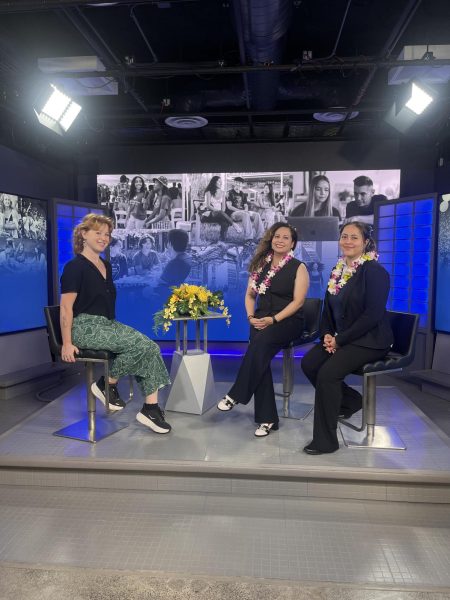
After attending a Know Your Rights training session hosted by the Graduate Student Organization, she realized how much critical information is not widely accessible.
“I thought that it would be really incredible if we could compile a know your rights training video that people could have access to,” Galvin said.
That experience combined with activism that she witnessed in the community shaped the project’s purpose.
“Seeing both the harm that has been caused by overreach from federal immigration enforcement and the community response and the wonderful things people have been doing to help each other are what inspired me to create this project,” Galvin said.
The broadcast was filmed as part of the Advanced Digital Studios course (SOCS 470), where students pitch and produce their own projects.
The production required extensive planning before filming began, including writing scripts, organizing guests and assigning roles.
Galvin took on the bulk of the responsibilities, from scripting and graphics to overseeing the control room during filming, to make the project come to life.
“I fulfilled a lot of roles because this project was kind of my baby,” Galvin said.
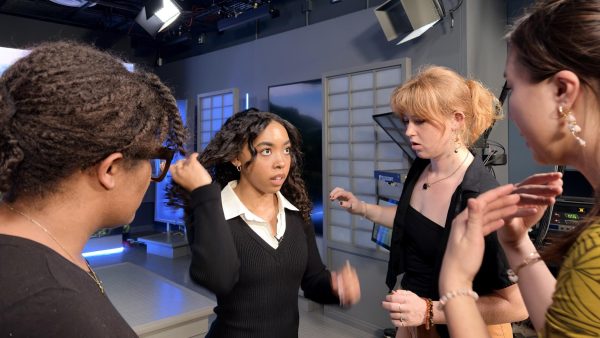
The production remained a collaborative effort, with students working together in studio roles and post-production.
Galvin reflected on the project as both challenging and educational, noting that she had never taken on a venture of that size before.
“I was definitely a little bit over my head, but I learned the importance of planning,” said Galvin.
Maryam Alammari, a law student and ACLU volunteer, was a speaker invited to talk on the broadcast. During production, Alammari was impressed with the level of professionalism and thorough coordination that Galvin had put into her work.
As a key part of the planning process, Galvin brought together speakers by reaching out to legal and community groups, including the ACLU, the Refugee and Immigration Clinic of William S. Richardson School of Law, and attorneys from The Legal Clinic.
“Finding the people to talk to was a combination of people being recruited and people volunteering to talk on the broadcast,” she said. “Everyone I contacted was super enthusiastic and glad to be a part of something like this and it all sort of just came together.”
Central Message: Empowerment, Knowledge, and Action
A central message that was carried throughout the broadcast is that rights are only effective if people understand them and actively use them.
“In order to preserve your rights, you must exercise them,” Galvin said. She noted that many people assume they understand their rights but are often unfamiliar with how those rights apply in specific situations.
A similar message was reinforced by Sergio Alcubilla of the ACLU of Hawai‘i.
“We want to make sure that people know what their civil rights and liberties are,” Alcubilla said. He added that without that awareness, those rights can easily be undermined.
“When we don’t [exercise them], it is easy for people to trample over them,” he said.
Galvin said even individuals who consider themselves informed may have gaps in their knowledge.
“I was really surprised by how much I didn’t know when I attended the first Know Your Rights training because I consider myself to be someone who’s pretty informed,” she said.
That realization highlighted how important it is for others to seek out this information as well.
“Regardless of whether you are aware or even fearful about immigration enforcement or just want to be an active member of the community, I think it’s important to know either way,” she said.
That idea is echoed by Chan, stressing the importance of understanding the legal nuances.
“Little things like do I have to open the door? Can I take pictures? Do I have to talk? These are basic things we don’t think about and now we need to,” Chan said.
Speakers also cited voices from the community who are actively working to ensure rights are understood and protected. They shared practical strategies for staying informed and engaged, demonstrating how knowledge of rights can translate into action.
For the Oʻahu Rapid Response Coalition, available at (808) 824-4707, this means monitoring federal immigration activity and providing a hotline for community members to report sightings.
“Documenting is crucial because what happened to Alex Pretti and Renee Good, if it wasn’t for the footage, they would have completely changed the story of what happened. They tried to,” Chan said.
Chan emphasized that awareness and vigilance are essential for safeguarding communities, “Our tools are to be present, to watch, to observe and to witness. This is how we can protect each other and ourselves.”
Alcubilla added that rights awareness is tied to civic participation, pointing to press freedom as a key part of holding the government accountable. He warned that limiting diverse perspectives and discouraging questioning poses a risk to democracy.
“In the press room, you’ll see this administration only invites certain people that echo what they believe in. When you start censoring the press or you only talk to people that agree with you, and you don’t have another side that is willing to question you, I think that is a danger to our democracy,” Alcubilla said.
Alcubilla admired how the broadcast encouraged engagement, bringing individuals who might not normally participate into conversations about civil rights.
“I think that people who normally wouldn’t be engaged in these types of events, for instance, the No Dictators Rally, will attend to fight for our civil liberties. It is great to see,” Alcubilla said. “People see that something is not right with the whole situation.”
Alammari emphasized the importance of accessibility.
“It is really great that we have these resources at UH to promote these important messages but also kind of bring a level of training to students in Hawaiʻi,” Alammari said, noting that viewers can access recorded presentations, volunteer opportunities, and other resources through the ACLU.
What Viewers Can Learn: Key takeaways from Broadcast
By connecting students, legal experts and advocates, the project sheds light on just how much knowledge can empower individuals to take meaningful steps in protecting their rights.
Galvin said the message she hopes viewers take away is that even small actions can make a difference.
“One simple thing people can do is to look out for their community,” she said, underscoring how an individualistic approach to these issues is not enough. “I think that it’s really important to have open and honest conversations and bring all sorts of people into these conversations.”
Galvin emphasizes that building community and supporting others is key to preserving rights.
“Try your best to inform the people around you in an understanding and compassionate way,” Galvin said.
Galvin also acknowledged a pervasive sense of frustration and helplessness many people feel. She cited a rampant despondency that can be attributed to factors such as how often we are on our phones and are scrolling on social media. Being exposed to this kind of content on social media can create distance and numb people emotionally. Even when it makes you upset, she said, it diminishes the genuine empathy you might feel, because it’s easy to scroll past without really engaging with it.
“You feel like there’s nothing that I can do about this, but there are initiatives and things you can get involved with,” she said.
She offered a gentle reminder that it is easy to practice basic civic duties such as submitting testimony to the legislature, calling local lawmakers, and making monthly donations.
“I think what I want people to walk away with is knowing that there are ways that they can help,” she added. “They don’t have to dedicate their entire lives to advocacy just to help make a change.”
Mānoa Mirror Staff notes that Laurel Galvin is employed as Editorial Coordinator of the newsroom.