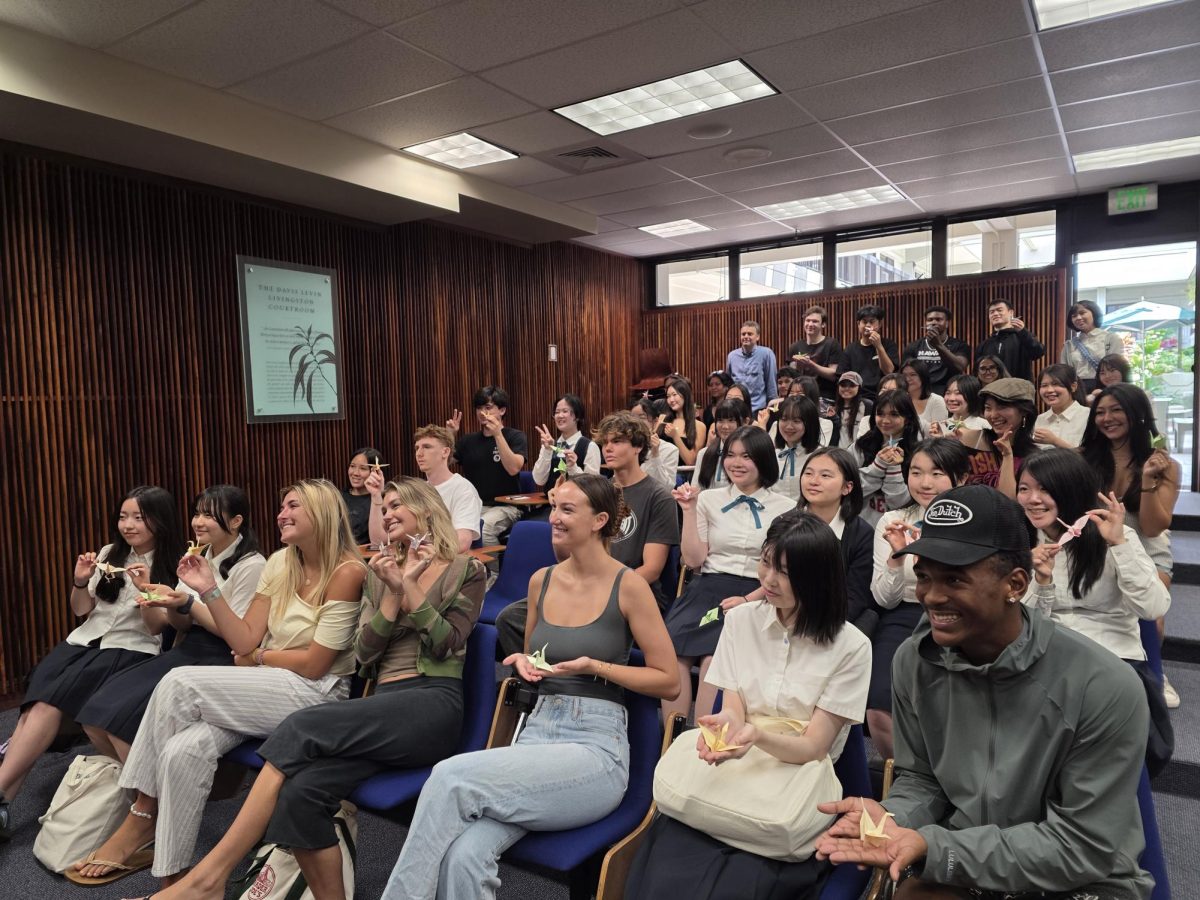
A group of high school students from Hiroshima, Japan, and UH Mānoa students enrolled in a Peace and Conflict Studies class gathered informally on March 31 at the Richardson School of Law, introducing themselves and exchanging small pieces of their lives.
What might have seemed like casual mingling was, in many ways, the foundation of the entire experience. Those first moments set the tone for everything that followed. By starting with simple, personal exchanges, students began to move past initial barriers and feel more at ease with one another.
“How we connect culturally and emotionally is a big part of the process,” said Micah R. Fisher, Ph.D., assistant professor at the Matsunaga Institute for Peace.
For Fisher, creating spaces like this is an important part of peace education. By bringing together students from different backgrounds, these exchanges allow them to move beyond theory and engage directly with one another. Through simple interactions such as introducing themselves, sharing stories, and listening, they begin to build the kind of understanding that peace education is all about.
The visit was part of an international exchange aimed at connecting students through peace education. According to Spencer Kimura, director of International Programs at UH Mānoa, the opportunity emerged when the Hiroshima group planned a trip to Hawaiʻi and expressed interest in engaging with students on campus.
“They have a very strong interest in learning about peace and sharing their message to the world,” Kimura said, noting that Hiroshima’s history gives students a unique perspective. “Hiroshima is the site of the atomic bombing, so they have a vested interest in sharing their message of peace… so we don’t repeat it.”
The session then shifted into a hands-on workshop led by the visiting students. Carefully guiding their university peers, the students from Hiroshima explained how to fold paper cranes—an act deeply tied to Hiroshima’s history and its message of peace.
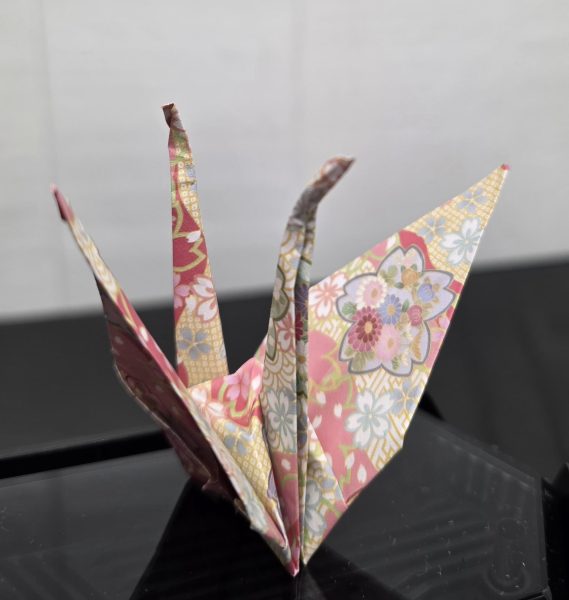
In Japan, origami has long symbolized longevity and good fortune, with a tradition of folding a thousand cranes to make a wish. Over time, that tradition became deeply connected to the story of Sadako Sasaki, a young girl who was exposed to the atomic bombing in 1945 and later developed leukemia. She passed away at age 12. Hoping to recover, she folded more than a thousand cranes using scraps of paper, including medicine wrappers, at a time when materials were scarce after the war.
After her death, a memorial was built in her honor and for other children who lost their lives due to the atomic bomb. Her story spread across the world, and paper cranes came to represent hope and a call for nuclear disarmament and lasting peace.
“The paper crane is a beautiful symbol of peace,” explained Yuzuki Nakamura, a high school student.
For the visiting students, peace education is not abstract. It begins early, in elementary school, and continues throughout their schooling, marked by the legacy of the atomic bombing. The memories and stories of that day still resonate across generations, and the scars remain present in the community. Through these lessons, students come to understand not only the history, but the lasting human impact of war.
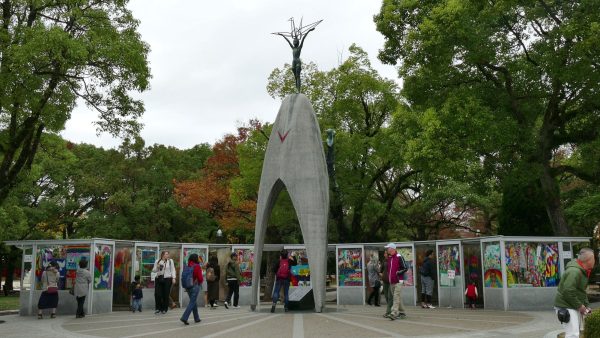
“The atomic bomb should not be used again,” said Nakamura. “Too many people suffered and died.”
After the workshop, the group moved outside, where Fisher introduced what he called a “systems game,” designed to make visible the connections within a group. The rules were simple: each student quietly chose two people—without telling anyone who they picked. Then, when the professor tapped one student on the shoulder, that student moved, and the others followed by adjusting their positions based on the two people they had chosen.
At first, the movement felt chaotic as students tried to keep track of their choices. The confusion was expected, showing how a single action can create unexpected disruption. As each person reacted, the effects quickly spread, demonstrating how even small decisions can lead to unintended consequences.
In the second phase, the dynamic shifted. When a student was tapped on the shoulder, they quietly sat down. One by one, students disappeared from the circle, making it harder for others to maintain their positions. As the group shrank, the connections weakened, showing how the loss of even one person can affect the entire system.
In the final phase, the tone changed again. This time, when a student was tapped, they stood up. Gradually, the circle began to rebuild as more students rejoined. The movement became calmer and more balanced, illustrating how positive actions can restore connection.
As everyone reacted together, the group shifted as a whole. The activity showed how one small action—like a single tap—can affect many people at once. Because everyone is connected, even indirectly, one change can spread through the group, creating a chain reaction.
“When you come into a new space, systems are already there—we’re all connected, even in ways we might not recognize,” Fisher explained.
What began as a simple interaction revealed how deeply each person’s actions were tied to others in the group. No one moved independently; every shift depended on someone else’s response, creating a visible network of connection. At that moment, the idea of a “system” was no longer abstract.
“When we do things, it affects so many people around us in ways that are unrecognizable to us,” Fisher said.
For educators involved in the exchange, moments like these are part of a much larger process. Benjamin Cole, an English teacher at the Hiroshima Jogakuin High School and member of his school’s global education committee, emphasized that peace education is built over years in their school system. By the time they reach high school, students are not only learning about peace, but also taking an active role in sharing its message beyond their own community.
“We have six years of peace studies,” he said. That long-term commitment prepares students not only to understand history, but to actively share its lessons. They move from learners to advocates, understanding that peace education is something to practice and pass on.
“The goal is to spread the message of peace and of Hiroshima—like Sadako’s story—to the world,” Cole explained.
That message is rooted in a history that continues to shape how peace is taught in Hiroshima today. The atomic bombing of the city in 1945 remains a defining moment, not only for Japan but for global discussions on war and nuclear weapons. Through education, students are encouraged to understand both the human cost of that event and their role in spreading their message.
The paper cranes created during the workshop symbolize that continuity, “You have the cranes now, and you pass it on to someone else. It extends into that cycle where the whole world can be improved.” said Cole.
The session concluded back inside, where Fisher reflected on the meaning of the systems game and the overall experience. The activity was far from anodyne. It transmuted an abstract idea, the domino effect, into something we could observe in plain sight.
“A lot of times when we have conversations, we’re already thinking about what we’re going to say next, and we forget to actually listen for meaning,” Fisher said. In many ways, the systems game reflected that same idea. Just as students had to pay close attention to one another’s movements, meaningful communication requires the same level of awareness.
Understanding others, their backgrounds, perspectives, and emotions, is at the core of peace education. That idea gave deeper meaning to everything that had taken place throughout the session. What started as introductions, activities and the game came together as part of a larger lesson. It showed how understanding others requires effort, attention, and openness.
Before departing, students exchanged gifts with the organizers, professors, and one another—a gesture that reinforced the sense of connection built throughout the session. Then, just as simply as it began, the gathering came to an end, and students said their goodbyes.
But the lesson did not end there. The experience left students with something they could carry beyond that day. By stepping out of their comfort zones and engaging with others, they had already practiced what it means to connect in a new environment.
“When you go into new settings, you can hold on to that confidence that you can have a conversation with anyone,” Fisher said.