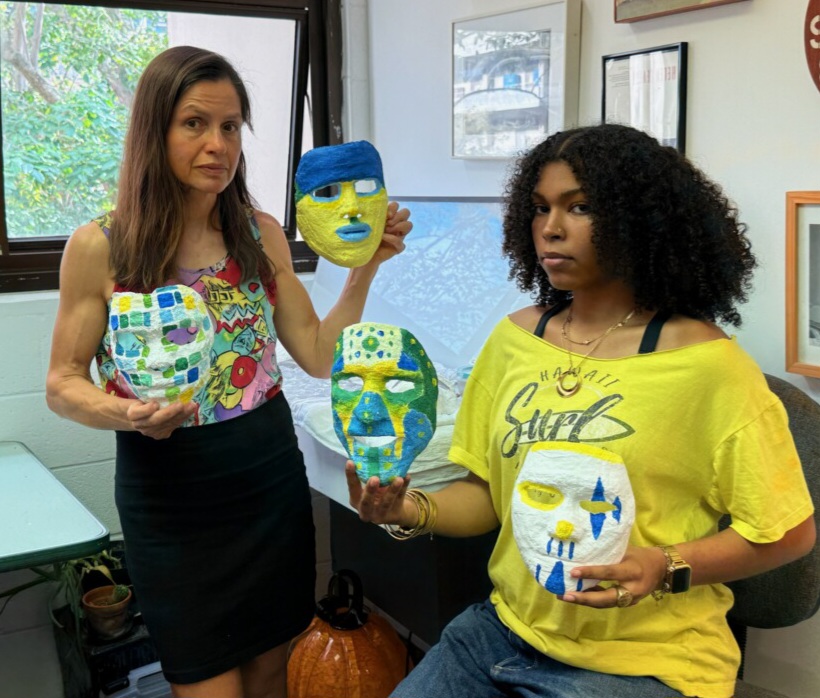
Eight students at Hālawa Correctional Facility sat together dipping plaster bandages into water and carefully shaping them into masks.
The workshop was led on Feb. 27 by Yola Monakhov Stockton, an assistant professor of photography at the University of Hawaiʻi at Mānoa, along with her student Jasmine Jones. Over two sessions, the participants created and later painted masks — a process that required collaboration, patience and trust.
Stockton was invited as an independent artist to facilitate the workshop as part of Chaminade University of Honolulu’s Prison Education Program.
The humanities workshop series, which is supported by the Mellon Foundation, brings local artists into correctional facilities to provide arts-based programming that supports students’ creativity and holistic development alongside their academic coursework.
For Stockton, the project reflects a broader goal: connecting universities with communities that often have little access to higher education.
“One of the things I hope to do is form meaningful connections between universities and the communities of Hawaiʻi,” Stockton said. “Providing access to creative work opens ways of thinking and learning that some people might not otherwise encounter.”
The activity itself was simple but intentionally collaborative. Participants worked in pairs, applying plaster to each other’s faces to create molds
“There was a reciprocal quality to it,” Stockton said. “You make my mask, I make yours. Everyone takes on different roles.”
For Jasmine Jones, a sophomore double major in art history and communication, the workshop was also a learning experience.
Jones first met Stockton in a black-and-white darkroom photography class and later volunteered to help prepare for the workshop. In the weeks leading up to the visit, she helped test materials, pre-cut plaster bandages and mix paint colors that participants would later use to decorate their masks.
But it was the conversations inside the facility that left the strongest impression.
“I think, like a lot of people, I had misconceptions about incarceration,” Jones said. “Once we started talking with the participants, I realized how much we could learn from each other.”
During the workshop, discussions ranged from culture and identity to education and personal history. One participant, serving a life sentence without parole, said that he was reading a book about world religions and wished he had encountered those ideas earlier in life.
“If I had read this when I was younger,” he said, “maybe I wouldn’t be here.”
The workshop also took place at a time of growing concern about mental health conditions in Hawaiʻi’s prisons. Reporting by Honolulu Civil Beat in February 16, 2026 investigated a troubling rise in suicides within the state’s correctional system. Over the past two years, confirmed or suspected suicides accounted for more than half of the deaths at Hālawa Correctional Facility, the state’s largest prison. Statewide, suicides made up roughly one-third of all prison deaths in 2024 and 2025. This proportion is significantly higher than national figures. According to data from the U.S. Department of Justice, suicides represented about 8% of deaths in U.S. prisons in the most recent nationwide statistics available.
Corrections officials have requested additional funding this year to hire more healthcare workers and strengthen mental health services inside the facilities.
Stockton said programs that encourage dialogue and creativity can help counter the inhumane isolation that often defines incarceration.
“What makes people feel hopeful and engaged is working with each other,” she said.
By the second session, Jones said the atmosphere in the room had noticeably changed. Participants appeared more relaxed and open, sharing stories about their backgrounds and discussing the limited number of educational and creative programs available in prison.
Several expressed interest in having more art classes.
The workshop ended with an unexpected moment. Participants who wished to join a small procession in the gym, walking together while carrying the masks they had created.
For Jones, the experience changed how she thinks about incarceration.
“People are more than the stereotypes we hear,” she said.
For Stockton, the workshop offered a reminder that education — and conversations it sparks — can reach far beyond the university classroom.
“When people engage with ideas and with each other,” she said, “it opens the possibility of seeing the world differently.”
The names of the participants have been withheld for privacy reasons.

Nancie Caraway • Apr 5, 2026 at 12:14 pm
This piece is a master class in good journalism. Not only “what where when why,” but moving quotes and policy takeaways for officials. Mahalo Sofia.