
Skateboarder Rei Fujimura didn’t speak a word of English.
His parents, originally from Yokosuka City in Kanagawa, Japan, moved the family to Hawai’i when he was 9. That was also the age when Fujimura began to realize what he could do with a skateboard — years after he first picked one up in their family shed at age 5. Skateboarding became his way of communicating, helping him build a community in Mililani as he learned both English and skateboarding at the same time.
Sitting outside and looking over Mililani Skate Park nearly more than a decade after his first visit, Fujimura remembered how hard it was to learn to “ollie,” a fundamental trick that took him months to land. But his biggest challenge, he said, wasn’t mastering the basics of skateboarding — it was adjusting to life in the U.S. without knowing English.
“It’s like you have to, pretty much, change the way you think,” he said. “Because your thought process changes.”
Growing up, spending time at the skate park helped him pick up English more quickly. Skateboarding connected him with friends, and despite language barriers, he recalled how welcoming the skate community was. He never felt any kind of judgment from anyone.
“I think hanging out with them made it easier,” Fujimura said. “I didn’t even learn it, I woke up and I’m like, ‘I can speak English now.’”
Fujimura has visited every skate park on O‘ahu — from Pearl City Skate Park to his favorite, Kapolei Skate Park, and to Banzai Skate Park on the North Shore. Though he loves them all, Mililani Skate Park holds a special place in his heart, he has seen the park change over the past decade.
“I watched a lot of graffiti get erased,” he said, glancing over the park with a nostalgic look on his face.
Rei and the weird skate bowl at his favorite O‘ahu park
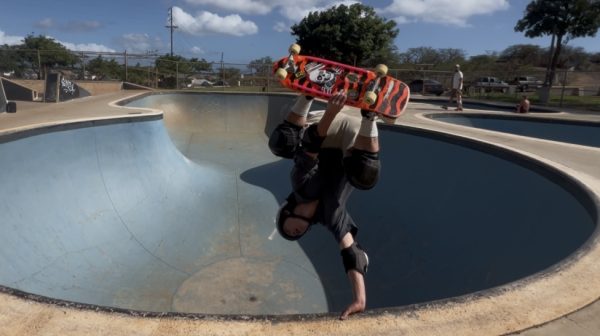
The Kapolei Skate Park has three bowls: one shaped like an egg, about four to six feet deep. Another, they say oddly shaped “amoeba,” about a foot deeper, and Fujimura’s favorite — a keyhole-shaped bowl that drops 10 to 12 feet and looks like a death trap to anyone who doesn’t skate bowls.
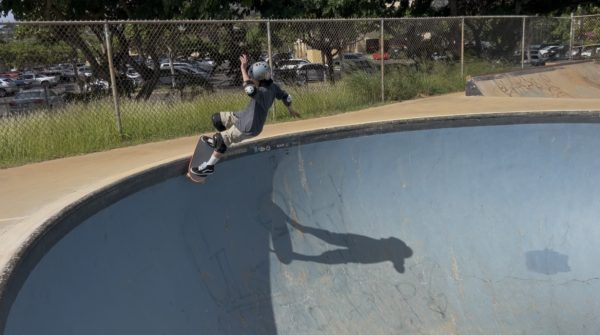
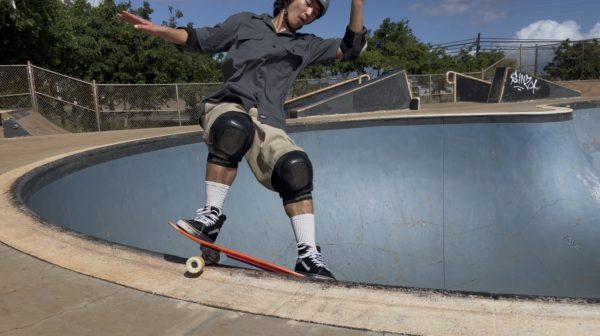
Fujimura rode around the 10-foot-deep skate bowl at Kapolei Skate Park. He landed a “rock to fakie” first try and with his skateboard strapped under his arm, he walked up and said, “Scratch that, I need to do something that scares me.”
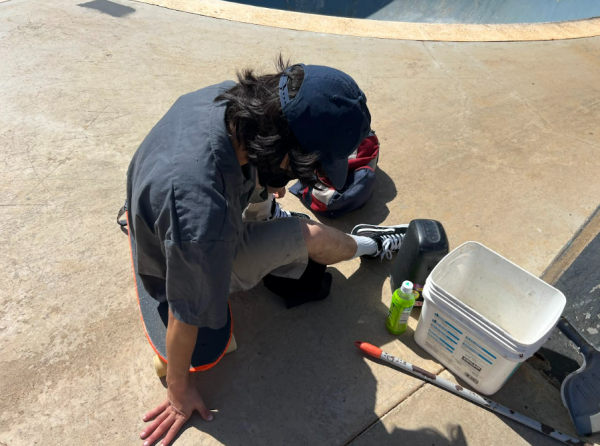
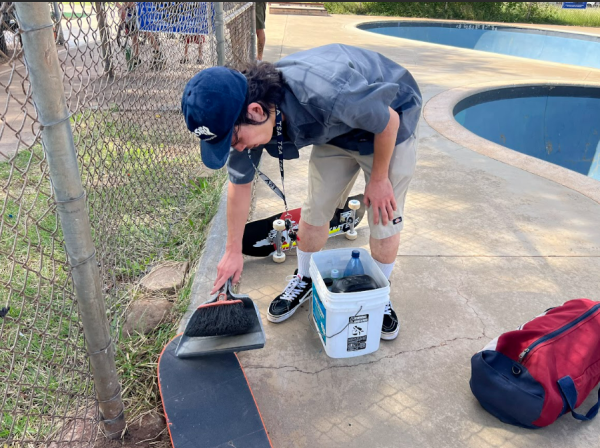
He would call out which trick he was about to try, land it, then immediately push himself toward something harder. When he bailed, after he let out a “F—k …” under his breath, he would get right back up and try again until he landed on both feet. During his fourth trick, one of his bearings fell out. Without hesitation, he pulled out a box of tools from his bag, fixed his setup in a couple of minutes and was skating again.
After bailing out on a “handplant” on one of Fujimura’s videos, skaters from Mililani said that tricks like that are the kind you only ever see in video games. Fujimura landed two handplants in a line after four to five attempts.
“F—k it.” He rode by smiling as if landing it twice in a row had been intentional although his first few attempts failed.
Go pro? Or skate for fun?
When Fujimura was a child walking through Ala Moana Shopping Center, a surf shop employee stopped his family — his hyped older brother and his confused mother — to hand them two identical DVDs. They were a skate video of professional skateboarder John Cardiel called “Epicly Later’d” by Vice.
“He didn’t even know that I skateboard, and that shaped my skateboarding.” Fujimura said.
After watching pro skater John Cardiel and other videos from the skateboarding brand “Antihero,” his perspective on skateboarding shifted. He realized that with a skateboard, the possibilities were endless.
“I always thought skateboarding was like, you would mimic surfing on sidewalk,” he said. “So it’s the 70s style, like you cruise down the street. But what I saw on the internet, it doesn’t even make sense when you first see it.
He didn’t know how to respond to the kinds of things people could make their skateboards do as they flipped beneath their feet. Even though he couldn’t understand how skaters seemed to “fly” with their boards, he likened it to martial arts.
“Skateboarding is like a battle within,” Fujimura said. “You’re not really fighting against the opponent, but you’re fighting against yourself.”
Fujimura can’t even remember the first time he landed a “kickflip,” but the rush that hooked him on skateboarding came from his very first drop-in. He recalled that even after going home that day, he still couldn’t fully process the joy and excitement he felt from landing it.
This sense of joy and excitement fueled his growth in the skateboarding scene, pushing him to embrace the opportunities that arose from his passion. He went on to skate throughout California — in Los Angeles and San Diego — traveling from San Bernardino to Carlsbad and Oceanside.
“There’s backyard pools,” he said. “Pro skaters just turning their pools into skate bowls, just draining all the water, or sometimes even with water, yeah, it was sick.”
He remembered one injury he got while visiting Echo Park in Los Angeles. The night before his flight back to Hawai’i, he split his knee open. His friends had to disinfect the wound, apply butterfly tapes and wrap it with a tourniquet to hold it together.
“I had to go on a flight, sit down on a plane for like five hours with my knee bleeding out,” Fujimura said. “It was the worst pain ever [but] that was fun, I still have a scar.”
Fujimura also skated across the West Coast, including Las Vegas and Washington, in pursuit of having fun and going pro. He rode vert ramps that were often located on the private property of people he knew.
During this journey, Fujimura said that filming became one of his lowest priorities. He met and skated with the professional skateboarders he had admired as a kid, spending time with them at skate parks and having meaningful conversations that made his experience worthwhile.
In 2020, when skateboarding has entered the mainstream — especially through events like the Tokyo Olympics — Fujimura was glad that children can see it as a legitimate, professional sport. Unlike in the 2010s, when he was growing up and skateboarding hovered between being legal and illegal, he’s happy that it’s now more respected, alongside popular sports like football.
“Once you start grinding these ledges, you become a threat to these people on the sidewalk, then it becomes illegal,” Fujimura said. “Or you damage the infrastructure, you get looked at in certain ways.”
He admits that, as a 27-year-old, skating is becoming increasingly difficult due to other responsibilities, and avoiding injuries is important to him.
His current sponsorship — EZ Skate Shop in Wahiawa — provides some support for his skateboarding. Nowadays, his focus has shifted from his own skating to wanting to mentor the next generation, whether they want to simply have fun or to go pro.
“I’m determined to skate forever, until I can,” he said.