


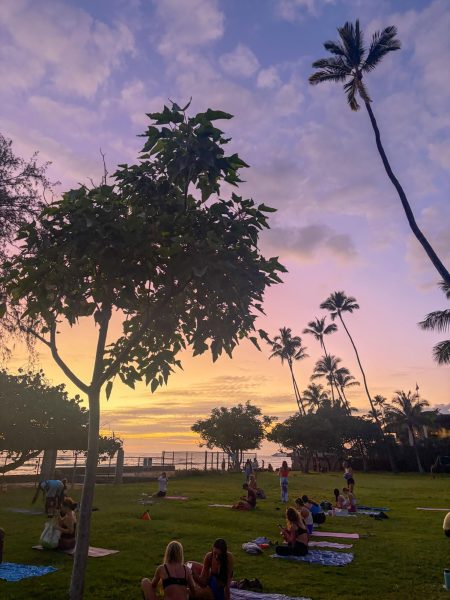
As the sun begins to dip below the horizon on Oʻahu’s south shore, Jackie Gocobachi moves through the grass, greeting familiar faces and adjusting her speaker as a group begins to gather at Lēʻahi Beach. Some arrive early, laying out their yoga mats and stretching quietly as they listen to the birds chirping overhead. Others wander in late, drop their bags, and join without hesitation. There is no front desk, no check-in, and no expectation. There is only the sound of the waves crashing against the shore, low music, and Gocobachi’s soothing voice inviting people to move.
For many University of Hawaiʻi at Mānoa students, scenes like this are becoming more familiar. As students continue to face academic pressure, financial stress and mental health challenges, yoga has become one way students are looking for balance outside the classroom.
At UH Mānoa, that interest is supported by the Student Success Center’s free weekly academic yoga wellness class, held on the second-floor roof of RISE. The class gives students a place to slow down, move and reconnect after a busy week.
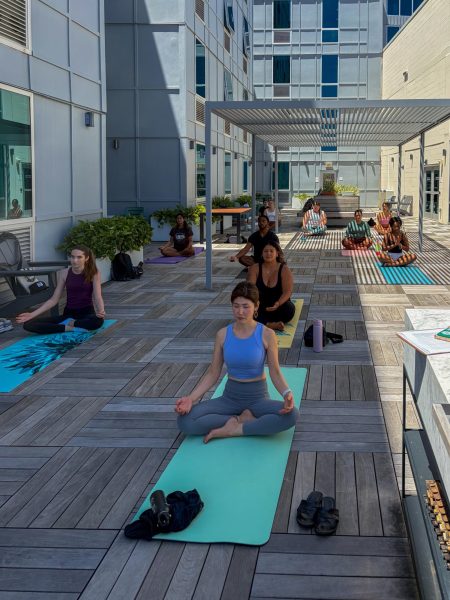
“When you think about student wellness, the academic journey cannot happen without mental and physical health,” said Kayoko Perkins, a Student Success Center coordinator and licensed yoga instructor. “We’ve built something like an academic wellness community. Students come back each week and start to feel like they have a place here.”
Across Hawaiʻi, yoga has grown far beyond a single image of quiet studio rooms and rolled-out mats. It now exists in campus wellness programs, open-air studios, beach parks, hotel lawns, community spaces and even farms.
That growth is part of what makes Hawaiʻi’s yoga scene distinct. The practice itself is rooted in ancient Indian traditions, with a history tied to breath, discipline, movement and meditation. But in Hawaiʻi, yoga is often shaped by the islands’ landscapes. Classes take place beside the ocean and under palm trees where the environment becomes part of the practice.
Perkins said the goal of UH’s class is not just physical fitness, but helping students build habits they can carry with them.
“You brush your teeth, you do yoga. It’s the same thing. It’s self-care,” Perkins said. “Even one session can help, but my goal is for it to become part of their lifestyle.”
The class began after Perkins pitched the idea to her supervisors about two years ago. At first, it was offered only a few times a semester. Now, it is held every week, giving students a consistent space to return to.
Perkins said she often sees a visible shift by the end of class. Students who arrive tense or quiet begin to soften.
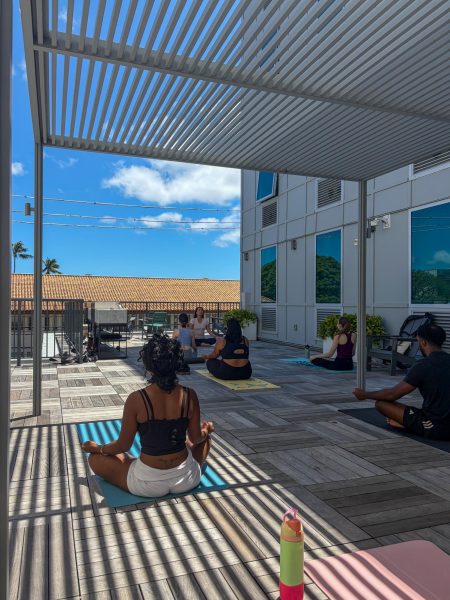
By the end, “their shoulders are relaxed, they’re smiling, and they’re starting to make friends,” Perkins said.
That sense of community is also what draws students beyond campus. Gocobachi, owner of the Outdoor Studio, started her beachside business in 2022 with the intention of removing barriers that often come with yoga studio spaces.
“I wanted to create an inclusive environment where no one feels any pressure to show up and that they have to pay anything,” Gocobachi said. “When I first started off, it was like, if you want to give, you can, but if you’re just here to show up, that’s it.”
What started as a small group of about 17 coworkers and friends has grown into a gathering of around 60 people, expanding mostly through word of mouth. Many attendees are students, sharing the yoga practice on the UH Mānoa shared Instagram story and bringing friends who may have never gone to a studio class before.
For McKenzie Heeb, a UH Mānoa junior and regular participant, that accessibility made yoga feel less intimidating.
“For me, this is such a good opportunity because I love that you can come if you can,” Heeb said. “It’s something I’ve begun to look forward to, and I feel like things in my body feel better when I do it. It gave me the accessibility and the opportunity to go from wanting to learn how to do something to actually doing it without it being scary.”
That fear of starting is one reason accessible yoga spaces matter. Studio classes can be expensive, and for beginners, they can feel intimidating. Outdoor and campus-based practices offer a different entry point, especially for students who may already feel overwhelmed by school, work and daily responsibilities.
In Hawaiʻi, outdoor yoga also connects to a wider culture of wellness. Yoga exists alongside other practices, including lomi lomi massage, meditation, surfing, hiking and ocean-based activities that emphasize the connection between body, breath and place. While yoga and Hawaiian healing traditions come from different cultural roots, both reflect the importance of physical, emotional and spiritual balance.
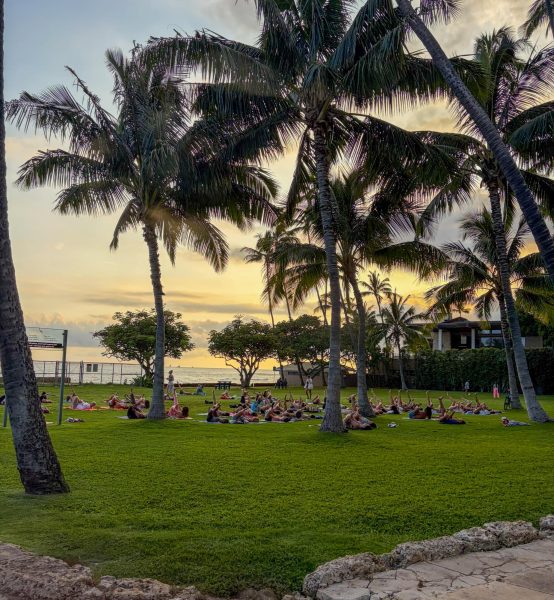
Experts say the benefits of combining movement with outdoor spaces are not just aesthetic. According to Dr. Gregory Bratman, a professor at the University of Washington, research shows time spent in nature combined with physical activity can reduce stress and improve overall well-being.
For Gocobachi, the outdoor setting is not a backdrop. It is part of the point.
Unlike traditional studios, the Outdoor Studio has no walls and no set structure. There may be wind, dogs, conversations, music from nearby groups or people walking past. Instead of treating those things as interruptions, Gocobachi sees them as part of the practice.
“It’s not a controlled environment. It’s real life,” Gocobachi said. “There are noises, people talking, a dog running around. But those distractions actually bring you back to the present.”
For Gocobachi and the community she has built, practicing outside is less about making yoga look beautiful and more about learning to be aware.
“Nature really challenges you to trust the moment,” she said.
At UH, Perkins said that kind of flexibility is especially important for students. The goal is not perfection, but participation.
Her class gives students permission to show up as they are, whether they are experienced yogis or just trying to make it through the week. In that way, campus yoga becomes more than exercise. It becomes a reminder that academic success is connected to the body students carry through their classes.
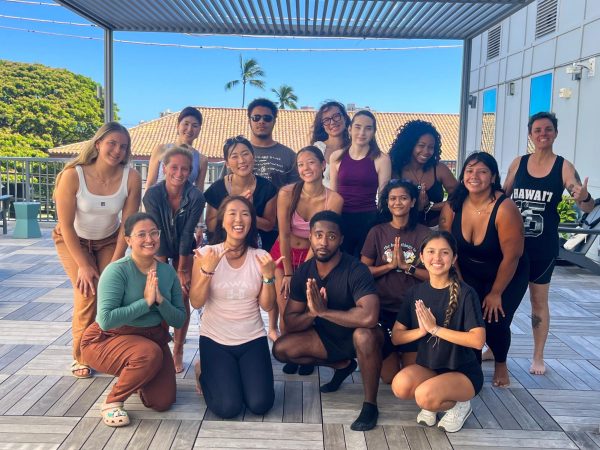
Gocobachi said that same idea guides the Outdoor Studio. Her goal is not just to lead a class, but to help people begin.
“I just want to get people started,” she said. “After that, they can take it and make it their own.”
Her practice on Lēʻahi Beach brings together people at different points in their lives.
“One person’s had the best day ever, someone else maybe had the worst day,” Gocobachi said. “Everyone’s in a different place, but we’re all here.”
As the class winds down, participants sit facing the ocean, watching the sunset. Some stay to talk or to get a hug. Others leave quietly. There is no required ending to the practice, only a shared experience and a moment of community before returning to the rest of their day.
Despite growing demand, Gocobachi has chosen not to expand the Outdoor Studio too quickly.
“I believe in quality over quantity,” she said. “I want to be consistent for my community.”
For now, whether on a rooftop at UH Mānoa or in the grass at Lēʻahi, yoga continues to offer students and residents a space to pause, move and reconnect.
“Movement is medicine,” Gocobachi said. “It’s a privilege to be able to move.”






Vikki Reynolds • May 7, 2026 at 4:04 am
Such a wonderful article! Made me feel i was right there and made me want to try it!
Jeanne Anderson • May 6, 2026 at 5:51 pm
This is such a beautiful opportunity for the students and community! Thank you for sharing!