

Black faculty are present on the University of Hawaiʻi at Mānoa campus, yet many say they are often unrecognized.
At the UH Mānoa, Black faculty make up about 1% of the population, according to College Factual.
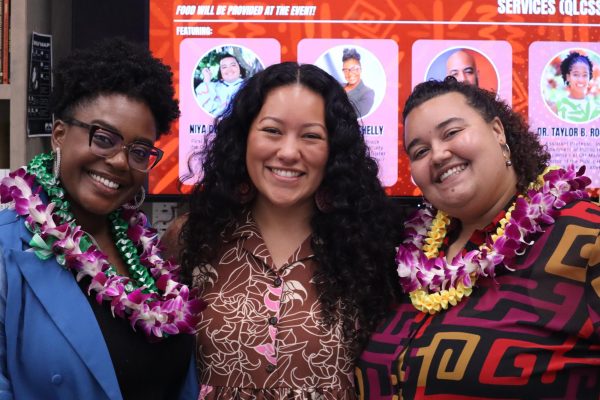
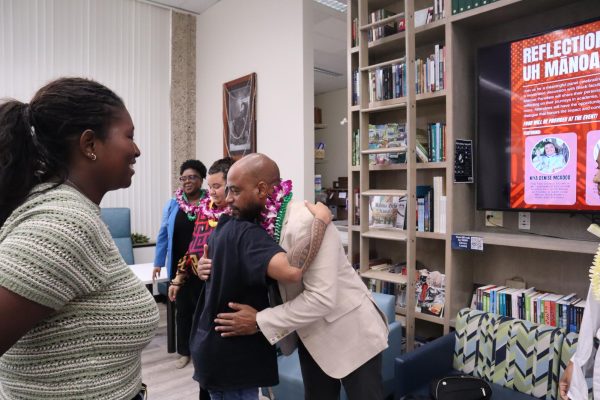
ASUH and the Black Student Association collaborated to host a panel titled “Reflections of Excellence: UH Mānoa Black Faculty Panel.” The panel featured Dr. LaJoy A. Shelly, an assistant professor in the Department of Educational Administration; Dr. Taylor B. Rogers, an assistant professor in the Department of Public Health Sciences and director of the Public Health Workforce Initiative; and Dr. London Thompson, a program coordinator at Windward Community College. The discussion was facilitated by Niya Denise McAdoo, a first-year doctoral student in the Department of Educational Administration, president of Black Student Association and co-founder of The Sister Circle at Mānoa, an organization dedicated to supporting Black, indigenous and other women of color in academic and social success.
The discussion centered on uplifting Black faculty at UH Mānoa and highlighting their lived experiences, the emotional and intellectual labor they often carry, and the guidance they can offer to undergraduates, fellow faculty members, and administrators.
“The goal of this event is to honor these experiences by engaging with curiosity so that we may understand how to better support our Black faculty and the Black community broadly at UH Mānoa” McAdoo said.
Panelists opened the discussion by sharing their path into how they each ended up in Hawaiʻi , recounting a crucial experience.
For Shelly, the path to Mānoa began in Blytheville, Arkansas. She moved to Hawaiʻi in 2014 after marrying a Navy submariner. What began as a relocation soon became an academic calling. After connecting with Drs. Stacey Roberts and Dr. Erin Kahunawai Wright of the Educational Administration faculty, Shelly found mentorship and inspiration that led her to pursue graduate studies with the program. That decision ultimately shaped her trajectory into academia, where she now serves as an assistant professor in the Department of Educational Administration.
Rogers’ journey started on the East Coast in Maryland. She completed her doctorate at UCLA in 2023 before undertaking a two-year fellowship at the University of California San Francisco, working remotely in public health research and workforce development. Eventually, an opportunity opened at UH Mānoa, bringing her to the islands.
Today, as an assistant professor in the Department of Public Health Sciences and director of the Public Health Workforce Initiative, Rogers teaches courses focused on health policymaking, health policy advocacy and the structure of the U.S. health care system, equipping students to understand and influence systems that shape community well-being.
For Thompson, the road to higher education was anything but traditional. Originally from Philadelphia, Thompson built a career in the music industry as a producer, songwriter and engineer, owning multiple recording studios. But the 2008 economic crash upended that chapter of his life, forcing him to close his studios. Around the same time, his wife who had vacationed in Hawaiʻi began exploring the possibility of relocating to the islands. The move marked a turning point.
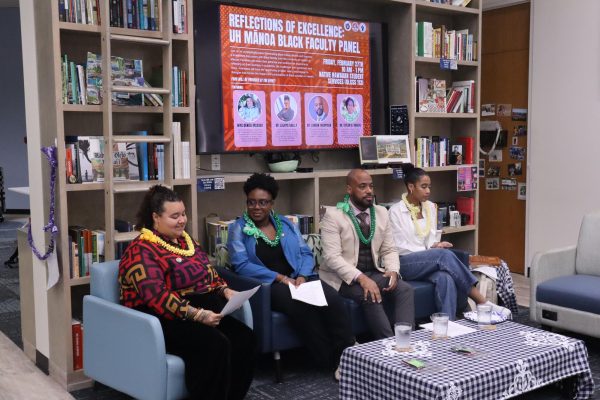
McAdoo explained that Black faculty exist within a layered context in Hawaiʻi at a predominantly non-Black institution situated in a place with its own deep histories of education, resistance, and sovereignty. Within this setting, Black faculty often navigate hypervisibility and invisibility at the same time.
Shelly reflected on her transition from student at UH Mānoa to faculty member and that the shift in title did not always translate into a shift in power. She shared that there were moments when she felt her positional authority was questioned or minimized despite her credentials and role.
“Our work has been mischaracterized as being combative and angry,” Shelly said. “I see the way that Black women, as part of my research, are socialized into service not just in the professoriate but almost from the beginning when our feet touch campus. We are socialized into serving the institution.”
The Black experience as faculty can also come with added pressures including being perceived as a DEI hire, being expected to organize cultural events, or serve as the default ambassador for the Black experience on campus.
Rogers recounted that in early August 2025, before she had even arrived on the island, she was invited by another faculty member to serve on a panel. “I definitely had moments where I felt like I don’t know why the other two faculty aren’t at the same level of ‘Do you want to join this committee?’” Rogers said.
She also reflected on her experience during Black History Month noting that her department did not push to organize any programming.
“One night I was reflecting and I was like, I don’t think anybody said anything at the department level and I was like I don’t want to have to plan it. But, I knew if I didn’t do it that space wouldn’t have been there and the acknowledgement wouldn’t have been there,” Rogers said.
Thompson spoke about how the lived experience of Blackness in America creates a distinct empathy that Black faculty often carry.
“It’s like a superpower. You have to be there and experience it to understand it. And so it helps you give a level of empathy with all students. Unfortunately though because of racism and white supremacy it does affect people in a way that they are not able to have those levels of energy,” Thompson said.
Adiatu Rieth, a senator for the College of Arts and Sciences and vice chairperson of the Internal Affairs Committee for ASUH, said she first brought up the idea of collaborating with the Black Student Association.
“I was thinking about our Black constituency’s visibility. I was walking around and seeing more Black people than I had probably ever seen in my life,” Rieth said.
Rieth shared that she had previously attended predominantly white institutions and described UH Mānoa as an eye-opening experience in terms of diversity, particularly regarding Black students. She also explained that the foundation of the Campus Life Committee is centered on fostering unity.
“The whole premise of the Campus Life Committee at a fundamental level is to unite the constituency. And I think you can’t necessarily unite a constituency if you don’t recognize parts of them. So it was a really amazing idea to highlight Black faculty members and Black students in general because I think that’s a demographic of students that we don’t necessarily highlight a lot,” Rieth said.
Mianah Burdin, a UH Mānoa graduate student who attended the event, said she first heard about the discussion on social media and saw it as the perfect opportunity to engage with a panel of higher education faculty who looked like her.
“I definitely want to implement some of these lessons into my own journey. It was valuable to hear about the challenges they faced at the institutional level and in teaching because that is something I am hoping to explore—possibly entering a space where I can teach. Anything I can learn now is definitely helpful. I also appreciated hearing their perspectives on both successes and challenges as African American women and learning how to navigate these spaces from people willing to share their experiences and guidance,” she said.