

A young Maya Soetoro often attended classes with her mother.
“I remember hearing birdsong, feeling the trade winds blow through the windows,” Soetoro said, recalling sitting in the corner of an open-windowed classroom, before the time of air conditioning.
“There was even a professor who would smoke Indonesian clove cigarettes while teaching, because you could do that in the ‘70s.”
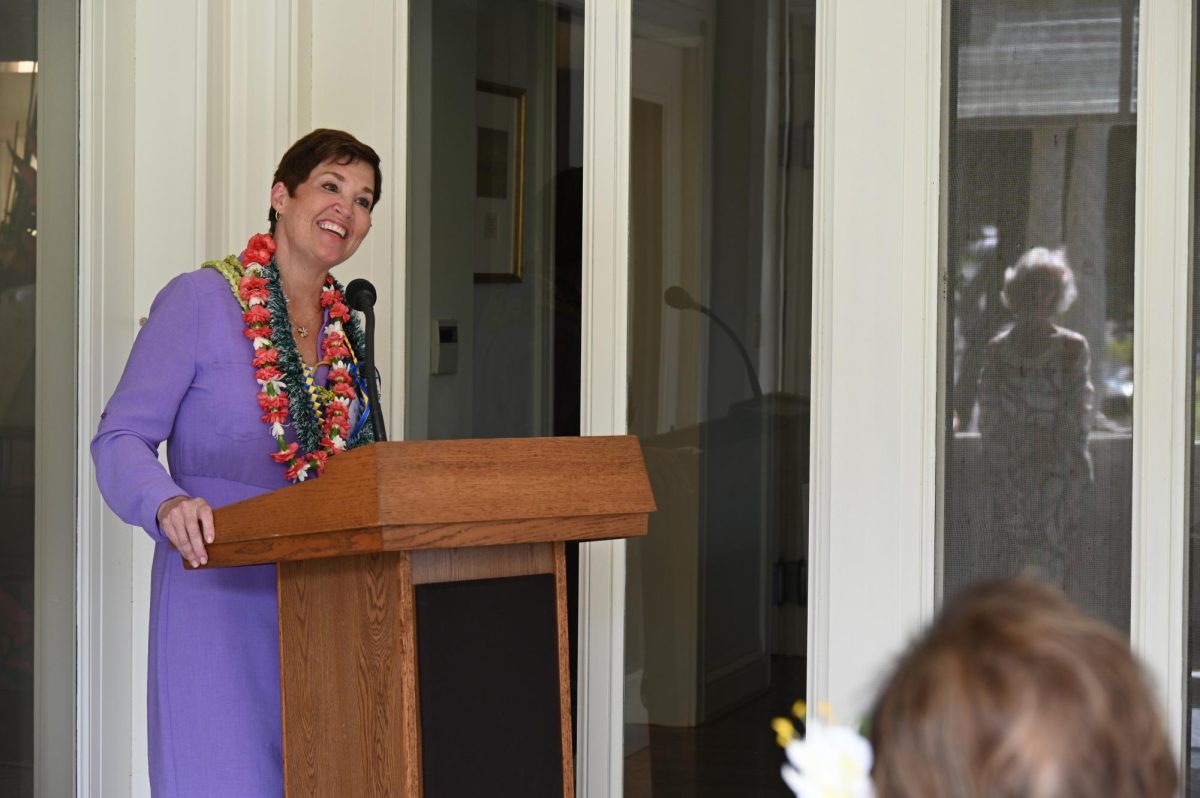
About half a century later, Dr. Soetoro is an associate specialist at the Matsunaga Institute for Peace. She is newly decorated with a “Live Long & Prosper” Tribute Award from the Nimoy-Knight foundation, named for Star Trek actor Leonard Nimoy who portrays the iconic Mr. Spock.
The “Live Long & Prosper” or LLAP Tribute Award celebrates “those who make extraordinary contributions to their communities, embodying the values that Leonard Nimoy championed throughout his life,” according to the Nimoy-Knight Foundation website. The award reflects her contributions to community building and promotion of diversity, equity, and inclusion through her teaching and various charities.
Soetoro said she feels some connection with the character Mr. Spock. While Spock grapples with the polarities of being human and vulcan, Soetoro too navigates a mixed-race identity. And both have used their talents to become bridge-builders between worlds.
As an educator, Soetoro applies her research and experience to further multicultural education and train the next generation of leaders and storytellers. As an advocate for peace, she is a cofounder of three non-profits where she continues work. In the midst of her accomplishments, she is a mother, a daughter, and an invaluable community member.
Soetoro encourages her students to see the truth from multiple vantage points. Her philosophy is cuci mata, an Indonesian phrase which translates as “to wash the eyes.” Most use this phrase lightly – one might say it when lavishing at a beautiful vista at the end of a long day, or when a cute stranger passes by on the street.

Soetoro thinks of cuci mata with a greater depth of meaning. She washes her own eyes with the work she does, using the ability to see things anew, through the gaze of others, to find restorative narratives in the midst of tragedy, and to commit to the hopeful possibility of peace-building for the future.
The Classroom and Beyond
Dr. Soetoro believes in a ground-up approach to change.
Reflecting on the phrase, “think global, act local,” Soetoro emphasized the need to “think local” when advocating for change in one’s community.
“Thinking local is about honoring the wisdom of place, of ancestors, and of culture and community,” Soetoro said.
In her classes, Soetoro teaches peace-building through a community-centered lens. She instructs her students to approach systemic change with empathy, compassion, and understanding.
Soetoro described the experience of looking into another person’s eyes, hearing their story, and truly feeling the impact of her words on them. She said that, after doing this, it’s hard to dehumanize or “other” someone else.
“That’s a really brave space of change,” Soetoro said.
For Soetoro, nourishing dialogue goes beyond sitting in the classroom and reiterating the same points. Instead, Soetoro helps students to grow their capacity for discomfort, stretching beyond their previous boundaries to reach something new.
Sometimes, Soetoro will give her students 10 different stories of the same event from different cultures or communities to compare. Other times she’ll employ structured academic controversy debates, having her students defend both sides of an argument. Throughout activities like these, she encourages students to see the meaning between words to arrive at a fuller picture of the truth.
The Matsunaga Institute for Peace provides students with opportunities to expand their skills in leadership, conflict resolution, and community building. Director Colin Moore praised Soetoro’s skills in teaching one of the program’s most popular courses: leadership for social change.
Sophia Lorentzen, a recent UH Mānoa graduate and former student of Soetoro’s, described the way that Soetoro teaches leadership as going much deeper than she expected.
Lorentzen recalled how Soetoro encouraged self-study in her leadership class. The course helped Lorentzen to understand that true skill in leadership comes from experience, confidence, and self-understanding.
Like many UH students, Lorentzen bounced around departments before landing on a double major in peace and conflict resolution and Spanish and Latin American studies.
Lorentzen reflected on the way that Soetoro was able to create community even within online classes. While it can be difficult to form connections over Zoom, Lorentzen said that she felt connected to Soetoro even through a screen. When Lorentzen had the chance to run into Soetoro in person, she recalled immediate recognition and a warm hug.
Outside of the classroom, Moore says that Soetoro has always been one of the faculty members who works most directly with the community.
Soetoro says that she draws strength and hope from this work. With community-building practices and traditional ecological knowledge, Soetoro hopes to join new techniques with those from a pre-colonial past, reviving traditions to look toward the future.
While some might find it difficult to conceptualize how one can teach peace building, to Soetoro it’s simple.
“If we are demonstrating kindness, helping kupuna or keiki, that’s an act of peace-building,” Soetoro said. “If we are working in the fish pond or nourishing the farms for food security, that is peace building.”
Outside of her work with the Matsunaga Institute, Soetoro has cofounded three charities: The Peace Studio, Ceeds of Peace, and the Institute for Climate and Peace. She dipped her toes into the world of politics campaigning for her maternal half-brother Barack Obama during the 2008 presidential election and remains involved with the Obama Foundation’s Leaders Asia-Pacific Program.
Soetoro says that the flavors of Mānoa are infused into her memory. She recalls meals at Hale Mānoa with her mom, remembering the open kitchen where women from a variety of Pacifica and Southeast-Asian backgrounds would cook and eat together, the scents mingling delightfully in the air.
Soetoro’s work with the Obama Foundation’s Leaders Asia Pacific Program now helps to uplift leaders from the same communities that nourished her as a child. Describing her return to UH Mānoa, Soetoro expressed gratitude for the full circle that brought her back.
“My students are my antidote to grief,” said Soetoro. “[They] make me feel an ongoing sense of possibility and wonder.”
Illuminating Ann Dunham
It makes sense that the University of Hawaiʻi at Mānoa would be a natural landing point for Dr. Soetoro, as it is where her late mother Ann Dunham earned all three of her degrees.
The inspiration that Soetoro draws from her mother goes far beyond the bounds of the university. As an economist and anthropologist, Dunham’s work brought her and her daughter on travels around Southeast Asia, where Soetoro witnessed the communities which would help inspire her future work.

Soetoro remembers communities of women in places like Indonesia, Pakistan, and Bangladesh. She recalled the courage and innovation they demonstrated as cultural bearers of their communities, even in the presence of struggle.
Ann Dunham worked with a variety of tradespeople—weavers, potters, cobblers, and blacksmiths to name a few. With the exception of blacksmithing, which was mostly men, many of the forces that made up these trades were women. Soetoro recalls how, at a time when many were focused on urbanization, Dunham was studying the potential of cottage industries to keep economies strong.
Soetoro described how this work helped to inspire one of her non-profits, the Institute for Climate and Peace, to focus community-source solutions, especially in communities that take the brunt of climate change.
“Not to invent new solutions,” Soetoro said, “but to harness valuable traditions, and to think about utilizing them for a new purpose.”
Soetoro helped to publish her mother’s dissertation on blacksmithing in Indonesia in 1992.
While Ann Dunhan inspired some of her daughter’s community-based work, her legacy can also be seen in Soetoro’s personal and creative endeavors.
“I named my daughter Suheila,” said Soetoro, “because it means ‘the glow around the moon,’ as I understood it. My mother loved the moon, because everywhere she went she said the moon was the same. Whether she was on a fire escape in New York, or a beach on Hawaiʻi, or a rooftop in Jakarta, the moon was always the same.”
Soetoro recalls her mother waking her up in the wee hours of the morning just to look at the full moon. While at the time she resisted being drawn from the comfort of her bed, she now holds those precious memories close to her heart.
Ann Dunham passed away at 52 years old in 1995. Years later, when Soetoro was pregnant with Suheila, she found a box filled with books and toys. On top, it read in her mother’s handwriting: “for Maya’s children.”
Soetoro thought that she could at least share this with her children, though they would never get to meet their grandmother. Then, she continued to think about the stories of her mother that she might share. It was this line of thought that prompted Soetoro to wonder what lessons Ann Dunham would have taught her granddaughters, leading to the creation of the book “Ladder to the Moon.”
The book follows Suheila as she wonders about her grandmother. Her mother says that she would wrap her arms around the whole world if she could. That night, Suheila hears the tinkling of bangles and looks to see her grandmother on a golden ladder leading up to the moon.
“They go up there,” said Soetoro, “and they see so much that is beautiful and brave on Earth, but they also see a lot of hurt, a lot of suffering. They invite people to come up to the moon and the moon becomes a sanctuary and a place of solace and connection.”
“And so I think the lessons,” she continued, “as I see it, are that sometimes we need to change our vantage point, wash our eyes, and Mom was always about seeing things from other perspectives.”
Building a Better Future
While Soetoro praised her mother’s skills in academia, she herself leans more towards the community-building aspects of her work.
Soetoro sees the progress made during her lifetime as she envisions a future for her daughters. She described a higher expectation of professional conduct toward women today than when she was first entering the workforce. Nevertheless, Soetoro finds that many of the women she works with tend to experience some imposter syndrome, or even diminishment in public settings.
Despite the work that remains to be done, Soetoro said she is inspired by women’s work happening all around the world.
“Seeing so many strong women doing great and imaginative things,” said Soetoro, “has enabled me to feel the presence of this sisterhood, and to be fortified by it, and to know that anything is possible.”
Soetoro emphasized that it is important not to fall into a place of despair, and encouraged taking inspiration from tangible movements. She reflected on opportunities available through various organizations, such as the girls opportunity alliance of the Obama Foundation.
Former student Lorentzen said that in competitive spaces, one can be overcome by the need to be assertive. In the midst of this pressure, she’s inspired by Soetoro’s ability to remain kind and empathetic.
When informed of the LLAP award, Lorentzen said that she thinks Soetoro deserves it more than anyone.
“She’s so easy to look up to,” Lorentzen said.
Soetoro brings new techniques to the classroom to expand multicultural education, moving beyond a view of culture as fixed, or unchanging, and instead embraces the dynamic and hybrid nature of our globalized world.
Modern technology allows access to hybrid worldviews to further understanding between cultures and communities. Soetoro notes that we are all, just like Mr. Spock, hybrids of some kind.
Soetoro encouraged all people to see themselves as sojourners, to remember we have more than a single story, to listen deeply, and to remain curious.
“We give a lot of our energy to images and voices of violence, oppression, and injustice,” Soetoro said.
In the midst of these images, she encouraged finding strength in community.
“If we can find this restorative and strength-based approach, then we don’t despair, because we know that all is not lost,” she said. “There’s a lot worth fighting for, working towards, caring for and preserving, but also growing and transforming.”