

University of Hawai‘i at Mānoa student Carlos Ochoa-Marquez is currently more than 3,000 miles away from his parents, immigrants from Mexico who now live in Colorado.
“I live in fear that ICE is just going to go to our house and take them when they’re both legal residents,” said Ochoa-Marquez.
Immigration and Customs Enforcement (ICE) has a small, but growing presence in Hawai‘i, which is, on its own, a cause of concern for many. But what about for college students whose families reside in the continental U.S., especially in areas where violent immigration crackdowns have become a norm?
UH Mānoa proudly touts its diverse student body—and with this diversity, it’s unsurprising that members of the UH Mānoa community are speaking out against the actions of federal immigration enforcement officers in the wake of the killings of Alex Pretti and Renee Nicole Good.
Outrage over this state-sanctioned violence has bridged the physical—and often ideological—distance separating Hawai‘i from the other states. Ochoa-Marquez believes that this is an issue that affects everyone, not just undocumented immigrants. In a time of fear, he was inspired to speak out on behalf of his parents.
“They fought really hard to be in the country and give me and my little brothers a future,” said Ochoa-Marquez.
Now, it’s his turn, “I’m here fighting for their rights to stay in the country. I’m here to try to make a difference for people who are living away from home.”
Ochoa-Marquez was one of hundreds of protestors at the ICE Out Walk Out held at the UH Mānoa Campus Center Courtyard on Jan. 29.
Hosted by the UHM College Democrats, Refuse Fascism Hawai‘i, the Young Democratic Socialists of O‘ahu, Anakbayan Hawai‘i, and Indivisible Hawai‘i, the event also included guest speakers from various student groups.
Many students came with signs in hand, displaying messages ranging from “Ice Out of Native Land” to “Fight Fascism.”
“College students are always the first people on the ground making change happen,” said UH Mānoa political science student and Black Student Association member Ariel Hall. “It is important for us to be here together because it ultimately affects the futures of all of us.”
Turning outrage into action
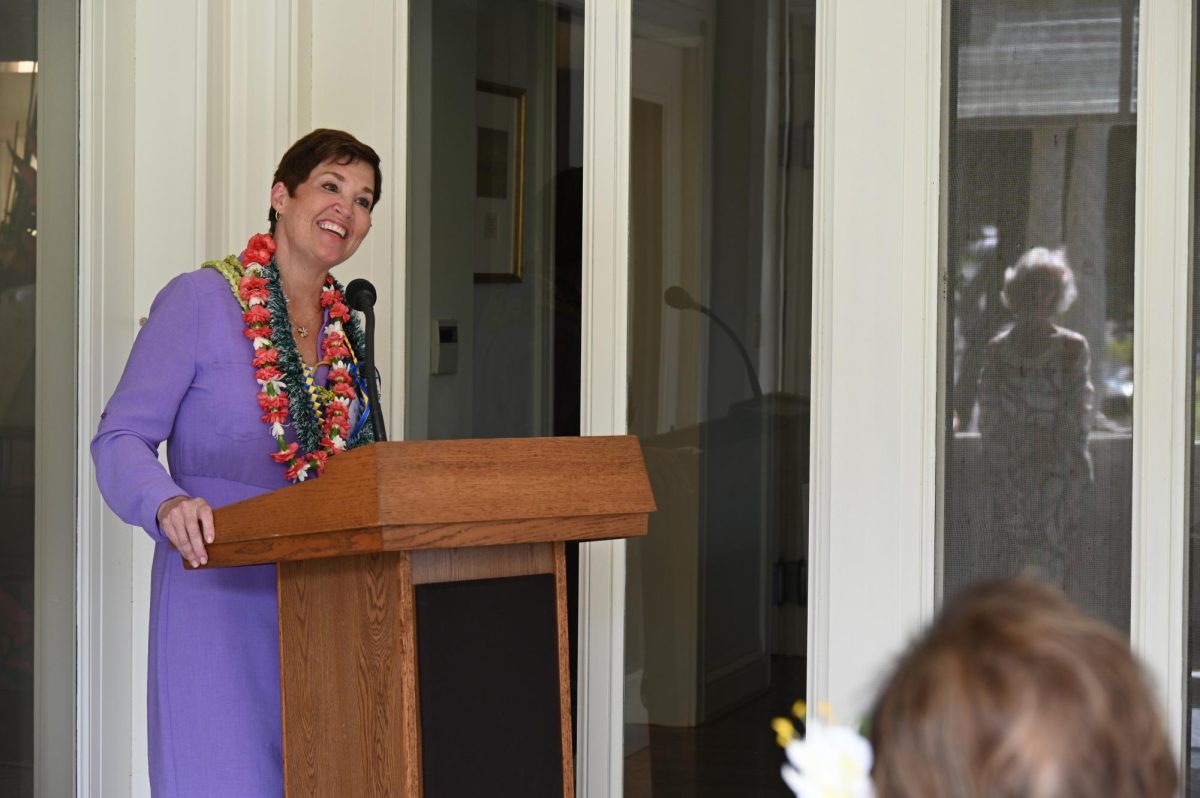
The rally featured a surprise appearance from Hawai‘i State Rep. Della Au Belatti, who spoke on the importance of channeling energy into the democratic process.
“I got the call from my daughter who’s a student here and she said, ‘Mom, it’s happening. We’re going to walk out,’” said Belatti. “And I said, ‘Okay, I’ll come watch and participate.’”
Belatti highlighted a bill she introduced, HB 2540, and its counterpart, SB 3322. If passed, these pieces of legislation would place restrictions on facial coverings, lack of visible identification, and civil immigration interrogation by law enforcement officers.
“I would like to see the support of the hundreds of students that are here to support those kinds of bills because we need to convert this outrage into action,” said Belatti.
Limitations from the state
While the State of Hawai‘i does not align itself completely with the current administration and its immigration policies, concerns exist over what will happen when push comes to shove.
“Our states will not hesitate to respond if [President Trump’s] words become illegal actions,” a joint statement from Hawai‘i Attorney General Anne Lopez and 10 other state attorneys general declared, “As state attorneys general, we have a responsibility to enforce state laws—and we will continue to investigate and prosecute crimes, regardless of immigration status. We will not be distracted by the President’s mass deportation agenda.”
However, as Civil Beat reported, all four counties have agreements with Homeland Security Investigations (HSI), a unit of ICE.
Some state lawmakers are seeking to change this; if passed, SB 2056 would prohibit state law enforcement from entering unlawful agreements with federal or out-of-state agencies, including the Homeland Security Task Force.
As a public institution, the University of Hawai‘i is prevented from fulfilling certain student demands, especially when it comes to calls for establishing UH Mānoa as a sanctuary campus.
“UH does not operate a campus police force on any of its 10 campuses and does not have the legal authority to declare sanctuary status,” reads one of the UH Immigration Enforcement FAQ answers. “However, the university is committed to protecting the rights, privacy, and safety of all members of its community, regardless of immigration status, in accordance with our laws and policies.”
The page does outline guidance for UH students and faculty, stating that “faculty are not authorized to allow entry into classrooms or nonpublic spaces.” It also underscores a directive for staff to protect student privacy.
As of an update on April 7, 2025, there have been no reported immigration enforcement actions or arrests on any UH campus.
University voices encourage education, solidarity across Hawai‘i
“On campus, it’s good to get other students involved, but I really want to reach out to the larger community,” said UH Mānoa psychology major Jordyne Johnston.
Over the past year, Johnston has participated in protests against the Trump administration and ICE, back in her home of Las Vegas and at the Hawai‘i State Capitol.
“As an outsider and as someone who’s also Pasifika, even though not native Hawaiian, I feel like it’s my responsibility to stand up for those Native Hawaiian voices and also try to just be one for the community,” said Johnston.
Hawai‘i also has a unique perspective in this struggle against injustice, according to Dr. Nandita Sharma, a UH Mānoa professor of sociology with expertise in international migration.
According to Sharma, colonization, the plantation system, and the internment of Japanese-American citizens during World War II all influence how people understand what the federal government can do to them, as well as how the federal government has violated their constitutional rights in the past, and continues to do so in the present day.
“So I feel that in Hawai‘i, we have a lived experience of and a shared knowledge of what is possible, and we need to counter that,” said Sharma.
Sharma believes that one of the simplest ways to begin countering federal government overreach is knowing your rights. As a graduate chair, Sharma has helped host “Know Your Rights” training sessions with the Graduate Student Organization, attended primarily by international students.
“As a researcher who knows this stuff inside out, I have a responsibility to share that information and educate not only in the classrooms that I teach in at UH, but also do political education outside of UH,” said Sharma. “I also feel it’s my responsibility to use the education that I have and the knowledge that I have about anti-immigration politics to build a movement against it.”
UH Mānoa students seem to have led by example, with high school students across Hawai‘i joining the fight, and organizing their own protests against ICE.
“Universities are a site of education, and education lifts the clouds from our eyes and allows us to really clearly understand what is going on in our world,” said Sharma.