
The “Forms of Void” exhibition fulfills a 15-year promise between painter Kloe Kang and ceramicist Suzanne Wolfe.
Wolfe and Kang began this dialogue during the developmental phase of their joint show, “Working Together,” in 2007. This is where the artists challenged themselves to not only share preexisting ceramic tiles as their medium of choice, but also a studio space. The ceramic tile medium would act as a middle ground between the two artists’ specialties.
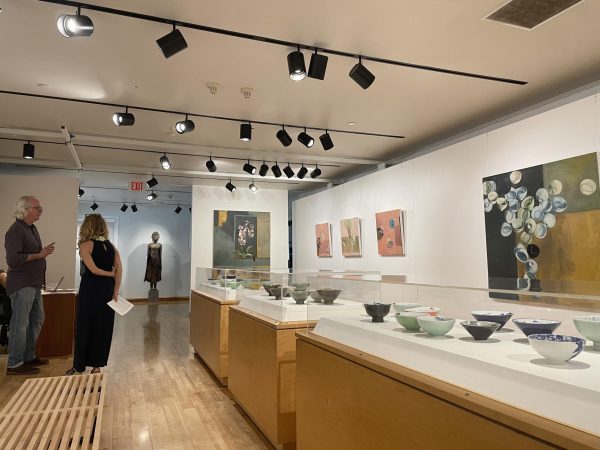
In the gallery, the audience is immediately met with the banquet-like arrangement of Wolfe’s ceramic pieces down the center of the room, sitting on table-like pedestals. Kang’s paintings surround this banquet with a presence that varies in scale and palette, finding a balance between the two-dimensional and three-dimensional.
Despite the artists working in vastly different mediums this time, the connection is undeniable. Even though bowls are considered a basic ceramic form, influenced by her travels to China and an archive of imagery, Wolfe reworks this collage into its utilitarian shape. For Kang, the bowl is more personal and symbolic for cultural identity, tying her Korean heritage with her life in Hawai‘i.
Katherine Love, artist and associate curator of contemporary art at the Honolulu Museum of Art, was invited to speak at the artists’ round table event on Feb. 1 because of her familiarity with both artists.
Love has been a long-time friend and peer of Kang, attending graduate school together at the University of Hawai‘i at Mānoa. She was also acquainted with Wolfe’s works during her time as a professor of ceramics and through her exhibition of “Cuptopia” at the Contemporary Museum at First Hawaiian Center in 2011.
Love and Kang led the conversation with a thematic understanding of the artists’ use of bowl forms in the creative process. Regretfully, Wolfe was unable to make the event.
Kang introduced the audience to the bowl form using a story of her friend gifting her a rice bowl. She had kept the bowl for years, using it early on during her painting process as a visual reference.
One day, she dropped the bowl. It was after it shattered and her attempt to repair it that she realized she could still use the bowl as a reference. Kang discussed the philosophy of Kintsugi, the Japanese art of repairing broken pottery with gold.
For Francesca Richmond-Buccola, a senior biology major who works for the art history department, the exhibition offered her a glimpse into the hidden world of Kang’s creative process. Richmond-Buccola was impressed by the way Kang would deliberately render the imperfections in her painted bowls after it had broken.
“Some of the bowls have cracks in them… I really like that because it’s almost like, you know, nothing is perfect. And that’s still important,” she said. “You can still make something as beautiful as it was before. I really like that she had that kind of meaning behind all of this. Everything’s intentional.”
Richmond-Buccola was also particularly drawn to the details and hidden “easter eggs” within both artists’ work.
Love also highlighted how Kang works from her home, with her canvases hanging on a wall close to her kitchen. It’s this proximity to domesticity—playing with the idea of serving food and consumption while the bowls remain empty in her pieces—that infuses aspects of utility and symbolism.
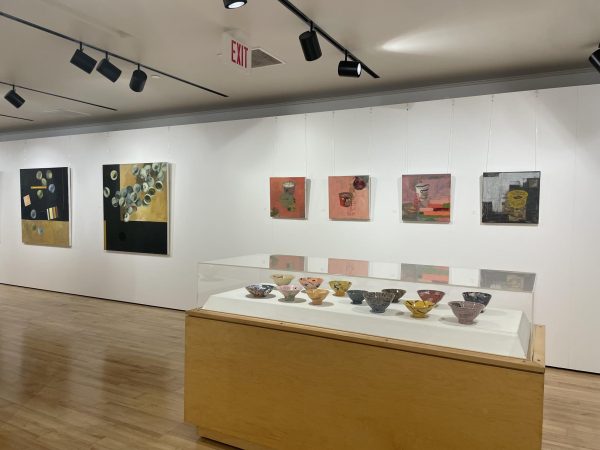
Wolfe’s works act as more of a visual archive, using a collection of decals and transfers from over the years to layer on meaning. Running from women’s magazines to Tibetan medical books, Love notes how she layers atmospheric imagery with more graphic text, which rewards viewers who take the time to absorb her work.
“You get a strong first impression,” Love said. “But then you look closer, and you get an understanding of the time they’ve spent on it. You notice the underlayers, the feeling of depth and richness.”
Ultimately, “Forms of Void” is a conversation of the bowl-form through 15 years of friendship.


Adrian • Feb 18, 2026 at 8:12 am
So great! Beautifully written article.