

This article was originally published on Dec. 4.
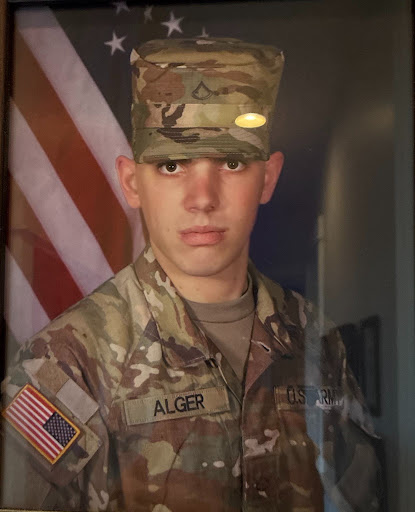
Eric Pōmaikaʻi Gee, who was born and raised in Waimea on the Big Island, sees Antarctica’s importance for future generations.
The 19-year-old international business student at UH Mānoa joined polar explorer Robert Swan’s ice expedition on Nov. 29, hoping to advocate for Antarctica’s preservation and to take an active, hands-on role in making a difference.
He’s concerned that without proper protection, the continent could face environmental exploitation, potentially resulting in ecological harm and worsening climate change.
“I’ve seen the changes of how our climate has shifted throughout the years especially on Big Island,” Gee said. “Places that used to have significant levels or high levels of precipitation have drought now. Places that have drought, all of a sudden have significant flash flood rates.”
The Ice Station Expedition aims to promote continued efforts to preserve Antarctica opposing the renegotiation of the Antarctic Treaty in 2041. Swan, who is also an environmental activist, created the “2041 Foundation” seeking to encourage the youth to conserve the Antarctic in support of the treaty that promotes peaceful scientific exploration, protects wildlife and keeps the continent free from international disputes.
Gee believes that relying on renewable energy will eventually become essential for sustaining life. He notes that one of the goals of their expedition is to show that renewable power can be used effectively on a large scale and in hostile environments, as the Ice Station will operate entirely on renewable sources. While he acknowledges that renewable energy is not yet as efficient as natural energy, he holds that improving how people harness renewable power is important.
“My future children shouldn’t be born into a world where there’s already detrimental impacts that can’t be undone because of previous, and Antarctica is not habitable, so we just go down, mine it,” he said. “This is going to start being discussed within the next decade, so it’s important that we start bringing youth voices to it, and empowering youth voices and ensuring that people know what it [the Antarctic Treaty] is, so that people can start being educated on this issue.”
Gee, who aspires to make a positive impact in public policy after graduating, was one of only two individuals chosen through the Villars Institute Fellowship Program. He is proud to be the only American youth selected for the expedition and is enthusiastic about this opportunity, which adds to a series of meaningful experiences he has had, including serving as the first chairperson of the Big Island Youth Commission.
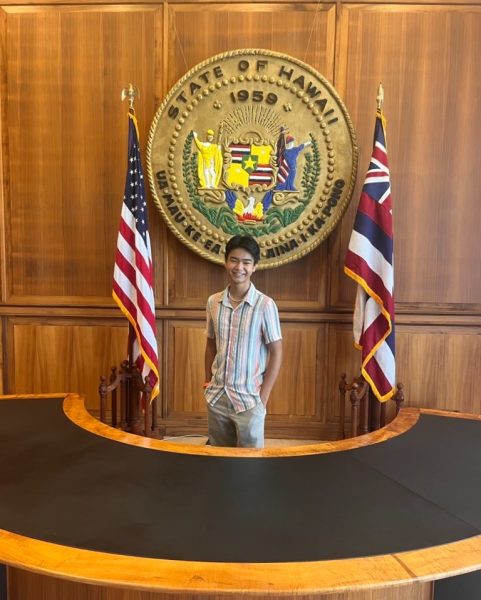
(Eric Pōmaikaʻi Gee)
“One of the biggest honors of my life was to be able to really implement true ideas. We all came in very hungry to get started, hungry to get work done, hungry to really accomplish these goals that we had in mind,” Gee said. “So as the chairperson for that commission, it was really my goal to elevate and empower all the voices of the commissioners, as well as the young people in the communities and as well as my own.”
During the three-week expedition, Gee will spend four to five days in Chile meeting with local organizations involved with Antarctica and speaking at local middle and high schools to share their mission. Even before they depart, the team has already begun their advocacy projects there.
The expedition will feature several projects, including a leadership program led by Swan, who is the first person to walk to both the South and North Poles on foot. The team will also conduct research for NASA, gathering samples that will support studies in climate science, atmospheric chemistry and analog research — work that will help NASA better understand extreme environments, including those similar to conditions on Mars.
“We’re also going to be doing an eDNA [Environmental DNA] program where we’re going to be collecting and analyzing eDNA samples,” Gee said. “So we’re looking for traces of organisms and bacteria in snow, ice and water, and mainly looking for biodiversity within Antarctica, which I think is really cool.”
Gee hopes to address the deeper issues that extend beyond the projects of the Ice Station Expedition. He wishes to educate young people about climate change and its connection to Antarctica. While he recognizes that global issues can be difficult for many to believe due to misinformation, he remains strongly convinced that these environmental challenges the world faces are supported by scientific evidence.
“We need to be aware that if Antarctica melts as well, and all these places with ice melt, sea levels are going to rise,” he said. “A majority of tourist destinations are on the sea level. Honolulu is on the sea level. LA is on the sea level. New York City is right on the sea level. All of these cities are directly going to be impacted by climate change.”
As a young person living in Waikoloa, a small Big Island town of fewer than 8,000 residents, Gee believes that people must prioritize lasting solutions instead of relying on deterrents. He also thinks that Hawai’i offers significant potential and opportunities to support environmental efforts despite environmental decline over the past century, influenced by tourism and military activities.
“The tourism industry here is continuously growing. Hawaiian Airlines just got bought out by another airline. We’re losing the soul of what Hawai’i really is,” he said. “And that’s sad for me, growing up here, seeing all these things that I saw growing up seeing, like the Royal Hawaiian hotel sold, all these things that are happening like we’re moving further away from what Hawai’i really stands for, and we’re going to this idea, this depiction of what Hawai’i and paradise should be like.”
He believes that people, especially younger generations, should take part in global affairs and societal improvements, principles he gained from his life in Hawai’i and its traditions of togetherness and respectful stewardship of the environment.
“I would say that a lot of the time, we are wondering ‘why,’ and we’re not thinking about ‘how,’” Gee said. “We think, ‘why is this happening?’ ‘Why are we going down this path?’ We need to be moving towards the how. How can we find solutions that are going to elevate and raise this community, bring communities together, and how are we going to improve the lives of as many people as possible? Because that should be the true goal.”