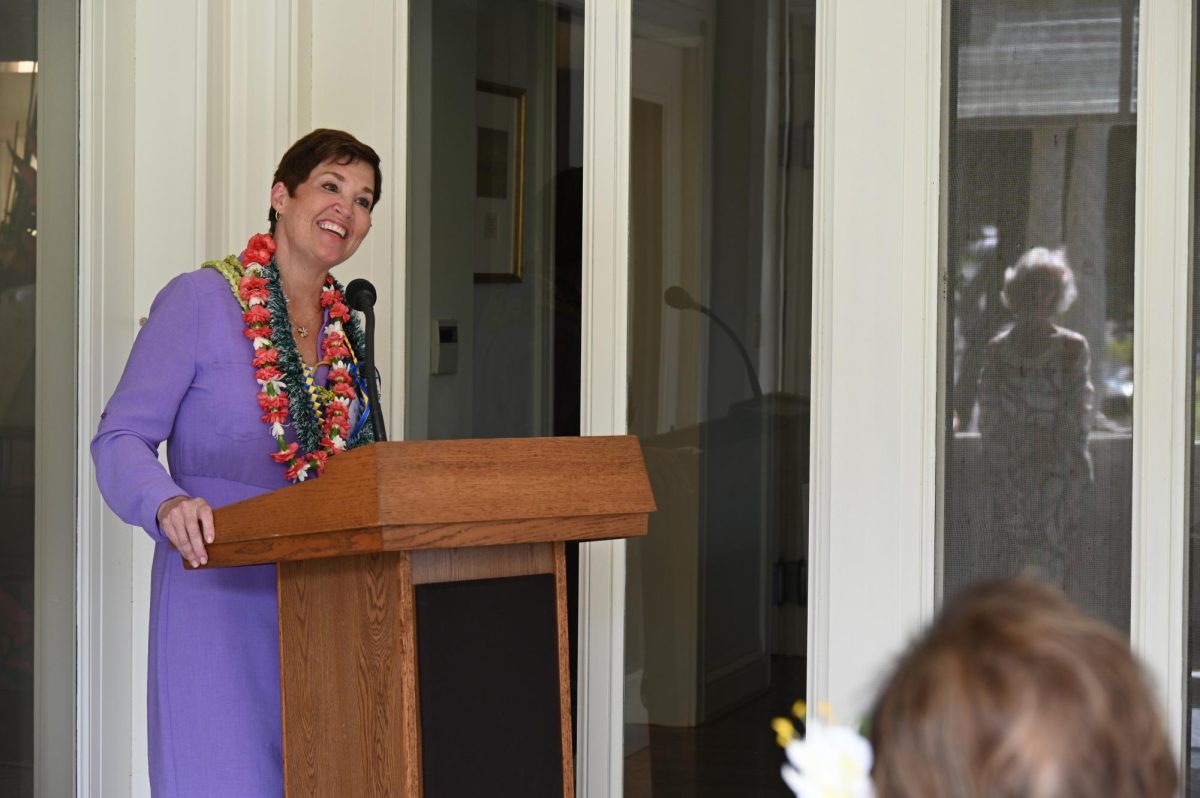


Officials of the Aloha Stadium Authority joined the Board of Regents meeting at UH Mānoa on November 20, speaking about their proposed plans and recent developments with the new stadium.
The new Aloha Stadium is not only expected to provide luxury boxes and over 25,000 seats, but will also allow UH Mānoa more revenue and leadership than ever before, a stadium authority official said.
“We want to build a stadium we can all be proud of,” said Eric Fujimoto, the chair of the Aloha Stadium Authority, “no matter if you’re from the Big Island or Kauai.”
The new project will be placed in Halawa on the same 99 acres of land as the old stadium. The state of Hawaii chose the Aloha Halawa District Partners to be in charge of the development, with the focal point of this project being the New Aloha Stadium Entertainment District (NASED). NASED describes itself as a “vibrant, community-centric mixed-use district, anchored by a new sports and entertainment venue” according to its official website. Its aim is to celebrate Hawaiian culture and embody the Aloha Spirit.
With NASED, developers are aiming to bring a lot of activity, traffic, and most importantly Aloha Spirit throughout the year.
Many locals will be and are currently involved in the project. Big local companies are preferably being utilized to the stadium authority’s best efforts. For example, Hawaiian Dredging is a main contractor.
The operator of this whole development is ASM Global, a worldwide venue management company. They run more than 350 stadiums that spread across five continents, including the State Farm Stadium in Glendale, Arizona and the Superdome in New Orleans.
For the new Aloha Stadium, the operators are planning to use the Canvas Stadium at Colorado State University as their blueprint. There are hundreds of exceptional stadiums all over the world, and the Aloha Stadium Authority is working on giving that to the state of Hawai’i for the first time.
The current design is expected to expand with 25,200 total seats. There will also be an array of luxury boxes, traditional sweet areas–which is a “given for the state operator” Fujimoto commented–and a common club to eat at.
“The new stadium will be built to expand,” said Fujimoto.
Completion is not expected until March 2029, around six months later than the prior Fall of 2028 date. In fact, this isn’t the first time the completion date of the stadium has been pushed back. Originally, it was said to be done by June of 2025, but that was when they were planning to start the demolition in 2020.
Board of Regents member Neil Abercrombie even brought up the shared concern about the project meeting its new timeline. As Fujimoto explained his awareness of the six month delay, he made it a point to say that because he was already being so transparent about the timing, it should be “taken as a sign of good faith.” A kick off of the stadium in fall of 2029 is the end goal, but the committee plans to keep UH and the public notified of any changes.
The old Aloha Stadium has been in the calendar to be demolished since it was first closed in December of 2020. Safety concerns began to arise when rust and steel corrosion were discovered. It had also simply become too difficult and expensive to maintain.
It came to the point where even the recent “Aloha to Aloha Stadium” celebration wasn’t able to be in the stadium itself, because of how dangerous the inside of it was.
For the next 30 years, the stadium will be maintained and under the responsibility of the Aloha Stadium Authority. This is officially known as the Aloha Partners Agreement. Within these next 30 years, the University of Hawai’i will have scheduling priority, as well as the seven games per year which is written in the agreement.
Fujimoto clarified at the meeting that when the stadium is needed, under this contract UH will have to pay no rent in order to use it. He also made sure to mention that it is very rare that a football game will occur where they can play rent free.
This is big news for UH, as the previous stadium would cost the school out-of-pocket money for things like security and ticket organization. UH will also now be able to control the parking operation and prices, which will lead to even more revenue for the university. However much each parking stall costs, UH will pay for it, but they will also get to decide how much they want to charge per stall. This means that it is up to the university department how much money they will make off of parking alone.
There will also be reserved stalls for premium stadium customers, which cost $100 pre-COVID, but now who gets the stalls will be a part of the “in the works” agreement.
“To have a vibrant stadium is to have a vibrant economy,” Fujimoto explained. To his understanding, the agreement is still in progress.
The project is located in what some may call an “opportunity zone.” This will allow properly designed companies to be placed here, as well as draw in local companies. The traffic in this area is expected to be heavy once completed.
The construction of the stadium is anticipated to offer approximately 12,000 contracting jobs, allowing increased employment for the state.
For the initial two to three months of construction, the public should not be expected to see much from the outside. On the inside of the stadium, things still need to be moved around and taken out in order for the demolition to begin. Once this is completed, things like cranes will begin to arrive and the operation will be much more noticeable to the public.
The Aloha Stadium Authority is expecting to have a shortfall with their operation price. $349 million is the expected total cost, in which they already obtained the initial $50 million to cover the soft cost up front. Fujimoto explained this is on public record and already in the bank account.
The cost of the shortfall will have to come from a private sector, meaning that whoever or whatever begins to fund it will have the ability to make choices and take control of the maintenance. The expected shortfall is known by everyone involved. It was especially made clear that the Aloha District Partners know very well of this, and they still went through with signing the agreement.