
To be an art student at the University of Hawaiʻi at Mānoa is to be a master of improvisation. As decades of maintenance turn studios into obstacle courses, it’s the adaptability of students and faculty that keeps the building running year-round.
Students will spend hundreds of dollars on materials to build their own canvases, buying the right clay, selecting the best camera, while working against the leaky ceilings and moldy studios. Not only do they need the money to cover the costs, but the knowledge to pick the right materials. If they buy the wrong paper or a cheap brush, they’ll be limited in what they’ll be able to create.
Art Studio bachelor’s student Kieren McKee is one such student who has spent hundreds on his material. During spring break, he had returned to pick up some of the material he had left in the studio, as many art students tend to do.
“I came in here to grab some brushes and stuff to take home,” McKee said. “I picked up the bag, and I looked at it, and I was like, oh my god! There’s mold all over my bag!”
McKee left his material behind to deal with it after spring break, where he noticed mold had built up on the table a foot away from his easel and painting.
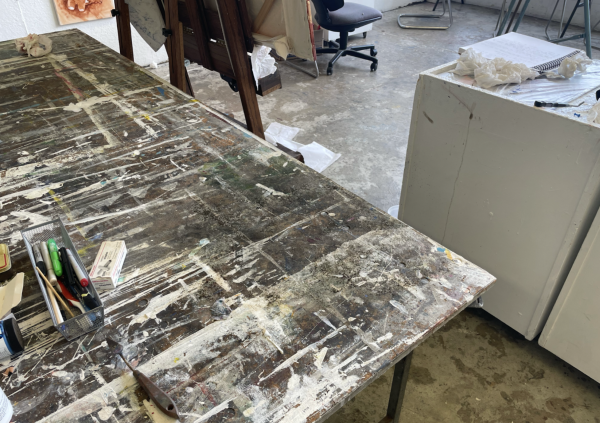
“I had to toss half of the wood, I had to toss my bag, some containers I was saving, and I had to spray the table down with bleach. I don’t know if the mold is really gone,” McKee said. He has since moved all his belongings off the table, where it remains in the studio.
In the past, water had dripped onto McKee’s face while working in the studio, and “in other rooms, they just have buckets out.”
The recent Kona Lows storms highlighted vulnerability in campus buildings. Some seasoned faculty, like Print Media Area Chair Scott Groeniger, have become experts at coming up with “band-aids” to protect studio equipment. He’s become familiar with when and where to place tarps to shelter vital material from leaks.
“During the recent Kona storms–including the record-setting rainfall on Monday, March 23– 12 rooms (11 on the third floor) in the Art Building reported water intrusion,” said UH System Director of UH Communications Dan Meisenzahl in an email.
Meisenzahl also noted that water intrusion was reported in February. As of now, until current projects to elevate mechanical equipment, piping, supports, and the project to reseal roof penetrations are completed, a full roof replacement project will remain low on the priority list.
The Art Building was built in 1975, housing two galleries, labs that hold specialised equipment, studios, classrooms, and offices. Despite how worn the building has become, it was designed with artists in mind, which is what makes its facilities invaluable for art students.
Students like Chester Lee question the raises in lab fees and department fees when issues within the Art Building are left unresolved. Groeniger specifies that these lab fees are strictly used for classroom supplies dedicated to students, such as buying printer inks and computer software. There is a call for more transparency with the use of these fees.
The financial burden is especially felt in the loss of specialty programs over the years. Kyle Shrier, a student who switched from marine biology to art and sustainability, recognises a need to preserve unique programs such as UH Mānoa’s glass-blowing program.
“We are one of the few schools with a glass program, so losing it would be a major hit,” Shrier said.
He highlights that in glass, students must buy their own color, which can cost hundreds of dollars to get a few good ones, forcing some to change their projects simply because of the expense of the materials.
In this kind of climate, students have turned to help one another. In the past, a former faculty member led a project known as the “free store,” which was often located within the art building and a place for students to trade in or donate art materials for others to pick up free of charge.
The original “free store” was shut down due to liability concerns regarding what some students would leave behind, but it has continued to inspire student-led variations. Though faculty no longer lead these variants, new donations will appear at tables or in small bins throughout the Art Building, providing students with a space to continue to donate to their community.
Department chair and professor Brad Taylor, who has watched the building’s “deferred maintenance” pile on over the years, recognizes this grit as artists’ greatest strengths. He notes that within the College of Arts, Letters & Languages (CALL), the Art Department is one of the largest units, consistently ranking as the largest or second largest department over the last several years.
“The university’s overall financial position is actually quite good,” Taylor said, clarifying that these “shortfalls” are often just bureaucratic reshuffling. Compared to other universities on the mainland where their student bodies may face “enrollment cliffs” and shrinking student bodies, UH Mānoa has the advantage of growth.
With the current climate leaning into the “AI Boom,” Taylor believes that people may need the humanities more than ever. He maintains that a dedicated chancellor for the Mānoa campus, a leader focused on Mānoa’s unique needs, may be able to advocate for the structural repairs and faculty positions necessary for the program’s survival.