


The official Capitol website contains everything – bills, committee reports, hearing notices, conference drafts. But for many first-time users, it can feel like walking into a dimly lit archive. The information is there. You just have to know how to find it.
Digital Democracy, a portal on the Civil Beat website, attempts to turn that archive into a dashboard.
The idea builds on earlier efforts in California, including a Digital Democracy platform developed with CalMatters, but this is the first version designed for Hawai‘i’s legislative process.
Launched in 2025, the Hawai‘i version uses artificial intelligence combined with human review to organize publicly available legislative data into searchable speech transcripts, bill timelines, and “Top 10” and “Bottom 10” lists, which rank lawmakers by categories such as most talkative, most bills passed, and other metrics. It packages governance in a visually digestible way. This year marks the first full legislative session documented through the Digital Democracy lens.
Currently, House Rep. David Tarnas leads the “Most Talkative” with more than 290,000 words spoken this session.
At first glance, the number seems to suggest dominance or grandstanding. But Tarnas says the metric reflects something else entirely: procedure.
“The reason why I have said so many words is because of the way I run my committee hearings,” Tarnas said.
As chair of the Senate Judiciary Committee, he reads full bill descriptions aloud, states amendments into the record line by line, and requires testifiers to approach the rostrum and verbally summarize their positions rather than simply “standing on” written testimony.
“If I’m making amendments, I will read the entire amendment into the record,” he said. “Sometimes that’s multiple pages.”
He does it intentionally.
“I assume that this building is a mystery to people,” Tarnas said. “I want to dispel that. I want it to be transparent. I want people to understand what we’re doing.”
For Tarnas, transparency is not just about data dashboards. It is about human interaction.
In Judiciary hearings, he regularly acknowledges trauma survivors who testify about sexual assault, police violence, or other deeply personal experiences. He encourages nervous speakers to take their time. He projects his voice clearly so livestream viewers can follow along.
“It’s okay to disagree,” he said. “But let’s not be disagreeable.”
Digital Democracy does not generate new information. It reports what already exists.
“It’s a tool that helps leverage the strengths of AI to help people access information that’s already publicly available,” said Civil Beat senior reporter Matthew Leonard.
Leonard emphasized that the platform includes a detailed “Data Sources and Methodology” section outlining how artificial intelligence is used in programming and where human intervention occurs. Civil Beat worked with developers to clarify what “AI” means in this context, distinguishing between automated data processing and human review.
“The key to addressing concerns is transparency,” Leonard said.
The platform’s bill tracker offers a simplified visual timeline of where legislation stands. But when compared to the official Legislature website, some procedural nuances can disappear.
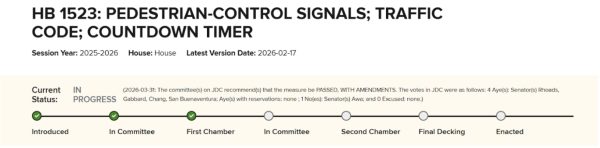
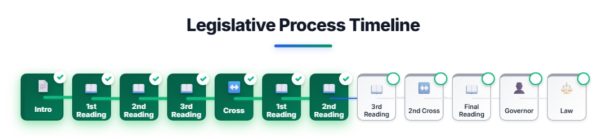
During a review of House Bill 1523 (a pedestrian safety measure), Digital Democracy displayed the bill as being in committee in the first chamber as of Feb. 17. However, according to the Legislature’s site, the bill had already advanced further and was awaiting third reading with a Senate amendment changing only the effective date.
On the official site, users can see committee referrals, conference committee stages, second decking, final decking, and 48-hour notices – procedural steps that are central to understanding how a bill moves. Digital Democracy condenses these stages into broader labels with spotty timelines, which can obscure technical but meaningful distinctions.
Tarnas pointed out another contextual gap: Senate members have no limit on the number of bills they may introduce, while House members operate under caps that vary depending on leadership roles and session year. Without that background, “Most Bills Introduced” rankings can skew perceptions.
“You could add a note,” Tarnas suggested, explaining the structural differences between chambers.
Still, the system is new. Leonard described it as a work in progress, with developers monitoring updates in real time and adjusting when data lags or inconsistencies occur.
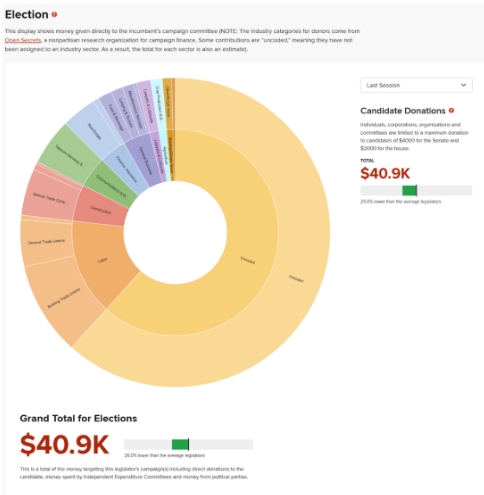
Categorizing campaign contributions and matching organizations with affiliated donors are long-term wrinkles to smooth out. Larger, more frequent contributors are prioritized first; smaller or ambiguous donations sometimes fall into a catch-all “uncoded” category. Improvements will continue over time, Leonard said.
For example, Digital Democracy represents Donna Kim’s funding in this measure.
Who Is It For?
Leonard said the platform was designed primarily for Hawaiʻi voters, particularly those who want a clearer window into how their representatives speak and vote.
Not surprisingly, Digital Democracy has quickly become a frequent tool for reporters inside the Civil Beat newsroom.
He explained that reporters use it regularly to track how often lawmakers speak, pull direct quotes from hearings, verify bill movement, and get a faster snapshot of legislative activity. Instead of manually scrubbing through hours of archived video or scrolling through dense committee reports on the Legislature’s website, journalists can search for a keyword and immediately see who said what, and when.
Leonard framed it less as a replacement for traditional reporting and more as a time-saving research tool. However, Civil Beat maintains that the platform is independent and will not collaborate directly with the Legislature itself.
“We’re the fourth estate,” Leonard said. “It wouldn’t be a collaboration. It’s complementary.”