

Some players blend into the rhythm of a match. Jordan Lucas doesn’t really try to.
When California State University of Northridge faced the University of Hawai‘i, Lucas was already a talking point before the first serve. Not just for how he plays, but for how he acts on the court. The CSUN outside hitter moves with an energy that refuses to go unnoticed. For some fans, that alone was reason enough to show up to the Stan Sheriff Center.
And once the match started, it was clear why his reputation had travelled across the ocean.
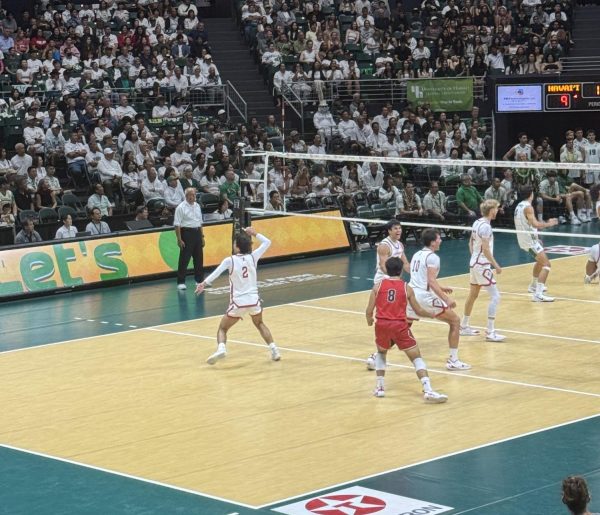
Word had spread about Lucas’ competitiveness and personality. In a sport that often leans toward quiet intensity, he brings an excitable, visible personality to the game. He reacts to points, stares across the net, and is willing to be fully himself in every moment of the match.
However, that does not always get the same reaction from every seat in the gym.
Lucas’ style sits in a space that naturally invites a response. For some, it is energizing. For others, it can feel like it goes beyond what they expect in the sport. But that mix of reactions is part of what makes his presence noticeable in the first place. It also raises a simple question: Who is this guy without all the flash?
On the court, Lucas answered that in real time.
When his team trailed Hawai‘i by a few points, he did not shut down. Instead, he turned to his teammates and repeated the same message, “keep going. Keep going. Keep going.” He was not screaming for the sake of being loud. He kept the team steady as momentum started to shift.
That side of his game often gets overlooked.
While he is often noticed for his personality, he also plays a consistent leadership role. He is a stable passer, a strong attacker and consistent voice on the court. His energy helps keep his team pumped up and connected, especially when competing against the No. 2 team in the country.
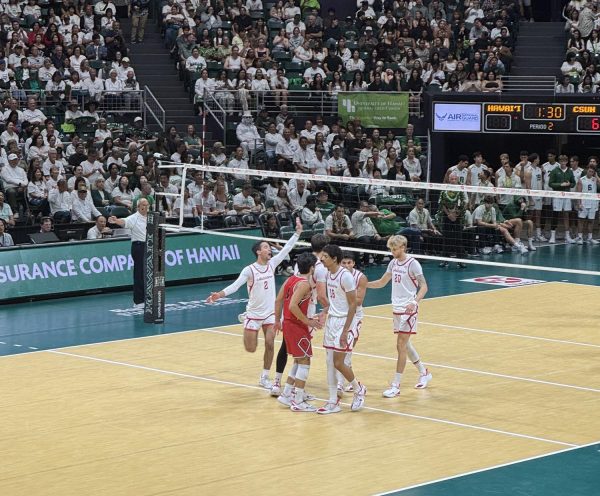
From the stands, that impact was clear.
“OMG, it’s so fun seeing some just being themself on the court,” said Lau Ah Mook Sang, a University of Hawai‘i soccer player who attended the match. “Even though everyone could be judging what he’s doing, he brings the energy and is unapologetically himself.”
That idea of being yourself in a competitive space is not so simple. Sports come with expectations, and men’s volleyball in particular has often emphasized control and restraint. Players are not meant to overenthuse or rile up their competition across the net. Lucas does not completely fit that mold, but he is not playing outside the game either. He is still competing and contributing, just in a way that reflects his own style.
Not everyone in the gym that night came strictly for the matchup. Some showed up out of curiosity, having heard about Lucas through teammates, social media clips, or word of mouth. Others came simply because they wanted to see what the conversation was about him in person.
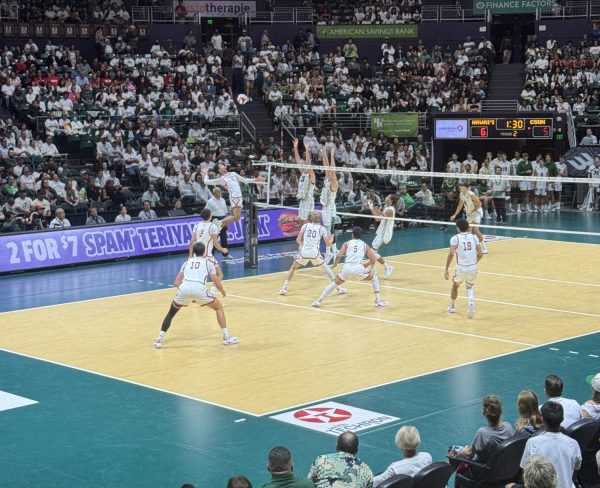
Whether they left as fans or not, they left having watched a player who did not try to shrink himself down to fit the moment. Instead, he played his true game, from start to finish.
In a sport that is still growing its audience, that kind of presence can matter and find new attention outside its core following. For some, Lucas becomes the entry point to watching a match they might not otherwise have attended. For others, he becomes part of a larger conversation about what expression in sports can look like and how much space there is for individuality within competition.