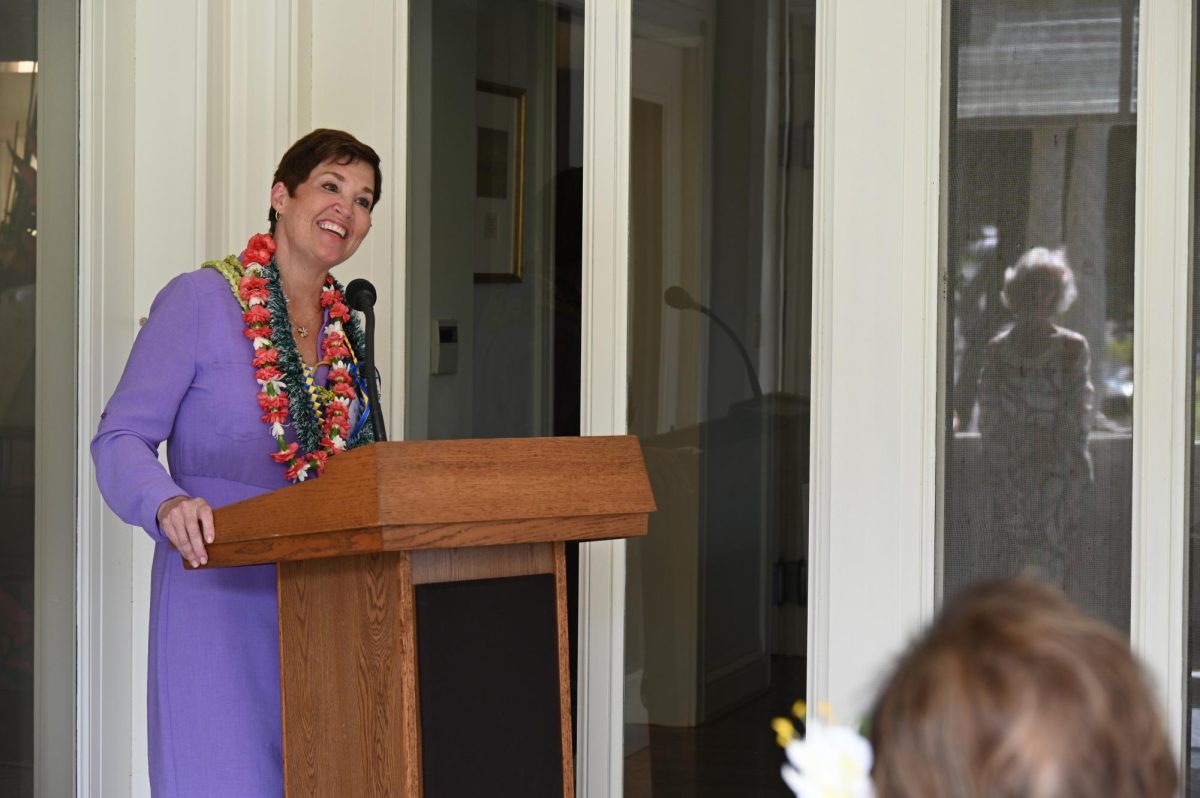

The unsettled tone in Kathy E. Ferguson’s voice hints at the scale of loss felt throughout the University of Hawai’i system.
A longtime UH Mānoa professor of political science and women’s studies, Ferguson is known for her work in feminist political theory. She discussed how recent Diversity, Equity, and Inclusion (DEI) funding cuts have significantly affected the operations of the minority-serving institution, University of Hawai’i at Mānoa.
The confirmed damage now exceeds $11 million in research cuts, with another $45 million in federal grants at risk. This includes a $10 million blow to discretionary grants, a nearly $1 million loss in Title VI allocation, and an $843,000 cut to Native Hawaiian Education Program funding, according to President Wendy Hensel’s UH Board of Regents update on Sept. 18 last year.
Together, these cuts represent one of the most significant setbacks to UH’s commitment to inclusion, education, and equity in its history. These reductions threaten the university’s operations and its broader commitment to students and educators.
On Sept. 10, 2025, the U.S. Department of Education announced it will end discretionary funding to several Minority-Serving Institution (MSI) grant programs. According to the executive order, the funding will be redistributed to promote equality and prevent Americans from being denied opportunities based on race or sex.
“The Department will no longer award Minority-Serving Institution grants that discriminate by restricting eligibility to institutions that meet government-mandated racial quotas,” said U.S. Secretary of Education Linda McMahon in the announcement.
This new executive order, 14173, issued by President Donald Trump on Jan 21, states that federal policy will end the DEI’s corrosive and disruptive “identity-based spoils system” and instead promote traditional American values of hard work and excellence.
The executive order states that it aims to minimize unfair opportunities, but it may worsen disparities for students whom DEI initiatives were initially designed to support.
UH Mānoa hit a new record of $754 million in extramural funding in fiscal year 2025, a 19.2% increase from last year. Despite this boom, there has been a hush around the programs that were terminated or reduced, leaving students and faculty in the dark about the real impacts of federal policy changes.
“Just because we get more extramural funding doesn’t mean the reality hasn’t changed dramatically,” said UH Mānoa political science professor Felix Mantz.
Minority-serving institutions have historically used this funding to address racial and ethnic disparities, remove systemic barriers, and provide support to at-risk and marginalized students. Under the new federal interpretation, many of these equity-focused programs are now deemed discriminatory.
“Ironically, the government says it’s trying to protect equity by making sure that women aren’t unfairly advantaged over men or Indigenous people aren’t unfairly advantaged over colonizers, but those are already the people who are unfairly advantaged,” said Ferguson.
The new administration’s agenda also restricts the initiation of new research opportunities across the education sector.
“Academic freedom entails that we’re able to teach and do research without fear. And that is clearly gone,” said Mantz.
During the current administration, an alleged list of banned words was leaked by the National Science Foundation (NSF). Any grant proposals containing these words will be flagged and may be denied funding, even if they are not specific to a DEI program.
“Anything that has to do with diversity, equity, inclusion…forget it. That’s out. But it’s much broader than that,” said Ferguson. “This list has ‘women’ on it. You’re not supposed to use ‘women’ in your grant application. You’re not supposed to say ‘indigenous communities,’ you’re not supposed to say ‘race,’ you’re not supposed to say ‘historically.’”
This raises a question about the direct impact the current administration will have on future research opportunities at UH.
“The University of Hawai‘i is a Research 1 institution. Creating new knowledge is our mission. Anytime the funding stream that allows that work is compromised, the impact is enormous,” said Ferguson.
Continued cuts will result in a loss of research opportunities for undergraduates, which are crucial to their professional development. Undergraduate research allows students to gain exposure to an area of interest and determine whether they want to pursue a career in that field.
“When research funding collapses, so does the system that keeps graduate students paid, labs running, and projects connected across campus,” said Ferguson.
The federal policy shifts have already begun a trickle-down effect that will change the landscape of research, graduate and undergraduate opportunities, and classroom discussion and education.
It is framed as an anti-discrimination initiative, but this new federal attack is quietly stripping away unique research opportunities at UH, such as these:
- UH is strategically located for research on oceanography, coral reefs, and climate change. Despite this, Alexi Meltel, a graduate student pursuing a PhD in Marine Biology at UH Mānoa, lost funding for a study of coral communities in collaboration with the Palau International Coral Reef Center.
- Dr. Noelani Goodyear-Kaʻōpua’s grant on an intellectual biography of Haunani-Kay Trask was revoked. Trask, a former UH professor and native Hawaiian activist, was a leading figure in the Hawaiian sovereignty movement and a principal figure in the university’s history – and that of the state.
- In July, undergraduate and graduate students from UH Mānoa participated in the South Sulawesi Field School to conduct oral history research and study political ecology. Their federal funding was cut before departure, minimizing the trip’s potential, as efforts were redirected towards securing alternative funding.
This is only a short glimpse of the many research opportunities impacted by grant terminations. UH officials have not yet released a complete list of the terminated and at-risk programs.
“To be clear, there’s no way to replace all of these funds, but we are certainly committed to ensuring that student success continues and finding ways to support that, as well as preserving and advancing Hawaiian ʻike, or knowledge, and ʻŌlelo, the language,” said Hensel at a UH Board of Regents meeting on Sept. 18.